
Old Powder Mills – Powder Mill
Old Powder Mills: the estate of the Powder Mill, in Pamplemousses
 The essentials in a few words
Old Powder Mills is a historic estate in Pamplemousses, in the north of Mauritius, about ten kilometers from the coast. Under the forest that borders the SSR hospital, more than sixty hectares of remains tell the story of three successive industries: the forges of Mon Désir, where iron for the island of France was produced from the 1750s; the Powder Mill, the king's gunpowder factory which manufactured gunpowder for the colony from 1775 to 1810; then the 19th century British buildings — prison, orphanage, hospital.
A stone tower, three large basalt buildings, a perimeter wall and a network of canals remain under the vegetation.
Classified as a national monument in 1951, the site is currently neither developed nor open to visitors.
There's a place in Pamplemousses that brochures never mention. A few hundred meters from the botanical garden, behind the hospital, a wooded area covers the most important industrial site the Île de France (Mauritius) has ever known. Iron ore was extracted here, blast furnaces were fired, bars were smelted, and the port's chains were forged; then, for thirty-five years, all the gunpowder for the colony was manufactured here. A stone tower still stands among the trees, a perimeter wall runs beneath the vines, three large buildings with collapsed roofs are slowly sinking into the vegetation, and canals dug in the 18th century still trace the outline of the land.
Old Powder Mills isn't a monument; it's a layered collection. Each era of Mauritius's history has left its mark, often on top of the previous one. First came the forges, purchased and dismantled in 1774. Then the royal gunpowder mill—the Powder Mill, which gave the place its name—built on the forges' machinery and operated by hundreds of enslaved men, whose trades and numbers have been preserved in the archives. After 1810, the British turned the estate into a prison, then an orphanage, then a hospital. And finally, the forest reclaimed everything. Since 2016, archaeological excavations have been gradually restoring the site to its historical context—while its buildings continue to crumble.
Summary
- Where is old Powder Mills Located?
- What remains of the estate
- Before the gunpowder: the forges of My Desire
- The Powder mill, The king's gunpowder factory from 1775 to 1810
- The king's slaves
- 1810: The English, and a painting that lies
- Prison, orphanage, hospital: The lives that followed
- What the excavations have uncovered
- Can we Visit Old Powder Mills?
- A state that has varied
- What to see nearby
- Frequently Asked Questions about Old Powder Mills
- Photos
Where is old Powder Mills Located?
The estate occupies a wooded area in the pamplemousses District, in the north of the island, immediately west of sir seewoosagur Ramgoolam Hospital And a short distance from the pamplemousses Botanical GardenThe remains identified by archaeologists are scattered over more than sixty hectares — much more than the archival plans suggested.
Two geographical factors explain everything else. The site is inland, about ten kilometers from the shore: out of range of an enemy ship, which was the very reason for its selection in 1774. And it is crossed by the Citron River, whose waters were captured as early as 1743 by a dam, then channeled to the mill wheels. The iron, the gunpowder, and the forest that now covers the area all owe their existence to this river.
The place has two names. Old Powder Mills is that of maps, signage, and most online searches. The Powder Mill is the original name, that of the French gunpowder factory and of all historical literature, which still uses it today. It concerns the same domain, and one is a translation of the other.
What remains of the estate
The most remarkable remnant is a stone tower, about ten meters high, preserved almost intact, against the perimeter wall and its monumental entrance. Its function is debated. Archival descriptions link it to a clock or pendulum mechanism—a comparable tower exists at the Toulouse gunpowder factory—but a structure already appeared on this exact spot on the 1774 plan of the forges. It could therefore have been built on older foundations and then modified during the British period. The precise history of this tower remains unestablished, and it is one of the site's open questions.
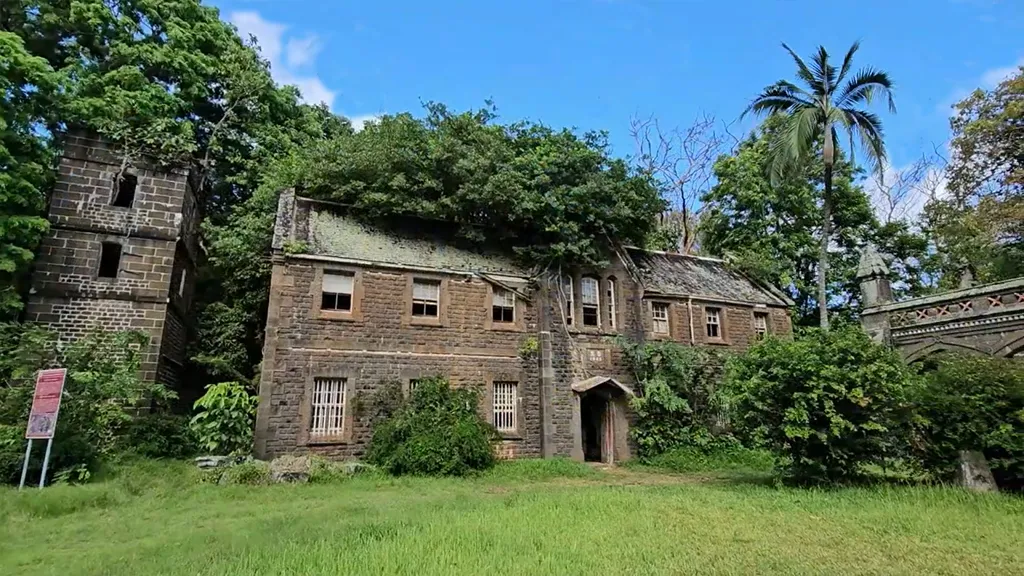
The stone tower and ruined basalt buildings of the Old Powder Mills estate in Pamplemousses
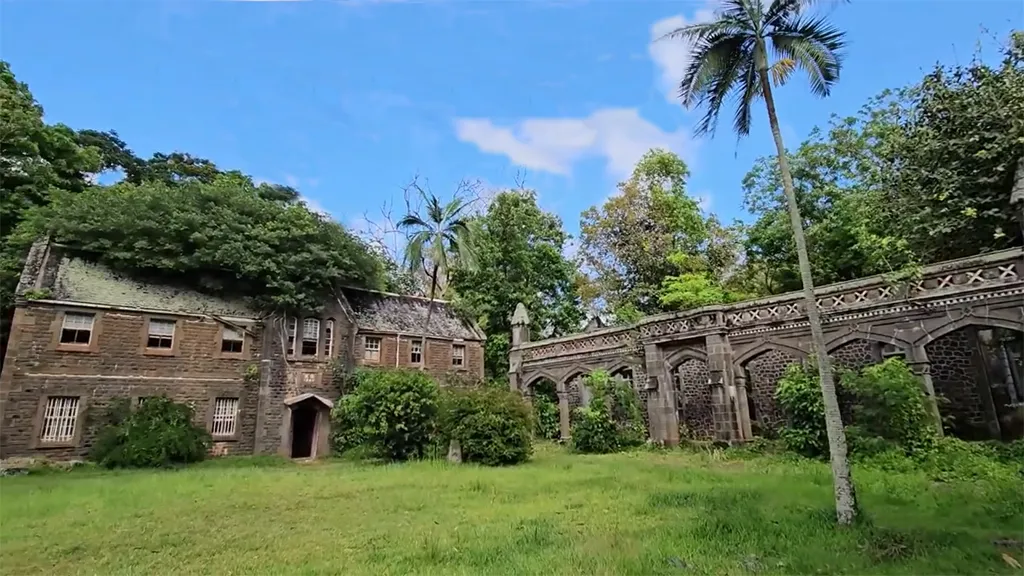
Right next to them stand three large basalt buildings with collapsed roofs, one of which still has its porch and engraved stone. These are the most photographed ruins on the estate, and they are almost always mistakenly presented as the gunpowder factory. They have nothing to do with it: they were built between 1860 and 1865 by the British administration to house and educate the orphans of indentured laborers, then converted into a leper hospital in the 1940s. The lintel, moreover, bears its own date: 1863. The King's gunpowder factory, on this site, was something else entirely—the artillery commander's residence, which the 1785 plan describes with a terrace, a wide porch, an orchard, and a medicinal herb garden. Nothing of it remains.

Two-story basalt building and ruined arcade gallery at the Old Powder Mills estate, Pamplemousses
The rest is less easily deciphered. Sections of the perimeter wall that enclosed the industrial zone, and the long gallery of pointed arches, pierced with mullions, that closes off the esplanade. The route of the supply canal and the hydraulic works. A well in front of the tower, dating from the British era. Isolation cells, a reminder of the prison. The remains of a Buddhist temple, built when the estate served as a detention center for political prisoners from Ceylon. And, on the ground, what the excavations have been gathering for ten years: iron slag, nails, and even a block of rock still bearing the mark of the explosive used to extract the ore.
Before the gunpowder: the forges of My Desire
Before becoming a gunpowder factory, the site was a metallurgical plant—the island's first major civilian industry. Iron ore was discovered in Mauritius in the early 1740s. Two French colonists, Jean-Baptiste Gilles Hermans and Count Louis de Rostaing, obtained concessions to exploit it and formed a partnership in 1742, on the condition set by Mahé de Labourdonnais that they establish a company. By 1743, they had also installed a saltpeter refinery and a gunpowder mill at Turtle Bay, the present-day Balaclava.
Iron ore extraction and smelting took off in the early 1750s at the Pamplemousses estate, now known as the Mon Désir ironworks. The ore came from various locations in the region, the forest provided charcoal, and several forges operated simultaneously. The iron produced here was considered superior to that of France: analyzed ore nodules contained over 40% iron. On August 4, 1756, twenty iron bars left Mon Désir for the French East India Company. By 1767, the forges were producing up to 489,500 kilograms of iron. They manufactured construction and agricultural tools, munitions, plates, keys, bars, nails—and the harbor chains.
This industry relied on skilled craftsmen who ran the workshops and hundreds of enslaved men who performed the work. Records show 586 enslaved people at the forges, and Hermans wrote to Rostaing, who had returned to France, that this was insufficient. Operating costs were high, the company accumulated debt, and the two partners quarreled. In 1774, the Mon Désir forges were sold.
The estate was then divided Up. mr. De launay Bought 740 arpents in January 1775, Mr. Pigeot 630 arpents in december of the same year, and the government acquired a portion For 227,000 livres to establish the gunpowder mill. The forges comprised three sections: The blast furnaces, the large forges, and the small forges with the Hammer Mill. it was this last section, with its mill and canals, that became the heart Of the Powder Mill. as for the lands that passed into private hands, they were converted to sugarcane cultivation and became the Beau Plan Sugar estate—today The sugar AdventureThe two sites, a few kilometers apart, are therefore two halves of the same domain.
The Powder mill, The king's gunpowder factory from 1775 to 1810
In 1774, the gunpowder mill at Turtle Bay exploded. The colony lost its gunpowder production in one fell swoop, and the coastal site, exposed to attack from the sea, was deemed unsuitable. It had to be rebuilt elsewhere, and quickly.
The choice of Pamplemousses was no accident, and the thesis devoted to the site details the reasons: its distance from the coast, providing protection; a mill and machinery already in place, adaptable without requiring complete reconstruction; the water from the Citron River already captured and channeled; sufficient space to add buildings while spacing them apart, precisely because of the explosion risk that Balaclava had just demonstrated; reduced cost; and above all, time saved. Less than a year elapsed between the purchase of the land and the restart of production. The gunpowder factory began operating in January 1775.
A royal establishment
Unlike Balaclava, which was financed by the East India Company, everything here was paid for by the king: the purchase, the construction, the operation. D'Espinassy, head of the artillery division, was appointed artillery commander of the Powder Mill in 1774; Captain Notaise was its first director. It was he who drew up, around 1776, the Bird's-eye view of the New Powder Mill commissioned by Governor Ternay — the first map of the site, which includes the perimeter wall, the administrative building, the mill, and a district known as "Camp of the Blacks".
The mills were essentially designed and manufactured locally, with very little equipment coming from France. The report that D'Espinassy wrote in 1784, after ten years of operation, describes an establishment that was struggling against itself: the buildings inherited from the forges were in poor condition, they needed to be rebuilt, and accidents were frequent.
The price of accidents
The list drawn from the archives is extensive, and much longer than the single fire often cited. An initial fire claimed the lives of a European and three slaves. A month later, another fire killed five men, a soldier, and four slaves, despite the efforts made to extinguish it. On September 29, 1779, excessive friction from a cylinder in the Mill with Rollers caused another fire: five deaths, an artillery soldier and four slaves. Six slaves died digging ditches for the Pulverizing Mill, which in turn caught fire, killing a seventh. The mill was completely rebuilt; excavations have uncovered its massive remains, including actual firebreaks.
Cossigny, or the wet powder
The technical improvement of the gunpowder factory is due to two men: D'Espinassy and Joseph-François Charpentier de Cossigny (1736-1809), a military engineer. Cossigny's involvement was not accidental: his father, Jean-François de Cossigny (1690-1780), chief engineer of the French East India Company, had been part of the team that built the first gunpowder factory in Balaclava, and was the general commissioner of gunpowder and saltpeter in Languedoc, Gascony, and Provence.
His research focused on the processes and quality of gunpowder, leading to new mills, faster production, and, above all, far fewer accidents. In a letter to the Minister of War dated January 19, 1809, Cossigny asserted that his method had prevented 116 explosions at the two mills on Île de France (Mauritius) over 28 years, that France had adopted it and then abandoned it for reasons unknown to him, and that grinding the gunpowder there took 21 hours, whereas his method required only four. These are his words and his defense; they have not been contradicted, but they come from the man himself.
One question remains unanswered by historians: why manufacture gunpowder in a colony when the royal gunpowder factories in France were already producing enough? Vijaya Teelock explicitly poses this question and believes it deserves to be studied. No one has answered it.
The king's slaves
The estate is not just an industrial site: it is a site of slavery, and this is what makes it one of the most studied places on the island today. The men who worked there belonged to the king — they were called the king's slaves — and came mainly from Mozambique and Madagascar.
The 1776 plan envisioned housing them outside the industrial complex, to the west, in a district laid out in rows and enclosed by its own wall: the Camp of the Blacks. Excavations carried out in this area yielded almost nothing, and the 1785 plan reveals a reality quite different from what had been drawn.
What remains are archives of unexpected precision. A record of production from September 1st to 7th, 1810, lists 165 slaves present on the site and details their trades: 91 powder makers, 15 carpenters, 8 coopers, 4 blacksmiths, a supervisor assigned to the sawmill, and others. Entrusting the manufacture of gunpowder to enslaved men was, as historian Vijaya Teelock points out, a gamble that no other French colony would have taken, for fear of revolts.
The excavations also unearthed numbered plaques—slave badges worn as pendants or on the arm. Each number was a man's administrative identification. This is, quite literally, what the estate has left of those who ran it. The subject is discussed more broadly in our article on the slave Route Monument, and theAapravasi Ghat tells the story of the period that followed.
1810: The English, and a painting that lies
1810 was the last year of production. British troops took the island, and the gunpowder mill, a military operation of the King of France, was immediately seized. According to accounts, the bulk of the English army halted at the mill on November 30, 1810, while marching on Port Louis.
An image of this scene exists, reproduced everywhere: a Drawing by richard temple, A British painter and military draftsman present in mauritius In 1810, Author of eight views of the capture of île de france. His Plate shows the camp Des noirs With the tower and the buildings of the construction site in the background.
There's a problem, and it's a big one. The camp he depicts corresponds exactly to the ideal plan of 1776—the one drawn up in France, and which neither the excavations nor the 1785 plan confirms. What had been planned was not realized. The archaeologist who directed the excavations concludes that Temple probably didn't witness the scene, and that he composed his drawing from accounts and the 1776 plan, or by combining the two. In other words: the most famous image of the site doesn't actually depict the site.
Prison, orphanage, hospital: The lives that followed
The site did not fall into disuse, however. The British used it first as a place of confinement, then as a place of healing, and the layers of history were added to the same walls. Archaeologists have identified isolation cells on the site dating from its use as a prison, and the remains of a Buddhist temple built when the site housed political prisoners from Ceylon. Several sources place the opening of a state prison as early as 1823, and the exile here, in 1825, of the Sinhalese prince Eyhelepola Wijesoondra, former Prime Minister to the last king of Kandy; these details are widely repeated but rely on secondary sources.
The three basalt buildings were erected between 1860 and 1865 for the orphans of indentured immigrants, and later for local children. In the 1940s, they became a leper hospital. Later, in the southern part of the estate, the Sir Seewoosagur Ramgoolam Hospital was built, which is still in operation today. Thus, the site of the King's gunpowder factory became seamlessly integrated into the hospital district of the island's north.
The estate was classified as a national monument in 1951.
What the excavations have uncovered
Old Powder Mills has been the subject of in-depth academic research since 2015, conducted by the Centre for Research on Slavery and Indenture at the University of Mauritius, with archaeological campaigns carried out from 2016 to 2021. A collective work was published in 2018, and a doctoral thesis entirely devoted to the site and its slaves was defended in 2022.
This work has done two things. First, it has restored the site to its true extent: the remains cover more than sixty hectares, far beyond what the archival documents indicated. Second, it has corrected a number of misconceptions by superimposing the old plans onto the actual topography—which has made it possible to establish, for example, that the large stone buildings are not the gunpowder magazine, and that Temple's drawing does not represent the camp as it existed.
The objects themselves speak of The ordinary: iron slag and nails from the forges, blocks blasted with explosives for ore extraction, firebreaks from the rebuilt mill, numbered badges from the Camp. the search continues.
Can we Visit Old Powder Mills?
No. The site is not equipped to receive the public, nor is it open to visitors. However, it appears on online maps as a historical site, which regularly leads visitors to a closed entrance.
The site is located within the perimeter of a healthcare facility, west of the SSR hospital, and the ruins are fenced off. An interpretive panel has been installed in front of the buildings: the site is therefore identified and monitored, but not accessible.
A state that has varied
The image given by the sources depends a lot on their date, and it is better to know this before relying on what you read on this site.
In the spring of 2024, the Mauritian press described an area being used as a dumping ground for rubble and bulky waste from the North Hospital—mattresses, broken furniture, and bags of garbage even inside the ruins. The National Heritage Fund acknowledged the situation and referred to a rehabilitation project under the Ministry of Health, the progress of which was unknown. Several visitors described the same situation, as well as a side passage used because the main entrance was closed.
Images filmed on site in November 2023 and then in November 2025 by the local press show, on the contrary, a mowed, cleared enclosure with its sign, and ruined buildings but without any visible debris. The 2024 incident therefore appears to have been a one-off event, or to have affected only a part of the property, and not the permanent state of the site.
What remains unchanged, however, is that the buildings are in ruins, the roofs have collapsed, and vegetation has grown up into the walls. We advise against attempting to enter. If the restoration project is successful and the site opens, it will be one of the most beautiful historical visits on the island; in that case, contact the National Heritage Fund before making any plans.
In the meantime, the history of the estate can be found nearby, in places that are open to visitors — and which you will find on our tourist map of Mauritius.
What to see nearby
THE pamplemousses Botanical Garden is the immediate neighbor of the estate, and the contrast alone is worth the trip: two pieces of the same colonial territory, one of which has been maintained for two and a half centuries and the other left to the forest.
The sugar AdventureIn Beau Plan, it occupies precisely the other half of the former Mon Désir forges, the part that was sold to private individuals and converted to sugarcane processing. Today, it is one of the best-designed museums on the island, and it recounts the continuation of the economic history that the forges began.
THE labourdonnais castleNearby, it shows what a large sugar estate house looked like in the 19th century. Balaclava, on the coast, is where this whole story began, with the island's first gunpowder mill — the one that exploded in 1774.
Frequently Asked Questions about Old Powder Mills
Can we Visit Old Powder mills In Pamplemousses?
No. The site is not equipped to receive the public; the ruins are fenced off, and the property is located within the perimeter of a healthcare facility. The buildings are in ruins, and we advise against attempting to enter them.
Are Old Powder Mills and the Powder Mill the same place?
Yes. Old Powder Mills is the English name, the one used on maps and signs; Moulin à Poudre is the original name of the French powder mill, still used in Mauritius and throughout historical literature.
Where exactly is Old Powder Mills located?
In the Pamplemousses district, in the north of Mauritius, west of the Sir Seewoosagur Ramgoolam Hospital and a short distance from the botanical garden. The site is about ten kilometers from the coast.
Is the large, ruined stone building the gunpowder factory?
No, and that's the most common misconception about the site. The three large basalt buildings were built between 1860 and 1865, under British administration, to serve as an orphanage, then as a leper hospital in the 1940s. One of them even bears the date 1863 on its lintel. The King's gunpowder factory predates it by almost a century.
What remains of the gunpowder factory Itself?
A stone tower about ten meters high, sections of the perimeter wall and its entrance, the layout of the canals, the foundations of the mills with their fire walls, and a large quantity of remains scattered over more than sixty hectares that excavations continue to identify.
Why was gunpowder manufactured in Mauritius?
Mauritius (then known as Île de France) served as a French military base and stronghold in the Indian Ocean, far from the mainland. Historians note, however, that the royal gunpowder factories in France were producing sufficient quantities at the time, and the exact reason for this colonial production remains to be determined.
What is the connection between Old Powder Mills and Balaclava?
The island's first gunpowder factory was established at Turtle Bay, present-day Balaclava, in 1743. Its explosion in 1774 led to the transfer of production to Pamplemousses, to a site further from the sea.
What is the connection between Old Powder Mills and L'Aventure du Sucre?
The two sites are two halves of the same estate. When the Mon Désir forges were sold in 1774, part was bought by the government for the gunpowder factory, and the rest passed to private individuals who converted it to sugarcane: this would become the Beau Plan sugar estate, now known as L'Aventure du Sucre.
Is the site protected?
Yes, it has been classified as a national monument since 1951, and since 2015 it has been the subject of a university research program. This classification has not prevented the buildings from falling into ruin, a fact regularly denounced by the Mauritian press.
The information in this article is for guidance purposes only and reflects the state of knowledge and the site at the time of writing. Access to the Old Powder Mills estate is not open to the public, and the ruined buildings pose risks: we strongly advise against attempting to enter them. For any questions regarding the protection, rehabilitation, or possible opening of the site, please contact the National Heritage Fund. The author and publisher accept no responsibility for the accuracy of the information provided. See the Terms of Use (Article 12).
(The photos you send will only be used to complete this page and will never be used commercially outside of this site without your permission)
To share your Mauritius vacation photos with friends, family, and colleagues, we offer a free, personalized webpage dedicated to your trip. Simply share the webpage address, for example, www.ilemaurice-im/vacancesdepierreetmarie, with anyone you'd like to share your photos with.
It's very simple, just click on the button below.
More information:
7-day weather forecast
Rent a car
Book a hotel or villa
Buy an airplane ticket
Free (not open to visitors)
Walking and hiking
Bus routes: Click here
Your advertisement on this page?
Do you want to display an advertisement for your business on this particular Page (or elsewhere on the Site)?
Thank you for contacting us in clicking here.
Contribute to and improve this page
We want to provide internet users with the most relevant and complete information, so if you would like to add to or modify this page (text, photo, etc.), or even report an error, please do not hesitate to contact us by sending an email to the following address: contribuer@ilemaurice.im
(remember to clearly indicate the page to which your contribution relates)
(The photos you send will only be used to complete this page and will never be used commercially outside of this site without your permission)
Not yet tested by the editorial team
If you would like to tell us about this place, this activity, etc., please send us an email to the following address: visiter@ilemaurice.im