
Museums - Historical places
Aapravasi Ghat World Heritage Site
Aapravasi Ghat: the steps where modern-day Mauritius begins
 The essentials in a few words
The Aapravasi Ghat is the former immigration depot of Port Louis, through which most of the indentured laborers of the 19th century entered Mauritius.
Listed as a UNESCO World Heritage Site in 2006, it is the first site of the British "Great Experiment" which replaced slavery with indentured labor.
- To have : the stone steps leading up from the quay, the hospital block, the remains of the kitchen and basalt dwellings.
- To understand: the Beekrumsing Ramlallah interpretation centre, with its model of the depot and its rooms on travel and indentured servitude.
- Practical : free entry, approximately one hour visit, open Monday to Saturday morning, closed on Sundays and public holidays.
Just a stone's throw from the Port Louis docks, between the main road and the sheltered waters of Trou Fanfaron, a few black basalt walls, a hospital building, and a stone staircase guard one of the most historically significant sites in the entire Indian Ocean. It was through this immigration depot that, in the 19th century, most of the indentured laborers entered Mauritius: men, women, and children, primarily from India, and more rarely from East Africa, Madagascar, China, or Southeast Asia, to work in the sugarcane fields. Many never left. Their descendants now make up the majority of the island's population.
The site is tiny, barely 1,640 square meters, and the city has swallowed up most of its buildings. But it was here that the British Empire launched its "Great Experiment," replacing slaves with indentured labor, a system subsequently copied worldwide. UNESCO designated it a World Heritage Site in 2006. Right next door, in a former 19th-century warehouse, an interpretation center recounts the "Great Experiment," the crossing, and the passage through the depot. Admission is free, and the visit takes about an hour: enough time to understand the origins of the Mauritius you are exploring.
Summary
- Why it all starts here: the "great experiment"
- November 2, 1834: the arrival of the Atlas
- The Immigration Office, from 1849 to the present day
- What you will see on the site
- The beekrumsing ramlallah Interpretation Centre
- How many volunteers were there, and where did they come from?
- November 2nd, a public holiday
- Tracing the steps of a politically engaged ancestor
- Prepare your visit
- Around the aapravasi Ghat
- Frequently Asked Questions
- Photos
Why it all starts here: the "great experiment"
Aapravasi Ghat is the birthplace of the modern diaspora of indentured laborers, and this is what earned it its inscription as a World Heritage Site. Slavery had just been abolished in the British Empire in 1834, and in Mauritius on February 1, 1835. Sugarcane planters were in need of labor. London then chose Mauritius as the first site for what was called the "Great Experiment": to prove that a "free" workforce, recruited under contract, could replace slaves in the plantation colonies.
The indentured laborer signed a multi-year contract with an employer. In exchange, he received a salary, housing, rations, and the promise of a return trip. On paper, he was a free worker. In reality, coercion, recruitment fraud, and abuses were common.
The experiment was a success, from the planters' point of view. Other colonial powers adopted it from the 1840s onward, and more than two million indentured laborers crossed the oceans—2.2 million according to the Trust Fund—to the Caribbean, southern and eastern Africa, Réunion, Australia, and Fiji. Mauritius alone received nearly half a million. This is why the buildings at Trou Fanfaron are considered one of the earliest material traces of an economic system that became global, and the only depot of its kind to have survived.
November 2, 1834: the arrival of the Atlas
On Sunday, November 2, 1834, a ship named the Atlas anchored in Trou Fanfaron Bay after a six- to eight-week voyage from Calcutta, according to accounts. On board were 36 Indian laborers from Bihar, including six women, according to L'Express. They had been recruited for the Belle Alliance sugar estate in the Rivière-du-Rempart district, which belonged to the trading house Hunter, Arbuthnot & Co.
They didn't disembark immediately. According to historian Satyendra Peerthum, who worked for the Aapravasi Ghat Trust Fund for many years, it was a Sunday and customs was closed: the 36 men and women spent the day on board, watching the city. The next day, GC Arbuthnot requested permission from the governor to let them ashore, and it was only after completing the formalities that they set foot on the island, on November 4th. They then departed for Belle Alliance, with a five-year contract.
However, Mauritius chose November 2nd to commemorate the arrival of the indentured laborers. Historians point out that these 36 workers were not the very first indentured laborers in Mauritian history. Even during the French colonial period, a few contract workers from southern India and Southeast Asia had been employed on the island. What began in 1834 was the mass arrival, organized and controlled by the colonial state.
Another important point: in 1834, the immigration depot did not yet exist. The first indentured laborers arrived in the port of Port Louis, but the buildings that can be visited today were not built until 1849.
The Immigration Office, from 1849 to the present day
The Trou Fanfaron immigration depot was built in 1849 on the east shore of the bay because the previous facilities were no longer sufficient to accommodate the number of arrivals. It was continually expanded. In 1859, according to a report from the Office of the Protector of Immigrants cited in the Encyclopedia Britannica, it could house 600 people. The stifling tin roofs were replaced with tiles, and latrines were installed.
In 1864, a railway line was built right through the middle of the depot, dividing it in two. The complex was then reorganized in 1864 and 1865: on one side were the new arrivals, and on the other were those already under contract and those whose time had ended, awaiting their return voyage. The plans drawn up at that time have been preserved, and they guided the restoration of the site a century and a half later. They show sheds for housing immigrants, kitchens, a hospital, latrines, and offices.
Arrivals slowed from the 1870s onward. Regular convoys of Indian indentured laborers ceased in 1910, and the depot stopped accepting immigrants in the 1920s. Sources disagree on the exact year the system ended: some authors cite 1920, others 1923 or 1924. Departures, however, continued for a slightly longer period: according to Satyendra Peerthum, the last repatriation convoy left Mauritius in 1929.
Two or three days at the depot
For a new recruit, the depot was their first contact with the island, and they generally stayed there for two to three days. The ship docked at the foot of the depot. The new arrivals climbed the stone steps leading up from the quay, passed through the gate, and entered a world of registers and controls.
After weeks at sea, the first step was a bath. Next came the medical examination, to identify the sick and isolate them. Each immigrant was registered, given a number, and photographed. These portraits still exist: some are reproduced on the panels that welcome visitors today, and they are part of the archives kept in Moka (see Tracing the steps of a politically engaged ancestor). During these few days, the newcomers shared their meals, their languages and their stories, before being distributed among the sugar estates of the island.
From The "Coolie Ghat" To the aapravasi Ghat
For over a century, the place was known as the Immigration Depot or, more commonly, the "Coolie Ghat." The word "coolie" referred to unskilled laborers from Asia and had become pejorative. The current name combines two Hindi words: aapravasi, meaning "immigrant," and ghat, which designates the place where land meets water: a wharf, a landing stage, steps leading down to a river. The word conveys both the site's function, by the sea, and what it represented for those who arrived there: the passage from one life to another. This name was coined in Mauritius.
The date of the name change varies depending on the source. The site was declared a national monument in 1987, and most sources, including Britannica, place the new name in the same year. Mauritian historians, writing in Le Mauricien and Defimedia, specify that the classification dates from April 11, 1987, and that the name "Coolie Ghat" was not officially changed until November 1989. For the visitor, the difference is inconsequential.
A site encroached upon by the city, then saved
Once immigration ended, the buildings were used for other purposes: offices, social services, and then military needs during the Second World War. Cyclone Carol damaged them in 1960. A bus station was built on part of the site in the 1970s, and a major road, built on the old railway line, swept away another section in the 1980s. Today, according to UNESCO, less than half the area occupied by the depot in 1865 remains, and the road still bisects the site.
The rescue began with the 1987 listing. Journalist and Member of Parliament Beekrumsing Ramlallah (1915-2000), after whom the interpretation center is named, was one of those who fought for the site's recognition. The Aapravasi Ghat Trust Fund was established in 2001 to manage the site. Conservation work resumed based on archaeological excavations and plans from 1864-1865, with support from ICOMOS expert reports in 2003 and 2004, and unwelcome additions from the 1990s were removed. On July 16, 2006, at its session held in Vilnius, the World Heritage Committee inscribed the Aapravasi Ghat on the UNESCO World Heritage List. It was the first Mauritian site to be included, before the Le Morne cultural landscape in 2008.
What you will see on the site
On the site itself, you will see the stone remains of the 1865 Depot: The staircase that led up from the wharf, the old hospital block, the remains of the immigrants' housing, the kitchen, the latrines and baths, as well as the quarters of the sirdars, the foremen responsible for supervising the groups Of workers. everything is built of basalt, the dark volcanic stone found in the old buildings Of Port louis. the hospital block is the most complete building.
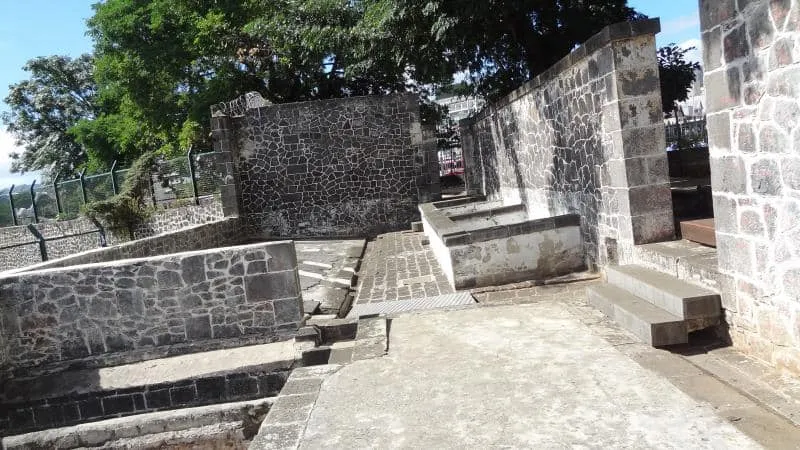
Basalt walls and basins, remains of the aapravasi ghat immigration depot In port Louis
Don't expect a grand, monumental complex. It consists of walls at eye level, foundations, paving stones, and steps, covering an area that can be explored in about twenty minutes. Some visitors leave disappointed by the scale of the remains. This is precisely why the visit begins at the interpretation center: once you understand what happened within these walls, the few remaining stones take on a whole new significance.
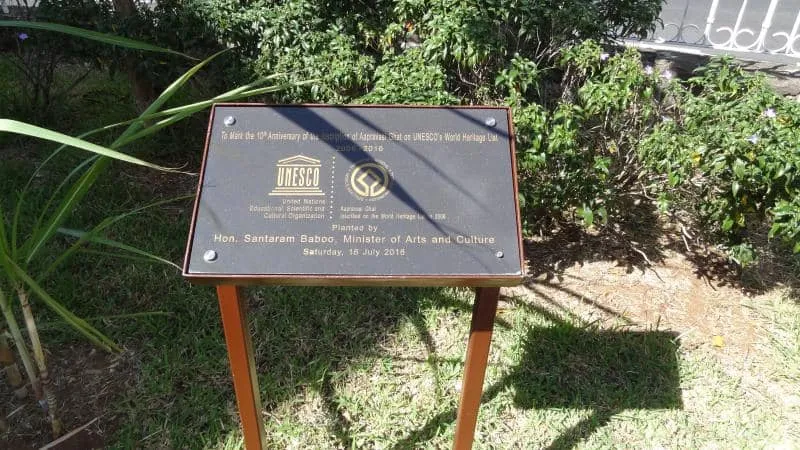
In the garden, a plaque commemorates the planting of a tree on July 16, 2016, for the tenth anniversary of the inscription on the world heritage list.
The steps: fourteen or sixteen?
The staircase is the symbolic heart of the site: it was the first thing the indentured laborers set foot on upon leaving the ship, and it is today the most reproduced image of the Aapravasi Ghat. The number of its steps, however, varies depending on the source. The official UNESCO description mentions a flight of fourteen steps. Most recent texts, from the Encyclopedia Britannica to Mauritian historians, count sixteen.
The explanation was given by L'Express in 2007, shortly before the official opening of the restored site: two buried steps had just been uncovered, bringing the total to sixteen. The UNESCO text, written based on the previous state of the site, has not been modified since. Therefore, you will see sixteen steps on site.
The beekrumsing ramlallah Interpretation Centre
The Beekrumsing Ramlallah Interpretive Centre is the Aapravasi Ghat Museum, and it is where the visit begins. It occupies a renovated mid-19th-century warehouse adjacent to the ruins. It opened to the public on November 3, 2014, the day after its inauguration, which was held to commemorate the 180th anniversary of the arrival of the indentured laborers. The Trust Fund describes it as one of the few places in the world entirely dedicated to indentured labor.
The permanent exhibition retraces the experience of indentured laborers and Mauritius's key role in the history of indentured servitude. The plan published by the Trust Fund in its 2015 brochure divides it into seven areas, which are visited in this order after entering:
- the Aapravasi Ghat;
- the Great Experience;
- the Journey;
- life around the depot;
- indentured Servitude;
- the immigration filing Office;
- the legacy of indentured servitude.
A shop completes the route. Other sources mention six sections: The layout may have changed since the publication of this plan.
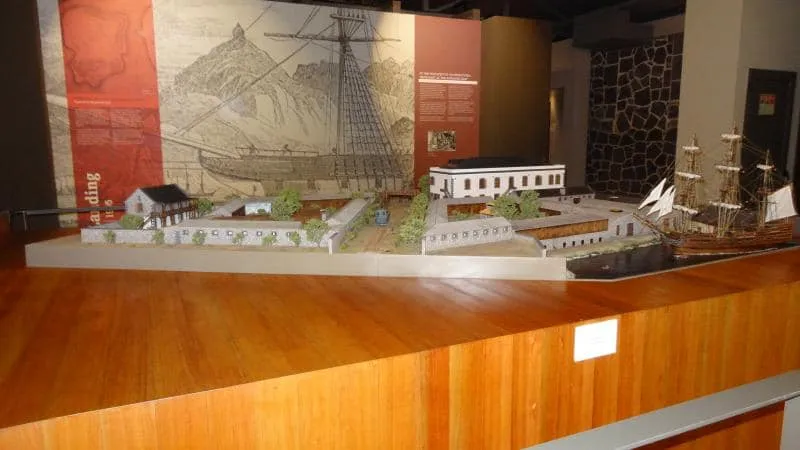
The most striking piece is a large model of the depot, as it appeared in the 19th century, with its courtyards, buildings, and a sailing ship moored at the Quay. it allows visitors to visualize what the road and bus station have erased, and to place each vestige within the whole.

Model of the Aapravasi Ghat immigration depot with a sailing ship at the dock, Beekrumsing Ramlallah Interpretation Centre
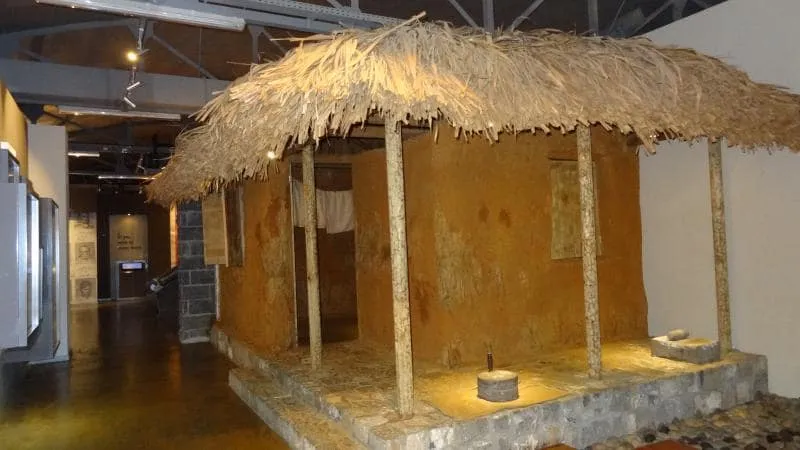
Further along, the exhibit features a life-size reconstruction of a hut, complete with a thatched roof, earthen walls, and millstones placed on the threshold. The final room is dedicated to the legacy of indentured servitude in Mauritius.
How many volunteers were there, and where did they come from?
Nearly half a million indentured laborers arrived in mauritius Between 1834 And the beginning of the 20th century. This is the figure used by UNESCO. according to the Trust Fund Brochure, 97.5% of them came from India. more precise figures vary depending on what they include, and none are Wrong.
- Nearly half a million, which came from India between 1834 and 1920, according to UNESCO. Other sources give 1849-1923 or 1834-1924 for the boundary markers.
- Approximately 454,000 Indian immigrants are recorded in the registers of the indian immigration archives, for the period 1842-1910 which these documents cover.
- Approximately 462,800 immigrantsAccording to historian Satyendra Peerthum, they arrived during some 1,700 crossings between India and Mauritius.
- More than 350,000 people they passed through the Trou Fanfaron depot itself, between May 1849 and August 1910, according to an article in Le Mauricien. This lower figure is explained: it only counts arrivals after the construction of the depot.
The Indian indentured laborers embarked from Calcutta, Madras, or Bombay. They came primarily from Bihar, present-day Uttar Pradesh, Tamil Nadu, Andhra Pradesh, and Maharashtra. Others came from East Africa, Madagascar, China, and Southeast Asia. Their exact number remains uncertain: L'Express reported approximately 50,000 people, a figure difficult to reconcile with the 97.5% Indian proportion given by the Trust Fund.
Not all of them stayed. Many returned home at the end of their contracts, while others left for other colonies. Sources suggest between 150,000 and over 160,000 departures.
What proportion of Mauritians are descended from these indentured laborers? Here again, the figures circulating vary, from 68% to over 70%, or even higher in some texts. These percentages are estimates: the Mauritian census has not asked about ethnic origin since 1972. The most conservative estimate is that of the CIA World Factbook, which states that Mauritians of Indian origin represent approximately two-thirds of the population.
November 2nd, a public holiday
November 2nd is a public holiday in mauritius, Commemorating the arrival of indentured laborers. the government Established it in 2001, the Year the aapravasi ghat trust fund was Created. In 2026, It Falls on a monday. in 2027, It falls on a tuesday, the day after all Saints' day, extending a long series of public holidays (see our article on public holidays in Mauritius in 2027).
The national commemoration is held annually at the Aapravasi Ghat site. As the site is closed to regular visitors on public holidays, this is not the best day to visit the interpretation center in peace and quiet.
Tracing the steps of a politically engaged ancestor
The records of Indian indentured laborers are kept in Moka, in the Indian Immigration Archives of the Mahatma Gandhi Institute (MGI). It is the world's largest collection on Indian indentured laborers: nearly 2,055 original registers, containing information on approximately 454,000 immigrants who arrived between 1842 and 1910. These archives have been inscribed on UNESCO's Memory of the World Register since 2015.
For a search to be successful, the MGI requires the immigrant's name and immigrant number. This number is often found on the family's old civil registration documents. The records may reveal the ship of arrival, the region of origin in India, and the estate where the indentured laborer was employed, and sometimes even their photograph: an entire series in the archives consists of portraits taken at the depot. Not all files are complete, and some information may be missing.
These documents are also used for official procedures: descendants applying for an Overseas Citizen of India card from the Indian High Commission must provide a certificate from the Mauritius Government Institute (MGI) proving their ancestry. The records of "free" passengers, who came from India without an employment contract, are kept at the National Archives of Mauritius.
MGI publishes its access conditions and services on its website, mgirti.ac.mu. Check the applicable terms and conditions there before travelling to Moka.
Prepare your visit
Aapravasi Ghat can be visited free of charge, Monday to Friday from 9 am to 4 pm and Saturday from 9 am to 12 pm. It is closed on Sundays and public holidays, and closes at noon on December 24th and 31st. These hours apply to both the site and the interpretation center.
Duration of the visit
Allow approximately one hour. The Trust Fund indicates 30 to 45 minutes for the interpretation centre, where the visit begins, followed by about twenty minutes at the World Heritage site.
Guided tours
Guided tours are available by prior reservation, subject to availability. The Trust Fund also offers a virtual tour on its website, useful for preparing for or extending your visit. To book, please call +230 217 7770.
Accessibility
The World Heritage site is wheelchair accessible, as are all the rooms and the main area of the interpretation centre. Accessible toilets are available. For any special needs, the Trust Fund recommends contacting them in advance at +230 217 7770.
Access and parking
The Aapravasi Ghat is located on Quay Street, on the waterfront, in the center of Port Louis. The interpretation center does not have its own parking. The Trust Fund recommends parking at the Granary or at Caudan WaterfrontFrom there, you can reach the site on foot. If you're coming by bus, the Immigration Square bus station is very close to the site. To locate it among other places to visit, see our tourist map of Mauritius.
Up-to-date contact details and information
Aapravasi Ghat World Heritage Site, Beekrumsing Ramlallah Interpretation Centre, Quay Street, Port-Louis. Telephone: +230 217 7770.
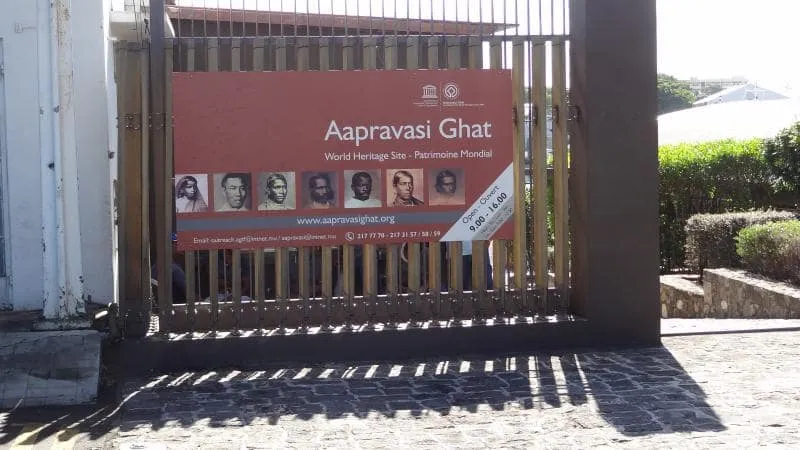
The Trust Fund's official website is now aapravasi.govmu.orgThis is where exceptional closures are published, such as the one scheduled for June 29, 2026, for staff training. Please note: the old address aapravasighat.org, which still appears on signs at the site entrance and in many guides, is no longer the Trust Fund's domain and now displays unrelated content.
Around the aapravasi Ghat
Aapravasi Ghat is in the heart of old Port Louis, and most of the capital's sights are within walking distance. Our port louis Guide presents them in detail.
- The Caudan Waterfront, on the other side of the bay, with its shops and restaurants: see our article on the Caudan Waterfront.
- The central marketA few streets away, for fruit, spices and street food: see the markets and bazaars of Mauritius.
- The citadel, on the Petite Montagne, for the view over the whole city and the port: see the citadel of Port Louis (Fort Adelaide).
- The natural history museum, where we discover, among other things, the dodo: see the National Museum of Natural History in Port Louis.
To further explore this story, see our article on the history of Mauritius places indentured servitude within the broader context of the island's past, and our page museums and historical sites includes other sites to visit.
Frequently Asked Questions
What does "Aapravasi Ghat" mean?
Aapravasi Ghat combines two Hindi words: aapravasi means "immigrant" and ghat refers to the place where land meets water, a wharf or landing stage. The name is often translated as "the place of arrival for immigrants." The site was formerly known as the Immigration Depot or "Coolie Ghat."
Why is Aapravasi Ghat a UNESCO World Heritage Site?
Aapravasi Ghat has been a World Heritage Site since 2006 because it was the first site chosen by the British in 1834 for their "Great Experiment": replacing slaves with indentured laborers. This system was subsequently adopted worldwide and displaced over two million people. The Port Louis depot is the only one of its kind to have survived.
Is there an entrance fee for Aapravasi Ghat?
No, entry to aapravasi Ghat is free, both for the world heritage site and for the beekrumsing ramlallah Interpretation Centre.
What are the opening hours of Aapravasi Ghat?
The Aapravasi Ghat is open Monday to Friday from 9am to 4pm and Saturday from 9am to 12pm. It is closed on Sundays and public holidays, and closes at noon on December 24th and 31st.
How long does it take to visit Aapravasi Ghat?
Allow approximately one hour to visit the Aapravasi Ghat: 30 to 45 minutes in the interpretation center, then about twenty minutes at the site of the ruins.
Is it possible to take a guided tour of Aapravasi Ghat?
Yes, guided tours of Aapravasi Ghat are offered by prior reservation and subject to availability, at +230 217 7770. A virtual tour is also available on the Trust Fund's official website.
Where can i park to visit Aapravasi Ghat?
The Aapravasi Ghat Interpretive Centre does not have a car park. The Trust Fund advises parking at Granary or Caudan Waterfront and walking to the site.
Is Aapravasi Ghat wheelchair accessible?
Yes, the Aapravasi Ghat site and the interpretation center rooms are wheelchair accessible, and adapted toilets are available.
How many indentured laborers arrived in Mauritius?
Nearly half a million indentured laborers arrived in Mauritius between 1834 and the beginning of the 20th century, the vast majority from India, according to UNESCO. Indian immigration records show approximately 454,000 for the period 1842-1910 alone.
How many steps are there in the Aapravasi Ghat staircase?
The staircase of The aapravasi ghat has Sixteen steps. the uNESCO description mentions fourteen, because it was written before two buried steps were uncovered during the works, shortly before the official opening of the restored site, scheduled for july 2007.
What is commemorated On november 2nd In Mauritius?
November 2nd, a public holiday in Mauritius, commemorates the arrival of indentured laborers, in remembrance of the ship Atlas, which entered the port of Port Louis on November 2, 1834, carrying 36 Indian workers. Official ceremonies are held at the Aapravasi Ghat site.
How to trace an ancestor who was an Indian indentured laborer?
The records of Indian indentured laborers are kept at the Indian Immigration Archives of the Mahatma Gandhi Institute in Moka. To begin a search, you need the immigrant's name and immigrant number, often found on the family's old civil registration documents. The records may indicate the ship, region of origin, area of employment, and sometimes a photograph.
The information in this article is provided for guidance purposes only. The author and publisher accept no responsibility for the accuracy of the information provided. It is recommended that you verify information directly with local operators or the relevant Mauritian authorities during your stay, particularly regarding opening hours and any exceptional closures, which are published on the official website of the Aapravasi Ghat Trust Fund. See the Terms (Article 12).
Last updated: September 2026
(The photos you send will only be used to complete this page and will never be used commercially outside of this site without your permission)
To share your Mauritius vacation photos with friends, family, and colleagues, we offer a free, personalized webpage dedicated to your trip. Simply share the webpage address, for example, www.ilemaurice-im/vacancesdepierreetmarie, with anyone you'd like to share your photos with.
It's very simple, just click on the button below.
Info +:
7-day weather forecast
Rent a car
Book a hotel or villa
Buy a plane ticket
Free
saturday: 9:00–12:00 and closed on Sunday
Accessible child and stroller
Wheelchair accessible
Parking
Toilets
Bus routes: Click here
Your advertising on this page?
Do you want to display an advertisement for your activity on this particular Page (or elsewhere on the Site)?
Please contact us in click here.
Contribute, improve this page
We want to provide the most relevant and complete information to Internet users, so if you want to provide additional or modification to this page (text, photo, etc.), or even report an error, do not hesitate to contact us by sending us an email to the following address: contribuer@ilemaurice.im
(Remember to indicate the page concerned by your contribution)
(the photos sent will only be used to complete this page and will never be commercially operated outside this site without your agreement)
Tested by writing
A place steeped in history, interesting and little-known