
The natural parks and "nature" parks of Mauritius
Rent a car
Conservation reserves, public forests open for walking, private estates where you can stroll beneath the trees: the natural parks and nature reserves of Mauritius offer access to what remains of the original forest and the endemic wildlife that lives there. Here are all the ones we visited and documented.
Everything you need to know about the natural parks and "nature" parks of Mauritius
We need to start with a figure, because it explains everything else: According to the mauritian forestry service, approximately Only 2% of Mauritius' territory is covered by good quality native forestForests, broadly defined, still cover nearly a quarter of the island, but most of it is planted with or invaded by exotic species. Four centuries ago, before the arrival of the first settlers, almost the entire country was forested.
The parks gathered on this page are what remains of this history, and what we are trying to reconstruct. Some protect a fragment of old-growth forest, others patiently replant on land that first had to be cleared of invasive species, and still others are forest plantations open to the public—plantations that fulfill a very real mission: retaining soil and water. The Forest Service itself states that the primary function of Mauritius's forests is not economic, but environmental.
"Natural Park" is not an official status in Mauritius
The clarification is worth giving, because in Europe the expression evokes a designation regulated by law, and nothing of the sort exists here under this name.
Mauritian law recognizes other categories. The Wildlife and National Parks Act of 1993 allows the President of the Republic to proclaim, under Article 11, a national park (national park), a special reserve (special reserve) or a marine reserve (marine reserve) ; there nature reserve (nature reserve) falls under the Forest and Reserves Act. These statutes are few in number and come with specific obligations and prohibitions: they are what close certain plots of forest to the public and strictly regulate access to others.
In other words, a place can be perfectly worth visiting for its natural beauty without having a protected designation. This is even the case for the majority of sites on this page.
Three families of parks, three ways to visit
The places gathered here are not all visited in the same way, and this is the point that visitors often discover too late.
National parks and reserves. These are the lands protected by law. Mauritius has two national parks on the main island; they cover areas disproportionately large compared to the rest of the island and are crisscrossed by hiking trails, with viewpoints accessible by car for those who prefer not to walk. black River Gorges National Park is the greatest example of this, and our page on hiking in Mauritius details the routes that cross it. The reserves, however, are often closed to the public: their role is to protect, not to welcome.
Forest walks laid out by the forestry service. They are called nature walksAnd there were four: Bras d'Eau, Monvert, Powder Mills, and Sophie. The one at Bras d'Eau has since become a national park. These are public forests open to the public free of charge, with marked trails, picnic areas, kiosks, and sometimes a visitor center or a small museum. You can just show up and walk for an hour or two. However, be aware that these sites are managed by a government agency and operate on the same schedule as a public service, closing mid-afternoon on weekdays. They are not places to visit at sunset.
Private conservation areas. Here, the environment is too fragile or too precious to be left freely accessible. Visits are not free, must be booked in advance, are usually conducted with a guide, and last for a set amount of time. This is the price of admission to see plants that sometimes number only a few dozen wild individuals, and birds that were on the verge of extinction. You can't just drop by on a whim on a Sunday afternoon: you have to plan ahead.
Why are some parks also listed among animal parks?
Several sites appear in two categories on the site, and this is intentional. The same domain may offer animals and attractions on one side, and a real walk in nature on the other: two different visits to the same place, which do not interest the same people on the same day.
A visitor looking for a day of activities for their children and a visitor seeking a peaceful walk under the trees should both be able to find these places. Classifying them into a single category would be like hiding half of what's available from one or the other. So, find all the leisure activities on offer on our dedicated page. animal parks and adventure parks of Mauritius.
What we see there
First, the flora. Ebony trees, palm trees, latan palms, olive trees, mat trees, tree ferns: names that mean nothing to the first visitor, but which take on their full meaning once you understand that many of these species grow only on this island, or in the Mascarene Islands alone. Several of them survive today only thanks to replanting efforts, irrigation, and individual protection.
Then there's the wildlife, and that's where Mauritius has a story worth telling. the island Is the land of the dodoThe animal that has become a global symbol of extinction. It is also, and this is much less well known, one of the countries that has saved the most bird species from impending extinction. The Mauritius kestrel, the pink pigeon, and the large green parrot each experienced a critical decline in numbers before being restored to viable populations. These birds live in the parks featured on this page, and that's where you have a chance to spot them.
Giant tortoises, finally, are present in several sites — not the original Mauritian species, long extinct, but Aldabra tortoises introduced to take over the ecological role of the extinct ones: grazing, trampling, dispersing seeds.
Practical advice applicable to all these sites
Bring mosquito repellent. This is the comment that comes up most often among visitors to the forest in Mauritius, and it applies to almost all the sites on this page.
Please wear closed-toe shoes. : the paths are dirt and become slippery after rain, which happens often, especially on the higher ground.
Add a light sweater if you're going up onto the plateau. Many of these parks are located at altitudes of 500 or 600 meters, where temperatures are commonly several degrees lower than on the coast and where fog often settles. This, in fact, is the whole point of the day: to discover another MauriceGreen and fresh, three-quarters of an hour from the beach.
Come in the morning. The light is better under the trees, the birds are active, there are fewer people, and this solves the problem of closing times.
Do not feed the monkeys. The macaques found in Mauritian forests were introduced and are among the species that have the greatest impact on endemic flora and birds. Observing them is fine; attracting them is not.
Where to find them
These parks are spread across the island: high-altitude forests on the central plateau, lowland reserves in the east, a forest undergoing restoration in the western highlands, and a protected islet off the southeast coast. None are more than two hours' drive from another, making it easy to visit two in a single day.
To locate them in relation to each other, plan an itinerary, or find out what to visit near your accommodation, use our interactive map of tourist sites in Mauritius It provides a detailed information sheet and driving directions for each site. If you are primarily interested in endemic plants, the endemic garden of the osterlog valley usefully complements this selection.
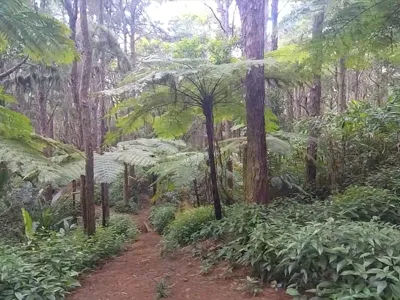
Sophie Nature Walk
Sophie Nature Walk, in Plaine Sophie near Mare aux Vacoas: a pine and tree fern forest in the center of Mauritius, a unique forest museum, easy trails and free entry
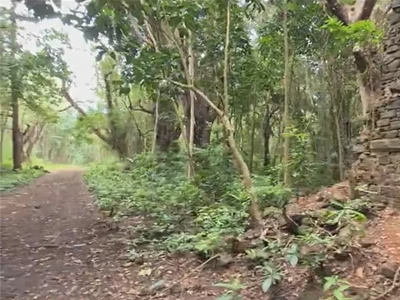
The Daruty Forest – Belle Vue Forest
Discover the Daruty Forest (Belle Vue): hiking trails, historic sugar mill ruins and tropical nature, 10 minutes from Grand Baie

Egret Island
One kilometer from Mauritius, in the magnificent bay of Mahébourg, Île aux Aigrettes is a true jewel of marine conservation
Ebony Forest
Ebony Forest: An Exceptional Conservation Sanctuary in the Heart of Mauritius
La Vanille Nature Park
La Vanille Nature Park is an unmissable experience for nature lovers and families.
Water Arm National Park
bras d'Eau National Park, nestled on the northeast coast of Mauritius, covers nearly 497 hectares of natural treasures and is one of the last remaining forest sanctuaries on the island.
Casela Nature Parks
Casela Nature Parks in Mauritius is a must-see destination for nature and adventure lovers.