
Casela Nature Parks
Casela, the large animal park of Mauritius
 The essentials in a few words
Casela Nature Parks is a 350-hectare wildlife park located in Cascavelle, in the west of Mauritius, just a few minutes from Flic en Flac. The entrance ticket grants access to the park and most of its attractions: a safari through the reserve where white rhinos, giraffes, zebras, elands, impalas, and ostriches roam; enclosures for big cats, including lions, tigers, cheetahs, caracals, and servals; numerous aviaries, some of which can be walked through among the birds; Aldabra giant tortoises, flying foxes, and macaques; walking trails with views of the plains and the sea; and a dedicated children's play area. Only certain activities require an additional fee, such as walking with lions or encounters with other big cats. Open daily from 9:00 a.m. to 5:00 p.m. Plan to spend the entire day there.
The park is situated on 350 hectares of meadows, woods, and hills, overlooking the sugar-growing plains to the west. Here, you can get close to animals you wouldn't expect to find on an Indian Ocean island: rhinoceroses, giraffes, zebras, and antelopes live in a vast reserve that you explore by vehicle, while lions, tigers, and cheetahs occupy their own dedicated area. Elsewhere in the park, aviaries are scattered along the pathways, some of which can be crossed on foot amidst the birds; walking trails climb to viewpoints that stretch all the way to the sea; and there's an entire area dedicated to children's attractions.
One thing, however, needs to be said from the outset, because many pages about Casela suggest otherwise: lions, giraffes, and rhinoceroses are not native to Mauritius. They are here because a park brought them. Casela is not a window onto Mauritian nature; it is a wildlife park combined with an amusement park—and it is for this reason, without any pretense, that it is worth the entire day one dedicates to it.
Summary
What casela Is today
Casela is a wildlife park combined with a leisure park, spread over 350 hectares and owned by the Mauritian Medine Group. The park's official website now organizes its offerings into six areas: aviaries, Pangia Kids Park for children, African Safari, Predator Kingdom dedicated to felines, animal feeding and interaction activities, and a handful of so-called exclusive activities, which can be booked in advance.
This division is important because it no longer corresponds to what most online guides describe, often still using a five-zone structure, one zone being entirely dedicated to thrill rides. We'll come back to this later; it's the point on which a visitor is most likely to be disappointed.
The other thing to know before you come is what the ticket covers. Entry grants access to the park, the safari, the enclosures, the aviaries, and the walking trails: enough to fill your day without spending anything extra. However, activities that bring you closer to the animals or involve a guide—walking with lions, encounters with big cats, electric vehicles, feedings—must be booked and paid for separately. These are what increase the cost, so it's best to decide which ones interest you before you arrive.
The estate is not a single, contiguous area: vast meadows crisscrossed by a stream, groves of thorny acacia trees, paths lined with aloe vera and cacti, and hills overlooking it all. The landscape changes completely with the seasons—the grass turns yellow in the southern winter and becomes a lush green again after the summer rains. The walking trails climb, and from the park's heights, you can see the sugar plain, the Rampart mountain with its broken pyramid shape, the jagged peaks of the Trois Mamelles, and the sea in the distance. It's one of the most beautiful viewpoints in the west, and it costs nothing more than the entrance fee.
The african safari
The safari is the heart of the visit and the first thing you should do. The reserve occupies most of the estate, you travel through it by vehicle, and the animals live in semi-freedom on vast wooded enclosures practically without fences that you quickly forget about.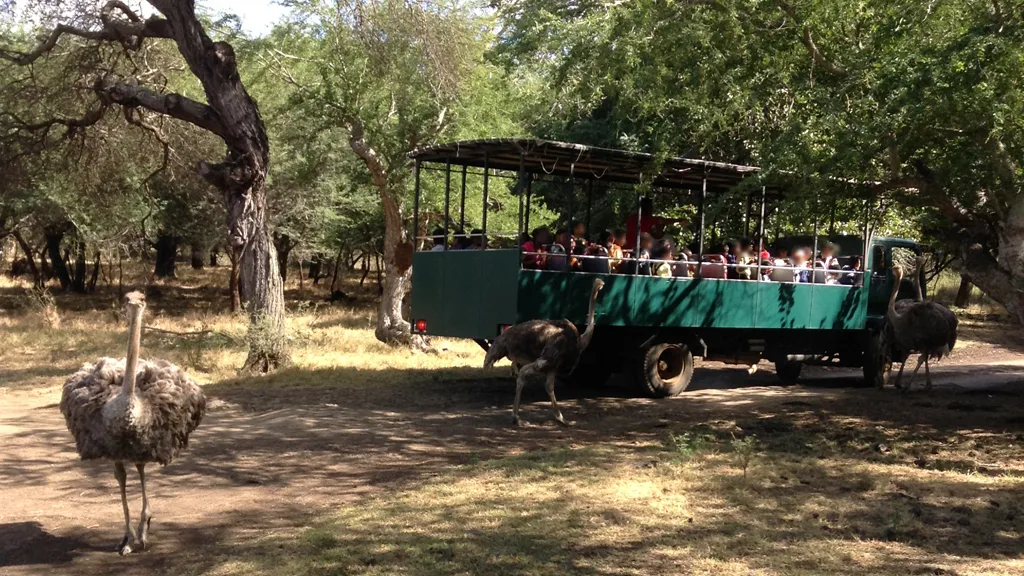
Three formulas coexist. The safari busAn open-sided truck is the classic approach: you sit down, drive slowly, and stop in front of groups of animals. Safari Eco-Rider the experience takes place on a self-drive, four-wheeled electric vehicle, in a line behind a guide, for one hour. private 4x4 safari hires a vehicle and driver for a private group.
What we really see
Everything is visible from the vehicle: you don't venture into the reserve, and the animals are inaccessible on foot or by hand. The southern white rhinos are the most impressive encounter of the journey: massive, calm, and indifferent to the passing truck, they graze just a few dozen meters away. The zebras allow you to approach quite closely and take refuge in the shade of the bushes during the hottest hours. The elands, these large antelopes with twisted horns, move in small groups; the impalas, more agile, move aside and watch you from the tall grass. The ostriches, however, don't move away at all: they come right up to the vehicle, and it's not uncommon to see their eggs laid directly on the grass, in dazzling white piles that can be spotted from afar.

ostrich eggs in the grass of the casela Reserve
The giraffes have their own area, with a raised platform that puts visitors at head height. It's the best spot in the park to photograph them, and one of the rare times when the animal comes to the public on its own.
Feeding the giraffes
The giraffes are fed from the platform with acacia-based pellets. Two important points to note, as the park itself specifies: the pellets are not included in the ticket price and must be purchased at the ticket counter or the Safari Shop, in limited quantities each day; and feeding does not take place on Tuesdays or Thursdays. On those days, you can see the giraffes but not feed them. It's therefore best to buy your pellets upon arrival rather than at the end of the day.
To go further, the park offers a breakfast with the giraffes served on the platform before opening. The meeting time is 7:45 for an 8:00 start, the activity lasts one hour, the capacity is twenty-four people spread across four tables, and it must be booked at least 72 hours in advance by email to the park.
Big cats
Predator Kingdom brings together the park's predators: lions, tigers, cheetahs, caracals, and servals. As with the safari, basic access to the enclosures is included in the ticket price, but anything that actually gets you close to the animals is charged separately.
THE drive thru you drive through the lion and tiger enclosure — it's the cheapest option and offers the most viewing without any handling. meetings encounters with a caracal, serval, or cheetah are short activities, supervised by keepers, during fixed time slots in the morning or early afternoon. feeding the big cats is viewed from outside the enclosures. Finally, the walk with the lionsThe activity that has made the park famous involves accompanying young lions in a wooded area, in a supervised group; it Is by far the most expensive activity in the park.
Two practical points about these activities. Closed-toe shoes are mandatory; this is non-negotiable and will be checked at the entrance. During the encounters with the big cats, only park photographers are authorized to take pictures: no phones or personal cameras are allowed. Therefore, you should plan to purchase photos if you want a souvenir.
The question that more and more visitors are asking, and which it would be dishonest to avoid, Remains: that of animal welfare during paid interactions with big cats. the park States that it applies the five pillars of animal welfare promoted by wAZA, the world Association of zoos and aquariums, and publishes a charter on the subject. everyone will Form their own opinion, but it's worth making an informed decision before booking rather than once you're there.
Aviaries and other animals
Casela doesn't have just one aviary, but a whole collection of them, and this is one of the most enjoyable parts of the visit, especially during the hottest hours since the area is largely shaded. Some aviaries can be viewed from the outside, like the lovebird aviary, where dozens of birds gather on the branches in a wall of green and orange, or the Alexandrine parakeet aviary. Others are explored on foot: you walk among the birds, past feeders where turacos and lovebirds land just inches from visitors, and large macaws perch along the path. This is the easiest place in the park for photography.
It also contains fruit batsThese large fruit bats hang in clusters under the branches. The one from Mauritius, the black flying fox, is endemic to the island and is on the red list of threatened species: it is one of the few animals in the park that can also be seen in the wild on the island, at the end of the day, when they leave their roosting trees.
Elsewhere in the park, an enclosure houses aldabra giant tortoisesThese are the same ones found at several Mauritian sites, and they can live for more than a century. Another one features macaques behind a glass partition — a reminder that the crab-eating macaque does indeed live in the wild in Mauritius, where it was introduced centuries ago. Camels complete the picture, with rides and feedings offered as an extra.
We also photographed a dwarf hippopotamus in a pond in the park, there is a West African species classified as endangered. It is not among the animals currently featured on the official website: so it's best not to come specifically for it, and to be happy to encounter it if the opportunity arises.
Casela with children
It's a great family outing. Pangia Kids Park has attractions for younger children: a carousel, bumper darts, a twelve-hole mini-golf course, a 4D cinema, a small train that runs to the petting zoo, and an area where you can feed the farm animals. You can also feed the fish in the ponds, which keeps little ones entertained without any effort on their part.
The main attraction for older children is the TulawakaA toboggan run on rails that hurtles down the hill through the vegetation, with a large loop clearly visible from the bottom of the park. You control your own speed, making it accessible to accompanied children. A great advantage: it doesn't require reservations and runs continuously from 9:30 am to 4:30 pm, so you can go when the line is short.
Two points to note for families. The park provides changing tables in all its restrooms, but its uneven terrain isn't always accessible with a stroller or wheelchair: some areas require walking. And if you're traveling with young children, check out our page on mauritius With a child in a stroller and the one devoted to children over 5 years old bring together the other adapted outings.
Zip lines and thrills: be careful what you're being sold
If you're booking Casela for its ziplines, read this paragraph before paying. The park's thrill-seeking offerings, long grouped under the name of Thrill MountainHas largely disappeared.
Here's what we see in September 2026. Thrill Mountain is no longer listed among the activities on the park's official website. The page dedicated to it still exists but now only features one attraction: an 80-meter double zipline. The 400-meter zipline, the Nepalese bridge suspended over the gorge, the Canyon Swing, and the Flying Hippo are no longer listed, and none of them are offered for sale on the park's online ticketing platform. A Mauritian tour operator indicates that these four activities are closed until further notice.
However, many travel websites, comparison sites, and agencies continue to promote Casela as the island's largest zipline park, boasting a 40-meter jump and a via ferrata. A visitor booking based on this information risks serious disappointment.
Two points of contention, in all honesty. The FAQ section of the official website still lists "Thrill Mountain activities" and quad bike tours among those requiring reservations: the park is therefore contradicting itself, which often happens when a page isn't updated. And quad biking, specifically, remains available for purchase on the online ticketing platform, as a one-hour double quad bike tour. The exact situation therefore remains to be confirmed, and the only useful course of action is to contact the park before booking if these activities are the reason for your visit.
How much does a day in Casela cost?
The prices below were taken from the official online ticket office in September 2026 for a visit in October 2026. They are given in Mauritian rupees and are indicative only: these are not contractual prices and they change regularly.
The entrance it costs 1,600 Rs for an adult and 1,300 Rs for a child aged 4 to 12. It is mandatory to access the park and to book any activity.
Individual activities these are in addition to the ticket price. For reference: the vehicle crossing of the lion and tiger enclosure is 725 Rs; the camel ride is 350 Rs and its feeding is 225 Rs; the encounter with a caracal is 600 Rs; feeding the big cats is 1,100 Rs; the encounter with a cheetah is 1,500 Rs; the encounter with the lions is 2,000 Rs; the one-hour Eco-Rider Safari is 3,800 Rs for an adult and 1,800 Rs for a child; walking with the lions is 5,000 Rs; the private 4x4 safari is 25,000 Rs for the vehicle.
Packages these packages combine entry and several activities, and are significantly cheaper than purchasing them individually. Four were offered on the same date: Casela Farm Special at 2,100 Rs per adult and 1,860 Rs per child; Full Day Safari Experience at 2,325 Rs and 2,025 Rs; Wild Thrills Adventure at 3,810 Rs and 3,570 Rs; Signature Safari Eco Rider at 5,050 Rs per adult.
A helpful tip: decide on your two or three activities before arriving and compare them with the current package deals. This is where the difference lies between a budget-friendly day and a bill that doubles on arrival. Payments are accepted in cash or by Visa, MasterCard, American Express, and UnionPay.
The park also offers deals reserved for Mauritians and residents, upon presentation of an identity document at the ticket office, generally outside the peak tourist season.
Organize your visit
When to arrive, and how long to stay
Plan to spend the whole day there and arrive right when it opens at 9 a.m. This is the only recommendation we would give above all others: the park itself advises arriving before noon, and our experience there shows that you should go on safari first, before the tour groups arrive. The enclosures are much better visited early in the morning, when the animals are active and the vehicles aren't following each other.
The park closes at 5 p.m., but several things stop before then: animal interaction activities end at 3:30 p.m. to allow keepers time to care for the animals, and the restaurants close at 4 p.m. If you have booked an activity, plan to arrive 45 minutes before the scheduled time.
What to bring, what is prohibited
Of the closed shoes They determine access to several activities, and the terrain, stony and sloping, is unsuitable for flip-flops. The park also recommends light, long-sleeved clothing, a hat, sunglasses, sunscreen, and mosquito repellent.
Outside food is prohibitedAnd this is something many families are surprised by. Only a bottle of water and baby food are allowed. So, you'll need to rely on the park's food outlets for lunch. Bicycles, rollerblades, and skateboards are prohibited, as are ball games.
Finally, a helpful reminder: the animals in the park are not toys. The park itself states that the tortoises, rabbits, and zebras can bite, and that children should never be left unattended within their reach.
How to get there
Casela is located in Cascavelle, on the royal road, in the black river District. It Is one of the most easily accessible sites in the west of Mauritius : since Flic en FlacIt takes about ten minutes by car along the road that winds inland; the entrance is signposted and the parking lot is large. From the north or from the airport, driving remains the easiest way, and our page on car rental details the solutions.
The park offers a free shuttle service from Flic en Flac hotels only No other region is served. From elsewhere, you must rely on taxis or public transport, which we detail on our page. transport.
You can locate Casela and other sites in the region on our tourist map of Mauritius.
Frequently Asked Questions about Casela Nature Parks
What are Casela's opening hours?
Casela Nature Parks is open daily from 9:00 AM to 5:00 PM, including public holidays. The park is closed on December 25th and January 1st. Animal interaction activities end at 3:30 PM and restaurants close at 4:00 PM.
How much does it cost to enter Casela?
Entry to Casela was charged at 1,600 Rs per adult and 1,300 Rs per child aged 4 to 12 in September 2026. This ticket gives access to the park, but most activities — safari, encounters with felines, feeding — are paid for separately.
How long does it take to Visit Casela?
A full day. The park recommends arriving before noon, and it's best to be there right when it opens to do the safari before the crowds arrive.
Is it still possible to go ziplining In Casela?
The park's zipline offerings have largely disappeared. As of September 2026, the official website only lists one 80-meter double zipline, and the 400-meter zipline, the Nepalese bridge, and the Canyon Swing are no longer listed on the website or online ticketing platform, even though many agencies continue to sell them. Contact the park before booking if this is the reason for your visit.
Is it possible to feed the giraffes at Casela?
Yes, from an elevated platform, with acacia-based kibble. The pouches are not included in the ticket price, can be purchased at the counter or in the Safari shop in limited quantities each day, and the activity does not take place on Tuesdays or Thursdays.
Can we bring our own picnic to Casela?
No. Outside food is not allowed in the park, with the exception of a bottle of water and baby food. You must plan to have lunch at one of the on-site food outlets.
Is casela suitable for young Children?
Yes, the park has an entire area dedicated to them with rides, mini-golf, a 4D cinema, a miniature train, and a petting zoo, and changing tables are available in all the restrooms. However, the terrain is uneven, and some areas are difficult to access with a stroller.
What kind of shoes do I need to go to Casela?
Closed shoes are required for several activities, particularly those involving big cats, and the stony and sloping terrain makes flip-flops uncomfortable.
Is there transport to get to Casela?
The park provides a free shuttle service from hotels in Flic en Flac only. From other areas, you will need to arrange for a car, taxi, or public transport.


The information in this article is for guidance only. The prices quoted were taken from the park's official ticketing website in September 2026: these are not contractual prices, they change regularly and may vary depending on the season and date of visit. The activities offered also change. The author and publisher accept no responsibility for the accuracy of the information provided. It is recommended that you verify the information directly with Casela Nature Parks or the relevant Mauritian authorities during your stay, especially before booking a specific activity. See the Terms (Article 12).
(the photos sent will only be used to complete this page and will never be used commercially outside of this site without your agreement)
To share photos of your Mauritius vacation with your friends, family, and colleagues, we offer the option of creating a free, personalized page dedicated to your stay. All you need to do is forward the address of this page, for example, www.ilemaurice-im/vacancesdepierreetmarie, to those with whom you wish to share your photos.
To do this, nothing could be simpler, click on the button below.
Info +:
7-day weather forecast
Rent a car
Book a hotel or villa
Buy a plane ticket
Paid
Walking and hiking
Accessible child and stroller
Wheelchair accessible (partially)
Parking
Toilets
Restaurant and bar
Bus routes: Click here
Your advertising on this page?
Do you want to display an advertisement for your activity on this particular Page (or elsewhere on the Site)?
Please contact us in click here.
Contribute, improve this page
We want to provide the most relevant and complete information to Internet users, so if you want to provide additional or modification to this page (text, photo, etc.), or even report an error, do not hesitate to contact us by sending us an email to the following address: contribuer@ilemaurice.im
(Remember to indicate the page concerned by your contribution)
(the photos sent will only be used to complete this page and will never be commercially operated outside this site without your agreement)
Tested by writing
There's lots to see and do, but you'll need to plan ahead for the day, so it's best to come early in the morning, if possible at the opening (so you can get to the safari before the crowds!).
it's a great family outing (if you've got the budget).