
Botanical gardens and other gardens
Endemic garden of the Osterlog valley
The endemic garden of the Osterlog Valley in Mauritius: a biodiversity sanctuary
 The essentials in a few words
Nestled between two mountains in southeastern Mauritius, this free 275-hectare endemic garden protects the last vestiges of the island's primary forest.
Discover 67 rare endemic plants labeled along an accessible hiking trail, including centuries-old trees found nowhere else in the world.
The walk leads to the spectacular Turtle Waterfall, named after the enormous rock shaped like a giant shell.
Observe endemic birds like the black bulbul, admire the tortoises in their enclosure, and enjoy breathtaking panoramas from the perched kiosks.
Ideal for a family picnic in the heart of nature.
Allow 2-3 hours, good shoes and mosquito repellent for this authentic immersion in threatened Mauritian biodiversity.
Introduction: a green treasure in the heart of the wild south of Mauritius
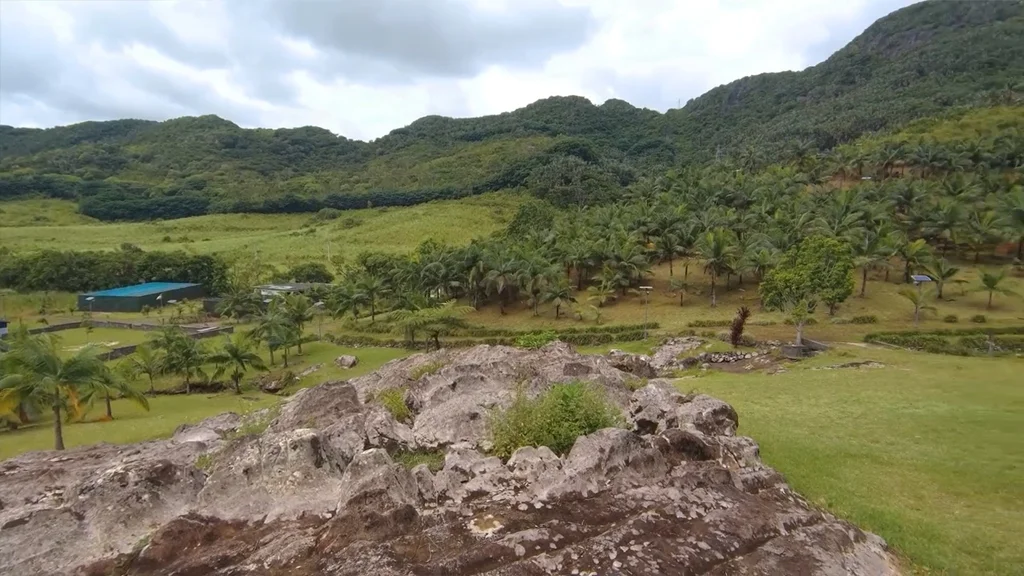
Nestled between the Lagrave and Lacelle mountains in the southeast of Mauritius, the Osterlog Valley represents one of the last natural sanctuaries of Mauritian biodiversity. This 275-hectare endemic garden, located in the Val region, was the first endemic garden created in Mauritius and shelters precious remnants of the primary forest that once covered the entire island.
The history and creation of the endemic garden
A government initiative for preservation
The Osterlog Valley Endemic Garden Foundation was established under an Act which came into force on September 4, 2007. After several years of development and conservation work, the garden was officially dedicated and opened to the public on June 11, 2014 by the Minister of Agro-Industry, Satish Faugoo.
Faced with the massive deforestation suffered by Mauritius since colonization, the government identified five potential sites for creating an endemic garden. The Osterlog Valley was ultimately chosen due to its exceptional geographical features and the richness of its endemic biodiversity.
A strategic location in the Creole chain
The garden is located in the Creole mountain range, specifically between Lagrave Mountain and Lacelle Mountain, on the border between the districts of Grand Port and Moka. This particular geographical location has allowed for the preservation of a unique ecosystem, where clear water flows down from the peaks to feed the valley.
Exceptional biodiversity to protect
A refuge for Mauritian endemic species
Of the 680 endemic species recorded in Mauritius, no fewer than 67 endemic plants are found in the Osterlog Valley, some specimens of which are over 200 years old. This remarkable concentration makes the garden a veritable living conservatory of Mauritian flora.
It is important to remember that after 400 years of human presence, only 2% of the primary forest remains in Mauritius, which underlines the crucial importance of this site for the preservation of the island's natural heritage.
The remarkable plant species of the garden
Among the threatened endemic and native species found in the valley are:
Iconic trees:
- Eugenia bojeri (clove wood): an extremely rare endemic tree of which only four specimens remain on the entire island
- Sideroxylon grandiflorum (tambalacoque): mythical tree linked to the story of the dodo
- Diospyros boutoniana (large-leaf marbled ebony): representing precious Mauritian ebony species
- Olax psittarum (parrot wood): An endangered endemic species
Endemic palm trees:
- Dictyosperma album var. album (White palm): A plantation of endemic palm trees overlooks the valley floor, serving as a showcase to demonstrate the natural abundance of this species in the region.
Other notable species:
- Pandanus iceryi (vacoa): an endemic palm tree with multiple traditional uses
- Natte wood, Mapou wood, elderberry wood and various species of native cacti
The valley is home to around sixty endemic plants clearly labeled along the trail, allowing visitors to learn how to identify these rare species.
A preserved endemic fauna
Beyond its exceptional flora, the Osterlog Valley also serves as a refuge for several rare and endangered bird species:
Endemic birds:
- Hypsipetes olivaceus (Mauritius black bulb)
- Zosterops mauritianus (Maurice's grey eyes)
- THE pond pigeon Classified as a vulnerable species, four specimens were introduced into the valley to help increase their population.
Mammals:
- Taphozous mauritianus (grey grave bat), a rare species of bat observed in the garden
Reptiles: The park also houses tortoises in a specially designed enclosure where young tortoises can be observed safely.
The visit experience: between adventure and discovery
Access to the valley: an adventure begins
Access to the Osterlog Valley is an adventure in itself. Located not far from Eau Bleue and Mon Trésor, the garden is reached by first crossing Saint-Hubert, then Le Val, before taking a long, bumpy road through the sugar cane fields that leads to this secret corner.
The access road, while scenic, presents some challenges with its potholes, making careful driving necessary. A suitable vehicle is recommended, especially during the rainy season. As signage is limited, it can be helpful to ask locals for directions.
Welcoming visitors
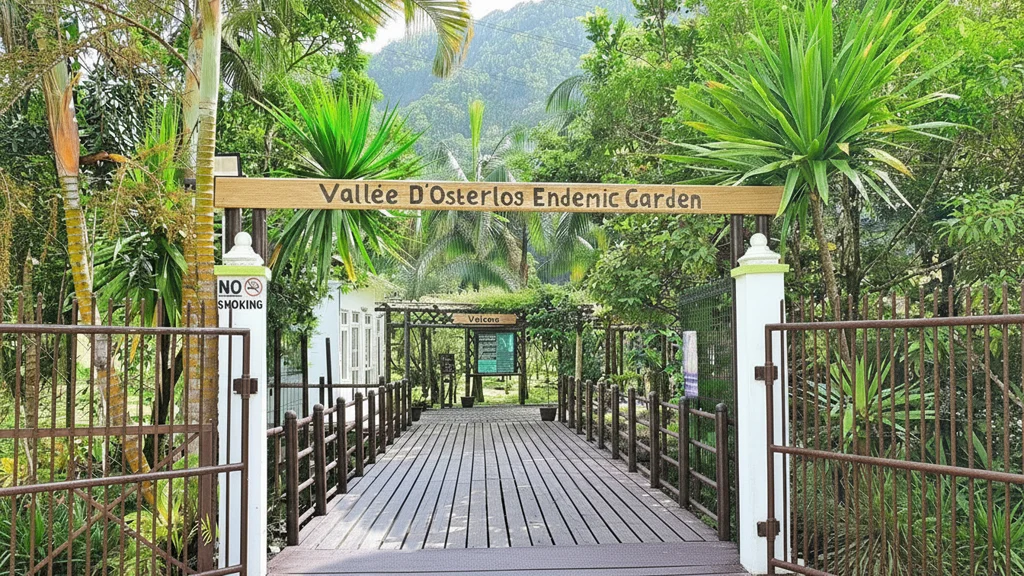
Visitors are welcomed beneath a thick, lush canopy by the site's wardens, whose friendliness and knowledge greatly enhance the experience. A visitor center provides information about the site and its biodiversity.
Infrastructure and facilities
The garden has several features to enhance the visitor experience:
- Picnic areas Specially designed areas offer breathtaking panoramic views of the valley.
- Panoramic kiosks Four kiosks have been installed on the heights, offering spectacular views over the Osterlog valley
- Well-maintained trails : a circuit of approximately 1 to 2 kilometers allows you to explore the endemic forest
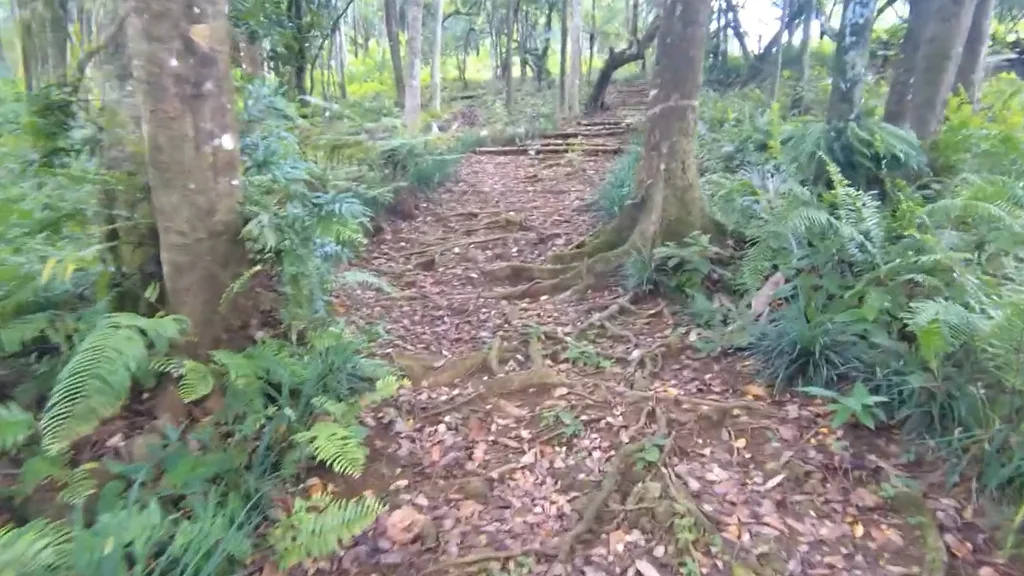
- Wooden stairs : improvements have been made to the steep slopes to facilitate the ascent for hikers
- Turtle enclosure : a dedicated area where visitors can observe the turtles
- Souvenir shop A gift shop allows you to leave with a souvenir of the site
- Safari bus : a 26-seater vehicle has been acquired to facilitate group visits
The hiking trail and its attractions
The main trail, dotted with clearly labeled endemic plants, awakens the botanist in every visitor. The hike can be done on foot or by bicycle, according to preference.
The flora is dazzling throughout the entire route. The wooden staircases installed on the steep slopes evoke the adventurous atmosphere of Indiana Jones films, adding a playful dimension to the discovery.
Turtle Waterfall: the highlight of the visit
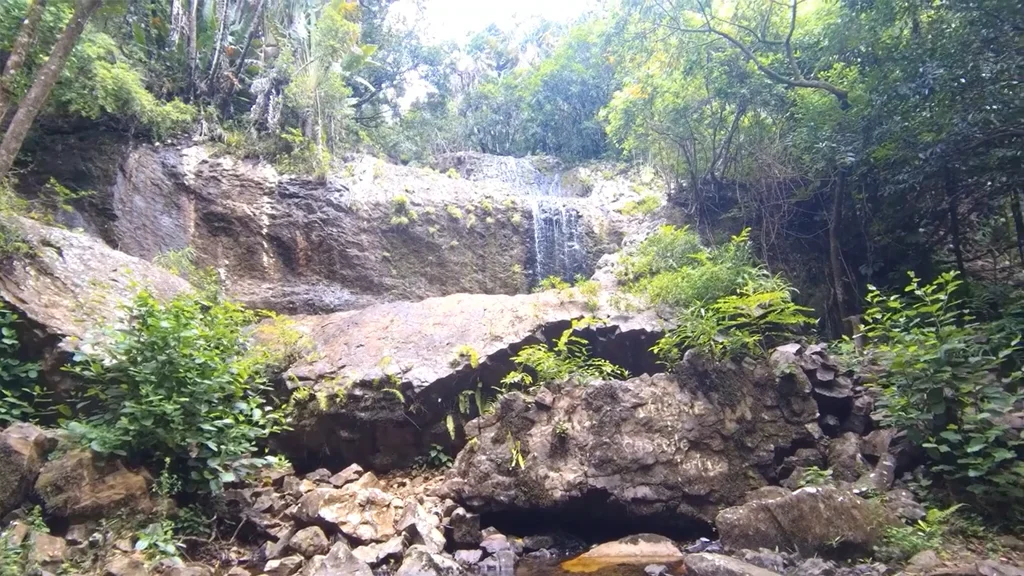
The route leads directly to the Turtle Waterfall, which takes its name from the enormous rock located downstream of the waterfall whose shape strikingly resembles a giant turtle shell.
The spectacle offered by the waterfall varies considerably depending on the season and rainfall in the region. During the dry season, it may only trickle a timid stream, while after the rains, it transforms into an impressive torrent.
Practical information for visitors
Hours of operation
The Osterlog Valley's endemic garden is open to the public from 9:00 AM to 3:30 PM.
Entrance fees
Access to the garden is currently free this free admission is available to all visitors, following a government decision aimed at encouraging wider access to this natural heritage. It replaces the previous fee system, which charged Mauritians Rs 25 (free for those over 60 and children under 5).
Contact
For further information or group visits, you can contact the Osterlog Valley at: Telephone: +230 5251 8666
The offices of the Osterlog valley Endemic Garden Foundation are located in Wooton, Eau Coulée.
How to get there
By car from Mahébourg:
- Take the B7 towards Riche en Eau then Saint-Hubert
- Follow the signs to Le Val
- Take the road leading to Cluny
- Follow the signs to the Osterlog Valley (GPS coordinates: MJ28+JM8, Cluny)
- Parking is available on site
Journey time: approximately 30-45 minutes from Mahébourg or Curepipe depending on traffic conditions.
Practical recommendations
Recommended equipment:
- Hiking boots or sturdy sneakers The trails can be muddy and slippery, especially during the rainy season.
- Sportswear comfortable and suitable for walking
- Mosquito repellent Essential because mosquitoes are numerous in this humid environment:
- Water and snacks for hiking
- Camera to immortalize the exceptional landscapes
Visiting tips:
- Arrive early in the morning to enjoy the cool air and observe the birds in the best conditions
- Avoid wearing white or new shoes that might get dirty.
- Allow approximately 2 to 3 hours to fully explore the site.
- The visit may be more difficult for the elderly or those with reduced mobility due to the rough terrain.
- For greater comfort, it is best to visit outside the rainy season (May to November).
For families: The site is ideal for a family outing, with the possibility of picnicking while admiring the tranquil views. Children will particularly enjoy watching the turtles and discovering the waterfall.
Conservation efforts and ecological importance
The role of the Osterlog valley Endemic Garden Foundation
The Foundation is responsible for the protection and management of the park, with several essential missions:
- Combating invasive species : to rid the 2.35 hectares of the garden of the majority of exotic species that threaten the endemic flora
- Planting program : development of plantations of endemic species to restore the primary forest
- Environmental education Raising awareness among visitors, especially schoolchildren, about ecological issues and environmental protection
- Ex-situ conservation : maintaining a shade house (greenhouse) for the cultivation and protection of young plants
Investments for the development of the site
Since its creation, several projects have been completed for a total amount of approximately Rs 17 million, including:
- The acquisition of a 26-seater Safari bus
- The construction of a shade house (greenhouse)
- The construction of a tortoise enclosure
- The creation of a souvenir shop
- The installation of information and observation kiosks
The government has also invested an additional Rs 8 million for the development and rehabilitation of access roads, although these still require improvements.
A scientific research site
The Osterlog Valley regularly attracts foreign academics and researchers who come to study endangered endemic plants. The site serves as a living laboratory for research in botany and the conservation of island biodiversity.
The ecotourism potential
The Minister of Agro-Industry highlighted the valley's potential for ecotourism. The site is ideal for:
- Moments of relaxation in the heart of nature
- Educational hikes
- School trips
- Nature photography
- From ornithological observation
The Osterlog Valley in the context of Mauritian conservation
Complementarity with other protected sites
The Osterlog Valley is part of a network of conservation sites in Mauritius which includes:
- THE Black River Gorges National Park in the West (created In 1994, 6,500 hectares)
- THE Bras d'Eau National Park in the East (welcoming Approximately 4,000 visitors annually)
- TheAigrettes Island, coral islet managed by the Mauritian Wildlife Foundation
- There Ferney Reserve, certified as a Biosphere Reserve by UNESCO
Together, these sites protect the last vestiges of Mauritian primary forest and constitute essential refuges for endemic and threatened species.
The urgency of conservation in Mauritius
Mauritius is ranked among the three countries in the world where flora is most threatened, with 60% of its endemic species considered endangered by the International Union for Conservation of Nature (IUCN). This dramatic situation results from:
- Massive deforestation The island was once covered in a dense ebony forest, intensively exploited by dutch, french and british colonizers.
- The introduction of invasive species Plants such as Chinese guava, privet or Ravenala, and predatory animals that degrade the endemic ecosystem
- Habitat loss Only 2% of quality forests remain today.
The Osterlog Valley therefore plays a crucial role in preserving this irreplaceable natural heritage.
Immersive experience: What to see and do in the Osterlog valley
Observe the endemic flora
Along the trail, visitors can easily admire and identify endemic plants thanks to the installed labels. It's a unique opportunity to see species that exist nowhere else on Earth, some of which are on the verge of extinction.
Discover medicinal plants
Some endemic plants of the valley possess medicinal properties traditionally used by Mauritians, such as "carrot wood" and other species that local guides will be happy to introduce to you.
Photographing exceptional landscapes
Photographers will find endless subjects in the valley: waterfalls, lush forests, mountain panoramas, endemic flowers, and rare birds. The morning light offers the best conditions for photography.
Observe the wildlife
Birdwatchers can try to spot rare endemic bird species. It's also possible to see macaques, although they are an introduced species. The tortoises in their enclosure are another point of interest, especially for children.
Picnicking in the heart of nature
The designated picnic areas offer a relaxing family outing while enjoying spectacular views of the valley. It's a chance to recharge in a pristine natural environment.
Introduction to conservation
Information kiosks and educational panels raise visitors' awareness of the challenges of conserving Mauritian biodiversity. A visit to the Osterlog Valley is therefore both recreational and educational.
Tips for a responsible visit
To preserve this fragile natural heritage, it is essential to adopt respectful behavior:
- Do not pick endemic plants or flowers
- Stay on the trails marked to avoid damaging the vegetation
- Do not feed wild animals
- Take all your rubbish with you and leave nothing behind
- Respect the silence so as not to disturb the wildlife
- NO SMOKING in the forest due to the risk of fire
- Follow the instructions park guides and wardens
Conclusion: a natural gem to discover and preserve
The endemic garden of the Osterlog Valley represents much more than a simple tourist attraction. It is a living sanctuary that shelters the last vestiges of the Mauritian primary forest, a natural conservatory of biodiversity unique in the world, and a symbol of Mauritius' commitment to the preservation of its natural heritage.
Whether you're a botany enthusiast, a hiking aficionado, a nature photographer, or simply looking for a family getaway in an exceptional natural setting, the Osterlog Valley offers an authentic and enriching experience. The pure air, breathtaking landscapes, rare endemic species, and peaceful atmosphere of the valley will allow you to discover the wild and unspoiled side of Mauritius, far from the tourist beaches.
By visiting the Osterlog Valley, you also contribute to conservation efforts and raise awareness among those around you about the importance of protecting these threatened natural treasures. Each visit is an act of discovery, wonder, and commitment to preserving Mauritian biodiversity.
Don't wait any longer to discover this secret garden nestled between two mountains, where mauritian nature reveals all its splendor and fragility.
The information in this article is given for information purposes only and corresponds to the data available in February 2026. The author and publisher decline all responsibility for the accuracy of the information mentioned. It is recommended to verify information directly with the relevant Mauritian authorities during your stay. See the Terms (Article 12).
(The photos you send will only be used to complete this page and will never be used commercially outside of this site without your permission)
To share your Mauritius vacation photos with friends, family, and colleagues, we offer a free, personalized webpage dedicated to your trip. Simply share the webpage address, for example, www.ilemaurice-im/vacancesdepierreetmarie, with anyone you'd like to share your photos with.
It's very simple, just click on the button below.
Info +:
Rent a car
Book a hotel or villa
Buy a plane ticket
7-day weather forecast
Walking and hiking
Child-friendly
Parking
Public toilets
Bus routes: Click here
Rent a car
Your advertising on this page?
Want to display an ad for your business on this particular page (or elsewhere on the site)?
Please contact us in click here.
Contribute, improve this page
We want to provide the most relevant and complete information to internet users, so if you want to add something or modify this page (text, Photo, etc.), Or even report an error, do not hesitate to contact us by sending us an email to the following Address: contribuer@ilemaurice.im
(remember to clearly indicate the page concerned by your contribution)
(the photos sent will only be used to complete this page and will never be used commercially outside of this site without your consent)
Not yet tested by the editorial team
If you would like to tell us about this place, this activity, etc., please send us an email to the following address: visiter@ilemaurice.im