
Natural parks and nature parks
Sophie Nature Walk
Sophie Nature Walk : la forêt méconnue et luxuriante des hauteurs de Maurice
 The essentials in a few words
Sophie Nature Walk is a forest area developed by the Mauritian Forestry Service, in Plaine Sophie, on the edge of the Mare aux Vacoas reservoir, in the centre of the island.
It includes an educational visitor centre, a forestry museum, an arboretum, a greenhouse of ferns and orchids, a garden crossed by a stream and a pond, kiosks and picnic areas.
Marked trails start from the parking lot, go under a pine forest populated with tree ferns and lead to the banks of the reservoir.
The walk is easy, flat, shaded, and accessible to children.
L’entrée est gratuite. On y vient pour regarder : la densité de la végétation est le spectacle du lieu.
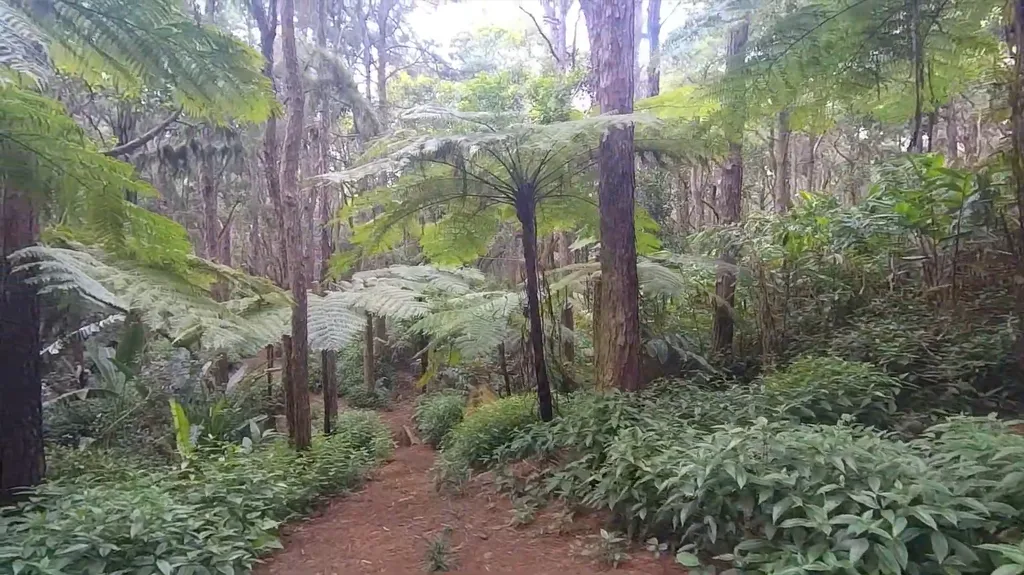
Il suffit de quelques pas sur le chemin de terre rouge pour comprendre ce qu’on est venu voir. Des fougères arborescentes déploient leurs couronnes de part et d’autre du sentier, si nombreuses par endroits qu’elles forment un second étage de végétation sous les pins. Plus loin, des troncs entiers disparaissent sous le lierre, gainés du pied jusqu’aux premières branches, au point qu’on ne devine plus l’écorce. Au sol, un tapis dense d’arbustes bas ferme les côtés du chemin. On est à 600 mètres d’altitude, dans une île qu’on associe au lagon, et on avance ici les yeux levés. L’entrée est gratuite, la boucle se fait en une heure, et pourtant très peu de visiteurs y passent : quelques milliers par an.
Summary
- La forêt qu’on traverse
- A forest entirely planted by human hands
- The water from Mare aux Vacoas, the true reason for this forest
- The garden, the stream, and the bald cypress trees
- The Forest Museum, the only forestry museum on the island
- The trails: from the garden to the banks of the reservoir
- What we can see happening here
- Useful information
- What to see nearby
- Frequently Asked Questions about Sophie Nature Walk
- Photos
La forêt qu'on traverse
Passé l’entrée et le jardin qui la prolonge, le décor devient beaucoup plus sauvage. Le sentier s’enfonce entre des fûts de pins très hauts, et c’est là que se trouve la vraie surprise du lieu : les fougères arborescentes. Elles ne sont pas cantonnées à une serre, elles poussent en peuplement de part et d’autre du chemin, leurs couronnes déployées à hauteur d’homme et au-dessus, si nombreuses par endroits qu’elles forment un second étage de végétation sous les pins. Au sol, un tapis dense d’arbustes bas ferme les côtés du sentier. C’est le passage qui donne à Sophie son air de forêt primaire, alors même que les grands arbres qui l’abritent ont été plantés.
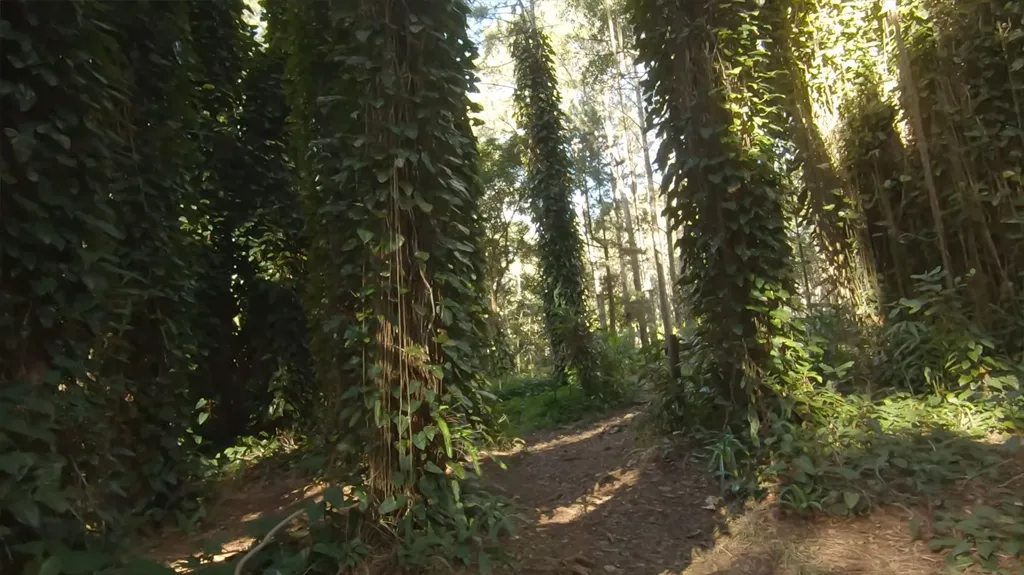
Further on, in another section, ivy takes over. The trunks disappear entirely beneath the leaves, sheathed from base to first branches, so thick that the bark is no longer visible, and the light falls in patches on the path between these green columns. Let us recall in passing what is often mistakenly believed: ivy does not parasitize the tree it climbs. It takes nothing from its sap and does not damage its bark; it simply climbs in search of light, and shelters beneath its leaves a fauna of spiders and small organisms that rid the tree of some of its harmful insects.
A forest entirely planted by human hands
The forest you walk through on the Sophie Nature Walk is not a native forest: it was planted, and quite recently. This detail completely changes how you look at these tall, aligned pines—they are not survivors, they are newcomers.
The site's museum tells this story, and it begins with a deed of sale. Plaine Sophie was acquired by the government from a Mr. Méradon on May 16, 1916, for 25,000 rupees, the state ceding in exchange a portion of Crown land at Carbonel Bridge, Curepipe. At that time, the area was covered in dense native forest, the type known as upland vegetation: a low canopy dominated by mangroves, where species grew that are found nowhere else in the world.
Between 1940 and 1943, naturalists—the museum cites Dr. Vaughan among the pioneers—studied this vegetation and tried to save the endemic plants in their habitat. Then everything changed: on the 1er in January 1944, a development plan dedicated to the planting of pine trees came into effect around Mare aux Vacoas. The native forest was largely cut down and replaced by fast-growing exotic species — pine, cedar, eucalyptus — which were much more productive than the local trees.
The 1945 cyclone accelerated this trend. A great deal of wood was needed quickly to rehouse a population whose homes had been destroyed and to provide posts for the stables. Exotic species were therefore planted with even greater vigor. It is this wood, planted in the immediate aftermath of the cyclone, that we see today reaching maturity above the picnic tables.
What remains of the former forest
The remnants of the native forest of Plaine Sophie survive in the Perrier Nature Reserve, at the northern end of the massif. It is a very small patch of Mauritian primary forest, with a low canopy — less than ten meters — dominated by red and green mangrove trees, and which shelters extremely rare plants, some reduced to a handful of wild individuals.
This needs to be stated clearly, because several pages leave room for doubt: the perrier reserve Is not open to visitors. It's closed to the public and not accessible from Sophie Nature Walk. You can know it's there, very close, but you can't go inside. It's frustrating, but that's precisely what keeps it standing.
The garden, the stream, and the bald cypress trees
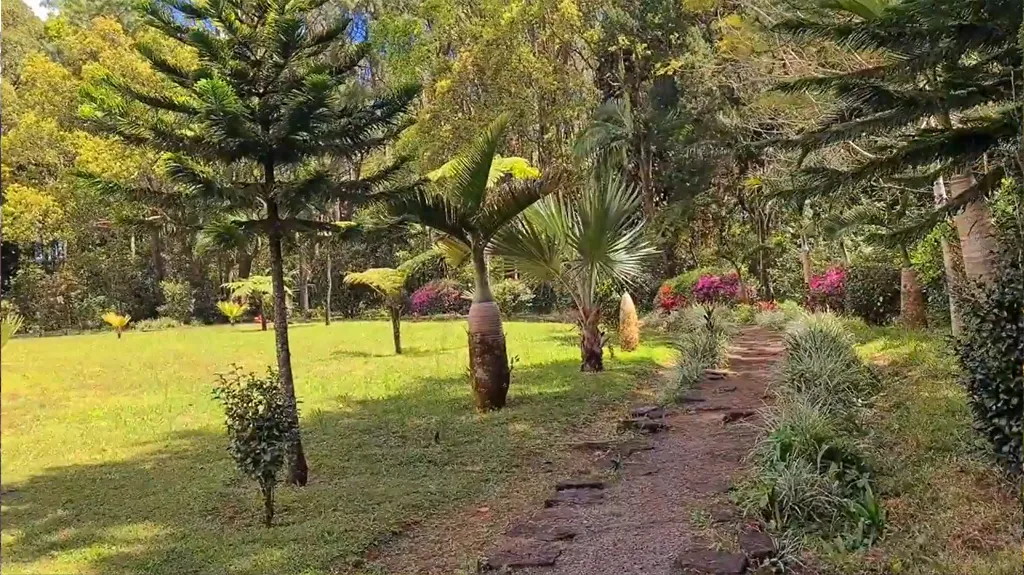
The section closest to the entrance resembles not a forest but a landscaped garden. A mowed lawn runs between the solitary trees, a stone-paved path meanders through the flowerbeds, and groves of pink and red blossoms close off the vista at the far end. Araucaria trees spread their branches in regular tiers, palm trees stand alongside clipped shrubs, and a small stream flows into a pond. You can easily spend an hour here without walking more than a few hundred meters, making it ideal for visiting with young children or for those who prefer not to hike.
Bald cypress trees grow along the stream. Take a moment to stop at the small wooden bridge and admire their base: the tree grows vertical outgrowths from the ground, called pneumatophores, woody "knees" that emerge from the waterlogged earth all around the trunk. It's a sight you wouldn't expect to find in Mauritius, and probably the most photographed detail of the site.
The site also houses a greenhouse dedicated to ferns and orchids. A sign reminds visitors that ferns are older than dinosaurs and provides figures for Mauritius: approximately 200 species, subspecies, and varieties have been recorded on the island, including about fifteen endemic species and around forty that are already extinct. These figures are those displayed on-site and should be interpreted as such, rather than as an up-to-date scientific inventory. If you are truly interested in endemic plants, the endemic garden of the osterlog valley and the daruty forest go further on the subject.
The Forest Museum, the only forestry museum on the island
Sophie Nature Walk houses Mauritius' only forestry museum. It's a small building that resembles a cabin and a lumberjack's workshop, and it can be visited in fifteen minutes, but it deserves to be explored at a leisurely pace.
Inside, hand tools from another era are displayed, some hanging on the hewn stone wall, others resting on the floor, with signs explaining the purpose of each: the rock pulley and its two pulleys, the crosscut saw with a wooden handle at each end, the brush saw stretched in its metal bow, the scythe, the jackbarrow, the forged pitchforks and rakes. There is also a collection of logs showcasing the grain and color of local and imported wood species: olive wood, rosin, antler, and red eucalyptus.
It's modest, and a little dark—several visitors have noted that reading the signs in the dim light requires some effort. But it's the only place on the island where the Mauritian forester's profession is explained, and that perfectly frames the rest of the walk: you leave the museum knowing why those particular trees were planted there.
The visitor centre, before the museum, plays the same role regarding endemic fauna and flora: educational panels, information on trails, and forest rangers generally willing to answer questions.
The trails: from the garden to the banks of the reservoir
The main route is an easy loop that starts from the parking lot, winds through the pine trees, and reaches the banks of Mare aux Vacoas before returning to the starting point. There are no technical difficulties, no significant elevation changes, the trail is well-marked, and the ground is compacted red earth.
What distance, what duration
Sources disagree on the exact length.And it's better to state this than to guess. The Forestry Service indicates a 1.8 km trail. The Mauritian Post Office, which has dedicated a stamp to the site, mentions a 3 km network of paths and walkways created through the forest. Visitors, however, most often report a loop of 2 to 2.5 km. These figures don't necessarily contradict each other: there's a main trail and a network of secondary paths in the garden, and depending on the route taken, the distance will vary. Allow an hour for the loop at a leisurely pace, more if you stop.
The trail markings are there but imperfect: some visitors report losing the path in the wooded section and request more arrows. It's not a dangerous place—you always end up back on the road—but if you're hiking with children, keep the group together rather than letting them wander ahead.
If hiking interests you more than walking, our page on hiking in Mauritius lists significantly more challenging routes, starting with those of the black River Gorges National Park, very close.
What we can see happening here
Beneath the pine trees, the wildlife doesn't put on a show; it lets itself be surprised. The most reliable visitor is a tiny grey bird that Mauritians call the pic-pic, found almost everywhere in the highlands. Birds are attracted to the pine cones, whose seeds they relish.
Macaques are the second possible encounter, and one regularly reported by walkers, often high in the trees. It's worth remembering what the website doesn't always mention: these monkeys are not native to Mauritius; they were introduced, and they are among the species that have the greatest impact on the island's endemic flora. Observing them is a pleasure; feeding them benefits no one.
The vegetation itself unfolds on two levels. Above, the planted high forest: pines with ochre-red bark, eucalyptus, and conifers sometimes entirely enveloped in ivy. Below, tree ferns and native and endemic species reintroduced by the forestry service, planted and monitored. This is the acknowledged paradox of the place: it is the exotic trees that now provide the shade the native trees need to recover.
Useful information
Opening hours and prices
Entry to Sophie Nature Walk is free. The site is open from 8 a.m. to 3 p.m. on weekdays, and from 9 a.m. to 4 p.m. on Saturdays, Sundays, and public holidays. These hours are those published by the Forestry Service and are confirmed by the site's online listing, which is quite reassuring for a public site. However, it's best to verify these hours on-site or by phone if you're traveling from afar.
The 3 p.m. closing time on weekdays is the key point to remember: this isn't a place to visit in the late afternoon. Plan to go in the morning instead, which is the best time to visit anyway—the light filters through the pine trees and it's less crowded.
Access and parking
The site is located in Plaine Sophie, in the Plaines Wilhems district, on the B102, the road that runs alongside Mare aux Vacoas. Coming from the towns on the plateau — Curepipe, Vacoas, Quatre-Bornes — take the B102 south and follow the reservoir.
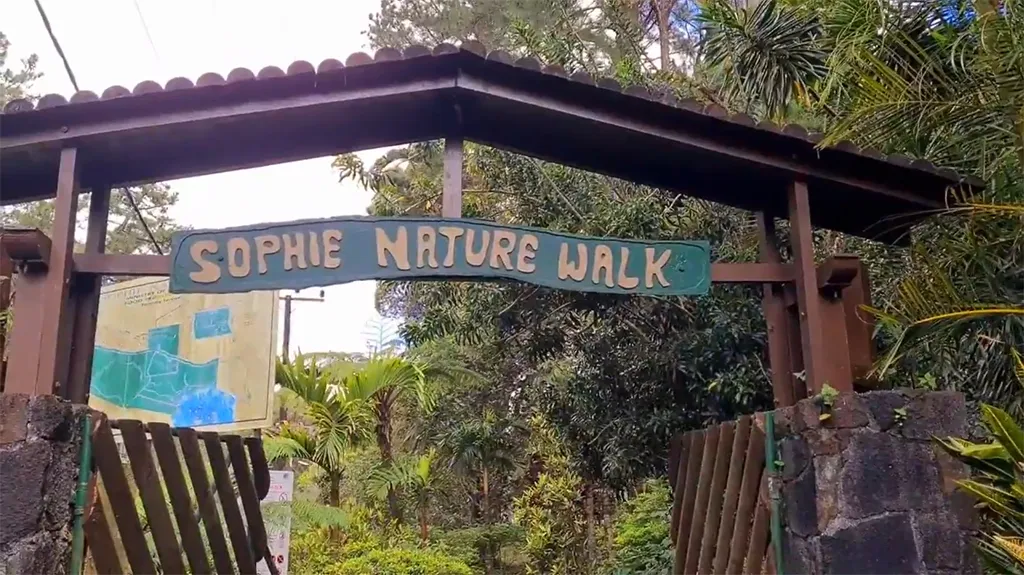
The entrance is easily recognizable: a wooden archway topped with a small tiled roof, bearing the site's name in large cut-out letters, framed by two dark volcanic stone pillars and closed off by wooden gates. On the left-hand pillar, a sign displays a map of the trails; it's worth taking a photo of it before setting off, given the uneven trail markings further along.
The parking lot is located across the road from the entrance. It's large and shaded. This is important to know: sometimes people look for a space in front of the barrier when they should park opposite and walk across.
Et c’est là le seul point de vigilance du site. Les véhicules roulent vite sur cette portion, et la visibilité est mauvaise en ressortant de la forêt : on ne voit pas arriver ceux qui descendent vers Mare aux Vacoas. Marquez bien l’arrêt avant de traverser, et tenez les enfants par la main.
It's a place that lends itself well to a stopover along the way: it's on the route that leads to Grand Bassin and the south, and an hour's walk in the shade can easily be squeezed into a day of sightseeing. Find its location, as well as that of other sites in the center, on our tourist map of Mauritius.
How much time should I allow?
Allow one hour for the loop alone, two hours for a complete visit including the visitor center, museum, and garden, and half a day if you plan to have a picnic. Tables, benches, and kiosks are available in designated areas, as well as restrooms.
What to pack
Mosquito repellent: this is by far the most frequent comment from visitors. The damp shade and the presence of water make this forest a favorable environment for mosquitoes, including inside the museum.
Also bring good closed-toe shoes—the dirt paths get muddy after rain, which is frequent at this altitude—and a light sweater. We're at about 600 meters, on the central plateau: it's regularly several degrees cooler here than on the coast, the weather changes quickly, and fog rolls in easily. This contrast with the coastline is part of the area's appeal, but it can be surprising for those who come up in beach attire.
What to see nearby
Sophie Nature Walk is in the geographic centre of the island, making it an excellent base for a day in the highlands. Grand BassinThe sacred lake is a few kilometers south along the same road. black River Gorges National Park and its viewpoints extend the day westward. On the city side, the botanical garden of Curepipe is very close, and the Bois Chéri estate opens the tea route southward.
To put everything in context, our portrait of center of Mauritius tells of this other Mauritius, the one of the plateau, fresher and greener, without beaches.
Finally, a useful clarification: Sophie is not the only development of this type. The forestry service had created four nature walks — Bras d'Eau, Monvert, Powder Mills, and Sophie. The Bras d'Eau area was designated a national park in 2011 and can now be visited under that name; see our article on the bras d'Eau National ParkMonvert, on the other side of the reservoir near Curepipe, still exists but several visitors describe it as being significantly less well-maintained than Sophie.
Frequently Asked Questions about Sophie Nature Walk
Is Sophie Nature Walk free?
No. Entry to Sophie Nature Walk is free. The site is managed by the mauritian forest service and there is no ticket office or reservation.
Where exactly is Sophie Nature Walk located?
Sophie Nature Walk is located in Plaine Sophie, in the Plaines Wilhems district, in the center of Mauritius, on the edge of the Mare aux Vacoas reservoir and along the B102 road, south of Curepipe. Note: several websites incorrectly place it near Blue Bay, on the southeast coast. This is wrong—the site is inland, at an altitude of approximately 600 meters.
How long is the walk?
The main loop takes about an hour at a leisurely pace. Allow two hours to include the visitor centre, the forest museum and the garden, and half a day if you plan to have a picnic there.
Is the walk suitable for children?
Yes. The path is flat, short, shaded, and without any exposed sections, and the garden near the entrance allows for a very quick visit if the children get tired. The picnic areas and the museum make it a complete family outing.
Do we need a guide?
No, the site is open to the public and the trails are marked. The visitor center provides information about the routes, and a map is posted at the entrance. However, some visitors have noted that the trail markings could be improved in the wooded area: keep your group together.
Peut-on venir avec son chien ?
En partie seulement, et la distinction est importante. D’après des visiteurs habitués du site, un panneau à l’entrée interdit les chiens du côté du musée, tandis que le sentier qui mène vers Mare aux Vacoas leur est accessible. Le secteur aménagé — jardin, centre d’accueil, musée — leur est donc fermé, la partie forestière non. Nous n’avons pas trouvé de texte officiel confirmant cette règle : en cas de doute, fiez-vous au panneau affiché à l’entrée, et ramassez derrière votre animal.
Is it possible to swim in the Mare aux Vacoas Reservoir?
No. Mare aux Vacoas is a drinking water reservoir that supplies the highlands of Plaines Wilhems and Moka: swimming is not permitted there. The path runs along the banks; you look, you don't go into the water.
Can we visit the Perrier nature reserve?
No. The perrier reserve, Which protects the last vestiges of the native forest of plaine Sophie, Is closed to the public and is not accessible from Sophie Nature Walk.
What is the best time to visit?
The site is open year-round. The morning is the best time of day, especially since the site closes at 3 p.m. on weekdays. At this altitude, rain and fog are frequent: it's not a deal-breaker—the forest is beautiful in the mist—but the trails become slippery.
Are there any dangerous animals?
No. There are no dangerous snakes or large predators in Mauritius. The only real nuisances at Sophie Nature Walk are the numerous mosquitoes and the macaques, which should not be fed or approached.
The information in this article is provided for guidance purposes Only. the author and publisher accept no responsibility for the accuracy of The information provided. opening hours for sites managed by an administration may Change without notice; it is recommended that you verify information directly with local operators or the relevant mauritian authorities during your stay. See the Terms of Use (Article 12).
(The photos you send will only be used to complete this page and will never be used commercially outside of this site without your permission)
To share your Mauritius vacation photos with friends, family, and colleagues, we offer a free, personalized webpage dedicated to your trip. Simply share the webpage address, for example, www.ilemaurice-im/vacancesdepierreetmarie, with anyone you'd like to share your photos with.
It's very simple, just click on the button below.
More information:
7-day weather forecast
Rent a car
Book a hotel or villa
Buy an airplane ticket
Free
Walking and hiking
Child-friendly, no stroller required
Parking
Public toilets
Bus routes: Click here
Your advertisement on this page?
Do you want to display an advertisement for your business on this particular Page (or elsewhere on the Site)?
Thank you for contacting us in clicking here.
Contribute to and improve this page
We want to provide internet users with the most relevant and complete information, so if you would like to add to or modify this page (text, photo, etc.), or even report an error, please do not hesitate to contact us by sending an email to the following address: contribuer@ilemaurice.im
(remember to clearly indicate the page to which your contribution relates)
(The photos you send will only be used to complete this page and will never be used commercially outside of this site without your permission)
Not yet tested by the editorial team
If you would like to tell us about this place, this activity, etc., please send us an email to the following address: visiter@ilemaurice.im