
Mauritian alouda
Alouda, the large iced glass that refreshes Mauritius
 The essentials in a few words
Alouda is a sweet, fragrant, iced milk drink sold in bazaars and street stalls throughout Mauritius. It consists of milk, a flavored syrup—rose, vanilla, almond, or strawberry, depending on the vendor—soaked basil seeds that swell into small translucent pearls, grated agar-agar jelly (which Mauritians call "mousse"), and very often a scoop of vanilla ice cream on top. It is descended from the Indian falooda, itself a descendant of the Persian faloodeh. It is drunk through a straw, finished with a spoon, and is most often enjoyed at the market, between a dholl puri and a chili cake.
It's midday at the Port Louis market, the corrugated iron smolders above the aisles, and a queue has formed in front of a counter where large jugs filled with a milky pink liquid sit. The vendor fills a glass to the brim, throws in a ladleful of grated jelly, a scoop of vanilla ice cream, and inserts a straw and a spoon. In the glass, thousands of tiny black seeds encircled by translucent rings float in suspension. It's alouda, and for many Mauritians, it's the taste of childhood.
This drink isn't really drunk: it's sipped, chewed a little, and finished with a spoon. It comes from Persia via India, changed its name and recipe along the way, and in Mauritius it has become something quite unique. Here's what's in it, where it comes from, where to get a real one, and how to make it at home.
Summary
- What exactly is an Alouda?
- The seeds of the toukmaria, and what they are not
- The mousse, that grated jelly that everyone can drink
- Milk, syrups and flavorings
- From persian faloodeh to mauritian alouda
- At the Pillay family's, alouda was born from a juice without milk.
- Alouda, falooda, black moss: do not confuse
- Where to drink an alouda in Mauritius
- How much does an alouda cost?
- Drinking an alouda without any unpleasant surprises
- The recipe for homemade alouda
- Frequently asked questions
What exactly is an Alouda?
Alouda is a sweetened and fragrant milk, served very cold, in which two textural ingredients float: basil seeds plumped with water and grated agar-agar jelly. This is the base, to which each vendor adds their signature—more condensed milk, an extra dash of syrup, a scoop of ice cream, sometimes crushed ice.
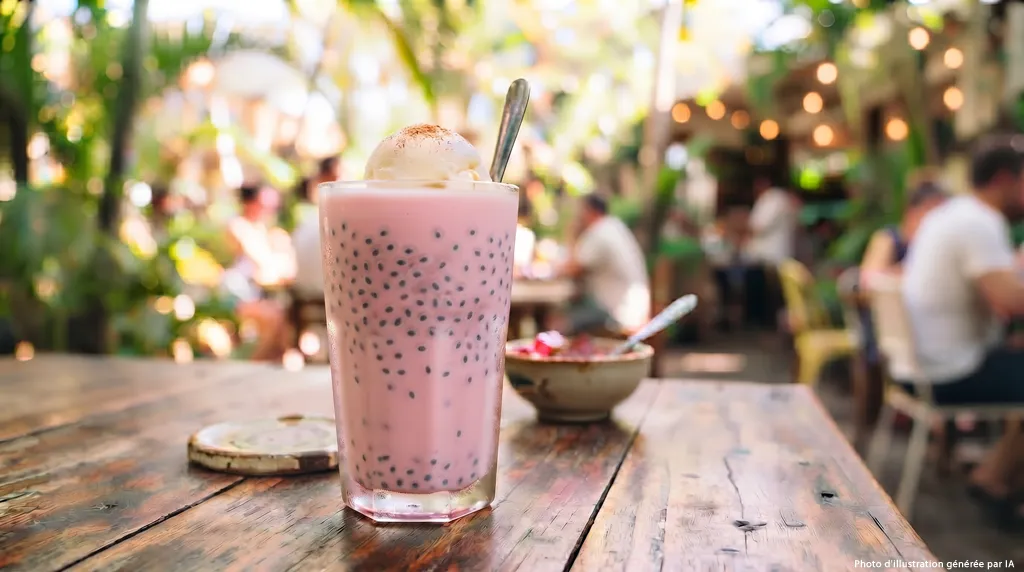
What's surprising about the first sip isn't the taste, which is rather mild and floral, but the sensation in your mouth. You sip a liquid, and it comes with things in it: the seeds rolling under your tongue, the strands of jelly rising up the straw. In France, we don't really have an equivalent. In Asia, we do: the principle is the same as that of bubble drinks.
It's also a nourishing drink. Between milk, sweetened condensed milk, syrup, and ice cream, a large glass easily serves as a snack. Many Mauritians even drink it after a very spicy dish to soothe the heat.
Don't bother looking for an official presentation; there isn't one. Depending on the vendor, the alouda arrives in a bistro glass, a large soda glass, or a plastic takeaway cup, with a straw, a spoon, or both. Some drizzle it with a little red syrup over the ice, others don't. Colors range from pale pink to yellow, and you'll also find green or blue versions, which are all thanks to the chosen syrup. An alouda isn't recognized by its glass, but by what's inside.
The seeds of the toukmaria, and what they are not
The small black seeds of alouda are basil seeds, called toukmaria in Mauritius (also spelled takenmaria or tukmaria, and sabja in India). Soaked for fifteen minutes in water, they become encased in a transparent, gelatinous shell and swell to several times their original size. The kernel remains crunchy, while the shell is soft: this contrast is what gives the drink its unique texture.
Many pages dedicated to alouda confuse them with something else, and it's worth setting the record straight. They are not tapioca pearls, which are white, much larger balls of cassava starch. Nor are they psyllium seeds, even though the two look similar once soaked, and Indian falooda is sometimes prepared with psyllium. In Mauritian alouda, they are indeed basil seeds.
They are traditionally believed to have refreshing and digestive properties, which partly explains the drink's popularity on hot days. These properties are based on popular usage, not medical recommendation.
The mousse, that grated jelly that everyone can drink
What vendors call "foam" is actually filaments of agar-agar jelly, obtained from seaweed and grated after it sets. It adds almost no flavor: its role is entirely in the texture, those tiny, melting vermicelli that rise with the milk.
Its other, less obvious advantage is significant on an island as diverse as Mauritius. Agar-agar is plant-based, unlike gelatin, which is often derived from pork or beef. Therefore, an agar-agar drink can be enjoyed by Hindus, Muslims, vegetarians, and vegans without any issues. However, alouda remains a milk-based beverage and is not vegan.
Milk, syrups and flavorings
The liquid base varies from stand to stand: fresh milk, reconstituted powdered milk, evaporated milk, sweetened condensed milk, or a mixture of the four. The syrup provides the color and flavor, and that's where the customer's choice lies.
- The rose : the most iconic fragrance, the one that gives alouda its pale pink hue. It is also the direct legacy of Indian falooda.
- Vanilla : very widespread in Mauritius, milder, it gives a pale yellow creamy drink.
- The almond : similar to orgeat, sometimes tinged with green.
- The strawberry and other fruit perfumes, according to the merchants and the fashions.
Add or omit the scoop of vanilla ice cream, and you already have a respectable number of versions. A merchant in the Port Louis bazaar claimed in 2019 to have developed thirteen ways to prepare his alouda without changing its basic taste: that's how easily the drink can be fine-tuned.
From persian faloodeh to mauritian alouda
Alouda is descended from the Indian falooda, which itself comes from the Persian faloodeh, a frozen dessert from the Shiraz region renowned as one of the oldest of its kind. The original faloodeh has almost nothing in common with the bazaar version: it consists of frozen starch vermicelli, rosewater, lime juice, and not a drop of milk.
The journey was eastward. Muslim merchants and dynasties carried the dessert to the Indian subcontinent, where Mughal court kitchens transformed it: milk, basil seeds, and later ice cream were added. Falooda became a festive dessert-drink, long reserved for noble families, before becoming popular throughout the subcontinent. Its name itself speaks volumes: in Hindustani, the idea of something shredded refers to the vermicelli noodles that form the heart of the recipe.
In Mauritius, it was 19th-century Indian immigration that brought it, with indentured laborers arriving by the tens of thousands after the abolition of slavery. The drink lost its full name, its wheat vermicelli—rarely found in Mauritian alouda—and gained local agar-agar. What remained was the principle: cold, sweet, flavorful, and with surprising textures.
At the Pillay family's, alouda was born from a juice without milk.
The best-documented history of Mauritian alouda is that of a family from the Port Louis bazaar, the Pillays, whose stall is now an institution. It holds a surprise: originally, what they sold wasn't alouda, because nobody could afford to drink it.
Recounted in 2019 in the Mauritian press by Sivananda Katherasa Pillay, a fourth-generation member of the family, the story begins with his great-grandmother, who set up shop in the market. There, she sold a juice made from water, sugar, a little coloring, and toukmaria (a type of spice). No milk was used: milk was expensive, and alouda was a luxury item. Her son took over the business, expanding it to Farquhar and Desforges streets, and even ran a restaurant in the Port Louis municipality. It was in the late 1950s that Sivananda's father began adding milk to the family juice. The Pillay family's alouda was born there—a good quarter of a century after the stall itself.
It is often said that the house has been making alouda since 1930; the two statements only appear to contradict each other, one dating the family business, the other the drink. The exact date of the switch to milk is known only through this family story: no one has published any records on the matter.
The rest of the story is more recent. Fresh alouda only keeps for three to four days, which for a long time confined it to the bar. After years of searching for a preservation method, Sivananda Pillay opened a small factory in the La Tour Koenig industrial zone in 2017 and launched a 250ml bottled alouda in July 2018, sold in supermarkets in three flavors—vanilla, almond, and strawberry—and priced at Rs 30 in 2019. The dream of bottling the drink was actually his father's, as he lacked the resources at the time to make it a reality.
Alouda, falooda, black moss: do not confuse
Three similar drinks are often circulated under interchangeable names, wrongly.
The alouda and the falooda
Indian falooda almost always contains vermicelli noodles—the famous falooda sev—and is often served in a tall glass, layered, with ice cream and sometimes dried fruit. Mauritian alouda, on the other hand, usually does without vermicelli, mixes everything together in the dispenser, and is sold by the glass, as a quick snack. The latter is a simplified, tropicalized descendant of the former.
The black foam
Black foam is another drink found in Mauritian markets, made from dark-colored seaweed jelly. It was once sold by the bowl, to be consumed on the spot, before vendors began bottling it. It shares the seaweed jelly family with alouda, but it is not a version of it.
Curdled milk
Several alouda vendors also sell curdled milk, reputed to be good for digestion and also served after a spicy meal. it Is a different product, without seeds or jelly.
Where to drink an alouda in Mauritius
The best aloudas are drunk in markets and bazaars, where the clientele is local and business is brisk. The clue is simple: look for the queue of Mauritians and the large jugs of pinkish liquid.
The port louis Bazaar
This is the historic address. The capital's central market houses several alouda vendors in its food court on the ground floor, next to stalls selling dholl puri and chili cakes. The most famous is Pillay's stall, which has been there since the 1930s and is mentioned in just about every guidebook—not that the neighbors are bad; many visitors report the opposite. The market is best visited in the morning, before the heat and crowds arrive. Our guide to the markets and bazaars of Mauritius details the opening hours and days of each, and the page Port Louis replace the bazaar in a visit to the capital.
The other markets on the island
Alouda can be found in most major markets: Rose-Hill, Quatre-Bornes, Curepipe, Flacq, Mahébourg, and Rose-Belle. Prices are generally lower there than in tourist areas, and the experience is more authentic. Street stalls and snack bars in city centers also serve it, often in the late morning and afternoon.
Bottled, at the supermarket
Since 2018, bottled alouda has been available in the refrigerated sections of several Mauritian stores. It's convenient for bringing back to a rental or for trying it without going to the market, but it's not the same drink: no ice cream scoop, no freshly grated foam, and a decidedly smoother texture. See our page on... supermarkets and shopping centers to know where to do your shopping.
Alouda naturally complements the rest of Mauritian street food: it's the glass that accompanies a dholl puri or that follows a curry well done. All the specialties are gathered in our dossier on mauritian gastronomy.
How much does an alouda cost?
There is no published and verifiable price for a glass of alouda: prices are not displayed everywhere, they vary from one vendor to another and from one region to another, and the figures circulating online are often outdated or copied. What is certain is that the drink remains in the category of low-cost items: a few dozen rupees, like the rest of Mauritian street food. The only accurately documented price is that of the 250ml bottle launched in supermarkets, priced at Rs 30 in 2019—a historical reference point, not a current price.
In practice, ask the price before ordering, and bring cash and small bills: credit cards are not accepted in bazaars. Stalls in very touristy areas tend to have higher prices than those in city markets.
Drinking an alouda without any unpleasant surprises
Alouda is a milk drink, served cold, often with ice: unlike dholl puri, which comes piping hot off the griddle, it hasn't been cooked in front of you. It deserves a little attention, but nothing too dramatic—it's the daily drink of an entire country.
- Choose the stalls frequented by Mauritians. High turnover means preparation done the same morning and bottles that don't sit idle.
- Check that the drink is actually cold.Kept in a cooler or refrigerator, and not placed in the sun.
- If you have a sensitive stomachStart with a small glass, and keep in mind that the drink is rich and very sweet.
- People with lactose intolerance they will pass: there is no milk-free version available commercially.
For general information — tap water, food precautions, pharmacies — see our page health and sanitary safety in Mauritius.
The recipe for homemade alouda
Alouda can easily be made outside of Mauritius, provided you can find two ingredients: Basil seeds (available in indian Or asian grocery stores, under the names tukmaria or sabja) and agar-agar powder (found in health Food stores or the baking aisle). the rest is common In most kitchens. plan to prepare it The day before or two hours in advance, to allow time for the jelly to set and for everything to chill thoroughly.
Ingredients for 4 large glasses
- 1 liter of whole milk
- 2 tablespoons of basil seeds (toukmaria)
- 2 g of agar-agar powder and 250 ml of water
- 4 to 6 tablespoons of rose syrup (or vanilla, or orgeat)
- 100 ml of sweetened condensed milk, to be added according to taste
- 4 scoops of vanilla ice cream
- Crushed ice
Preparation
- The jelly. Bring the 250 ml of water to a boil with the agar-agar, let it boil for about thirty seconds while stirring, pour into a shallow dish and let it set in the refrigerator. Once firm, grate the jelly using the large holes of a grater: you will obtain the characteristic strands.
- The seeds. Rinse the basil seeds, cover them with cold water and let them soak for 15 to 20 minutes. They should triple in volume and be surrounded by a transparent halo. Drain.
- Flavored milk. Mix the milk, condensed milk, and syrup. Taste it: an alouda is quite sweet, but the syrup should still be noticeable without overpowering the milk. Refrigerate; the drink should be ice-cold.
- The assembly. Place two spoonfuls of soaked seeds and a good spoonful of grated jelly in each glass, pour in the flavored milk, add the crushed ice and then the scoop of vanilla ice cream.
- The service. Serve immediately, with a wide straw and a spoon. Stir before drinking: the Seeds will sink to the bottom.
Two mistakes to avoid: soaking the seeds too little, which then remain hard and without a halo, and failing to set the agar-agar by underdosing it — a slightly firm jelly that grates well is better than a soft jelly that disintegrates in milk.
Frequently asked questions
What does alouda taste Like?
Alouda tastes like fragrant sweet milk, floral with rose syrup, and richer with vanilla. The surprise comes from the texture: the basil seeds crunch slightly, the agar-agar jelly melts, and the whole thing rises in the straw. It's a dessert drink, rich and very refreshing.
Does alouda contain alcohol?
No. Alouda is a non-alcoholic drink made with milk, syrup, and water. It is consumed by all ages, including children.
What is the difference between alouda and falooda?
Indian falooda contains vermicelli noodles and is served in layers in a tall glass, often with ice cream and dried fruit. Mauritian alouda generally omits the noodles, mixes the ingredients during preparation, and is sold by the glass in markets. Alouda is the local, simplified version of falooda.
What are the small black seeds of the alouda?
These are basil seeds, called toukmaria in Mauritius and sabja in India. When soaked in water, they swell and become encased in a transparent, gelatinous coating. They are neither tapioca pearls, nor chia seeds, nor psyllium.
Is alouda suitable for vegetarians?
Yes for vegetarians: the jelly is made with agar-agar, a plant-based ingredient, not animal gelatin. No for vegans and those with lactose intolerance, as the drink is milk-based.
Where to drink the best alouda in Mauritius?
The port louis Market is the most frequently mentioned address, with pillay's Stall and its neighbors in the food court. The markets in Rose Hill, Quatre Bornes, curepipe, Flacq, and mahébourg also Serve it. the most reliable rule is to follow the queue of Mauritians.
Can we bring back alouda as a souvenir?
Fresh alouda only keeps for a few days and doesn't travel well. However, there are commercially produced bottles sold in supermarkets in Mauritius that have a much longer shelf life. To recreate the taste at home, the easiest way is to bring back a sachet of toukmaria seeds and a bottle of rose syrup, and prepare the drink yourself.
At what time of day does one drink an Alouda?
Especially during the hottest hours, between late morning and mid-afternoon, and often after a spicy meal to soothe the heat. It's a market and street drink, not a table drink.

The information in this article is for guidance purposes only. The author and publisher accept no responsibility for the accuracy of the information provided. Prices and addresses mentioned are approximate and may have changed; they do not constitute fixed prices. It is recommended that you verify information directly with local operators or the relevant Mauritian authorities during your stay. See the Terms of Use (Article 12).
(The photos you send will only be used to complete this page and will never be used commercially outside of this site without your permission)
To share your Mauritius vacation photos with friends, family, and colleagues, we offer a free, personalized webpage dedicated to your trip. Simply share the webpage address, for example, www.ilemaurice-im/vacancesdepierreetmarie, with anyone you'd like to share your photos with.
It's very simple, just click on the button below.
More information:
7-day weather forecast
Rent a car
Book a hotel or villa
Buy an airplane ticket
Bus routes: Click here
Your advertisement on this page?
Do you want to display an advertisement for your business on this particular Page (or elsewhere on the Site)?
Thank you for contacting us by clicking here.
Contribute to and improve this page
We want to provide internet users with the most relevant and complete information, so if you would like to add to or modify this page (text, photo, etc.), or even report an error, please do not hesitate to contact us by sending an email to the following address: contribuer@ilemaurice.im
(remember to clearly indicate the page to which your contribution relates)
(The photos you send will only be used to complete this page and will never be used commercially outside of this site without your permission)