
The mauritian dholl puri
Mauritian dholl puri: History, recipe and where to eat it in Mauritius
 The essentials in a few words
Dholl puri is a thin Mauritian flatbread, made from wheat flour, stuffed with ground yellow split peas and flavored with turmeric and cumin.
Street vendors fold it around a curry (large peas, red beans, butter beans…) accompanied by a tomato rougail and, depending on the vendor, a dash of chili sauce or pickles.
It can be eaten at any time: breakfast on the go, quick lunch, snack after shopping.
A symbol of Mauritian street food, present at weddings, religious festivals and weekend fairs, it remains one of the most popular dishes on the island, appreciated by all communities and accessible to all budgets.
If you had to choose just one dish from your stay in Mauritius, it would probably be this one. Dholl puri is a golden flatbread, as thin as a crepe, filled with ground split peas, which a vendor offers you folded around a pea curry and a drizzle of tomato rougail, all wrapped in a paper that slowly soaks up the flavors. Three bites later, you understand why Mauritians eat it at all hours of the day.
A quintessential popular dish, inherited from the migration of indian indentured laborers In the 19th century, dholl puri has transcended its origins to become a national emblem, sold everywhere, eaten by everyone from busy downtown executives to pilgrims of Grand BassinHere's everything you need to know to spot it, taste it, and even prepare it at home.
Summary
Origins and history of dholl puri
The dholl puri arrived in Mauritius with Indian indentured laborers recruited from 1834 onwards in the plains of Bihar and Uttar Pradesh. Many disembarked at theAapravasi GhatThe former immigration depot in Port Louis, now a UNESCO World Heritage Site. In their luggage, they carry their culinary traditions, including an Indian lentil-filled flatbread known in northern India under names similar to puri or paratha.
On the island, the recipe Evolved. the flatbread became thinner, more pliable, and better suited to quick cooking on the hot griddle. The filling, made with yellow split peas, took on a golden color thanks to turmeric. Above all, its Use changed: the flatbread no longer accompanied the meal, But enveloped it. it is this seemingly simple transformation that made dholl puri a portable food format, perfectly suited to urban life. Mauritian street vendors embraced it. Street vendors popularized it from the end of the 19th century onwards, and the dish crossed all the island's community boundaries.
The favorite dish of Mauritians on a daily basis
Ask any Mauritian what the island's signature dish is, and nine times out of ten the answer will be the same. Dholl puri has no serious rival in the hearts of the locals. It's eaten everywhere, at any time, and by everyone.
At breakfast, it's bought hot outside school or the office. At lunch, it replaces the sandwich for tens of thousands of workers. in The evening, after a long day, it's the easy way to feed a family without cooking. During major religious holidays, such as Diwali or Maha ShivaratreeThousands of dholl puri are distributed free of charge to pilgrims and neighbors, in a spirit of sharing that transcends communities.
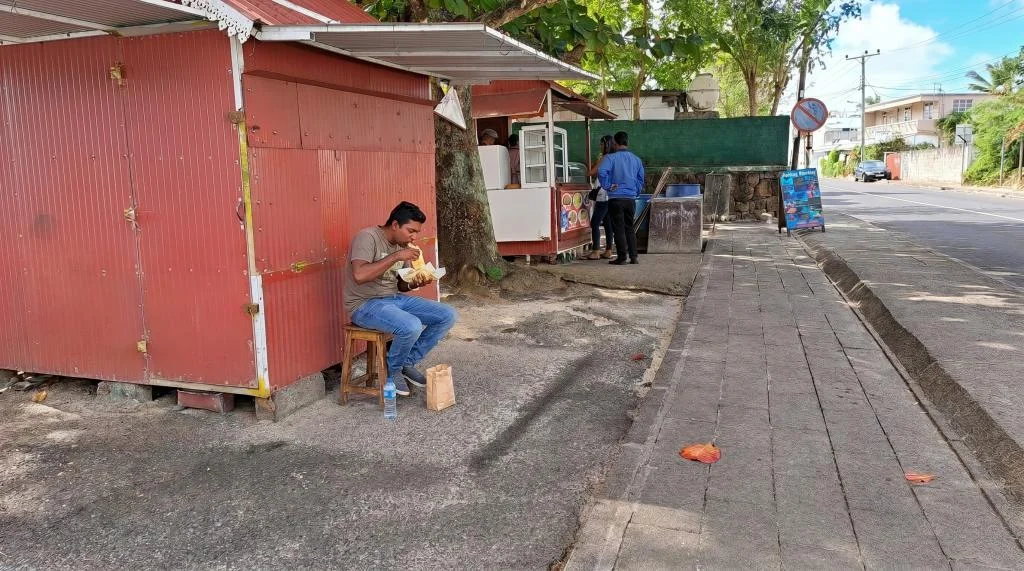
The dholl puri vendor is a familiar figure in the Mauritian landscape. Often set up on a strategic street corner, behind a cart or counter, he cooks the flatbreads on a large metal griddle, stuffs them in front of you, ladles on the sauces, and hands you everything in under a minute. The best vendors have had their regulars for thirty years. Some sell over a thousand dholl puri a day.
Where to taste the best dholl puri in Mauritius
In Port Louis
The capital is home to the traditional vendors. The Place d'Armes, the central market district, and the surrounding area... Caudan Waterfront they bring together several renowned merchants. Weekday lunchtimes between noon and 2 p.m. are the peak time: be prepared to wait in a cheerful queue, it's usually a good sign.
In the cities of the Central Plateau
Rose-Hill, Quatre Bornes, and Curepipe are home to some of the island's most famous merchants, whose reputation sometimes extends beyond the country's borders. The weekly markets, such as the one held on Thursdays and Sundays in Quatre Bornes, are excellent places to discover these treasures.
In the villages of the north and east
Goodlands, Flacq and Mahébourg each have their own traditions. The weekend markets are perfect for comparing different versions and finding the one that suits you best. MahébourgThe Monday market attracts traders from all over the southeast.
During the festivals
Events such as The Food Festival Series or the pilgrimages of Grand Bassin are an opportunity to discover dholl puri in exceptional conditions, sometimes prepared in industrial quantities by volunteers, and offered free of charge.
And you ?
And for you, where can you find the best dholl Puri?
Feel free to share your favorite address or experience via the form present on this page.
The recipe for mauritian dholl puri
Making dholl puri takes a little practice, especially the tricky steps of filling and rolling out the dough. Allow two hours the first time, and one hour once you're comfortable. The recipe yields about ten flatbreads, enough to feed four people.
Ingredients for the dough
- 500g of soft wheat flour (T55)
- 250 to 300 ml of lukewarm water
- 2 tablespoons of neutral oil
- 1 teaspoon of salt
Ingredients for the stuffing
- 250 g yellow split peas (dhal or dholl)
- 1 teaspoon of turmeric powder
- 1 teaspoon of ground cumin
- 1 teaspoon of salt
- Half a teaspoon of ground white pepper (optional)
Preparing the stuffing
Soak the split peas in plenty of cold water for 3 to 4 hours, or overnight. Drain, rinse, and then cook them in simmering, unsalted water. Cooking time is crucial: the peas should be tender but still slightly firm in the center, never mushy. Allow 15 to 20 minutes, depending on the quality of the peas. Drain immediately and spread them out on a clean cloth to dry.
Once cooled, grind the peas in a blender or coffee grinder in small batches until you obtain a coarse, dry flour. This texture is crucial for the quality of the filling; if it's too wet, it will tear the pastry. Mix in the turmeric, cumin, salt, and pepper. Set aside.
Preparing the dough
Mix the flour, salt, and oil in a large bowl. gradually Add the water, kneading by hand until you obtain a soft, elastic, and non-sticky dough. knead for About ten minutes, cover with a damp cloth, and let rest for at least 30 minutes at room temperature.
Shaping and baking
Divide the dough into balls the size of a tangerine, and the filling into equal portions. Flatten each ball of dough into a disc, place a portion of filling in the center, fold the dough over the filling by pinching the edges, then gently roll out to form a thin pancake 20 to 25 centimeters in diameter. The filling should be evenly distributed without tearing the dough.
Heat a large, flat skillet (or tawa) over high heat, without any oil. Place a dholl puri in the skillet and cook for 30 to 40 seconds, until golden brown spots appear underneath. Flip and cook the other side for another 30 seconds. Stack the dholl puri in a clean cloth to keep them soft and warm.
Traditional side dishes
Traditional side dishes
Street vendors always fold dholl puri around a curry and a tomato rougail, which are its inseparable companions. At the table, at home or during a family meal, dholl puri is served flat on a plate, and the accompaniments can be numerous.
Curry, the main accompaniment
It's the traditional partner of dholl puri. The most iconic is the butter bean curry, made with butter beans (lima beans) simmered in a sauce of tomato, onions, garlic, ginger, turmeric, and thyme. The sauce should be generous, almost soupy, to thoroughly soak the flatbread. Other curries also work well: red beans, chickpeas, or even meat curries in the heartier versions served at the table.
Tomato rougail
A fresh salsa made with finely chopped firm tomatoes, red onions, cilantro, salt, lime, and a touch of chili. It provides the acidity and freshness that balance the richness of the filling and curry. A staple on all dholl puri street food.
Vegetable pickles
Crunchy vegetables (cabbage, carrot, green beans, onion) marinated in a turmeric, mustard, and oil sauce. They add a crunchy texture and a slightly spicy note. Often included in street food, always present at the table.
The coconut satin
A chutney made from freshly grated coconut, mixed with coriander, green chili, garlic, and salt, then ground into a thick paste. Sweet, fragrant, and slightly spicy. Rarely served as street food with dholl puri, it's more commonly found at family meals or festive buffets, alongside other chutneys.
Frequently asked questions
Is dholl puri a vegetarian dish?
Yes. The galette, the filling, and the traditional accompaniments are entirely plant-based. This is one of the reasons for its popularity on an island where a significant portion of the population follows a vegetarian diet for religious or cultural reasons.
How many dholl puris should be planned per Person?
Two galettes make a comfortable portion for a meal. Those with a bigger appetite can eat three or four, especially in the street food version where they are thinner.
What is the difference between dholl puri and Mauritian roti?
Mauritian roti (or farata) is a simple, unstuffed, thicker, and flaky flatbread cooked in oil. Dholl puri is thinner, cooked without oil, and always filled with split peas. Both can be served with curry, but they are two distinct dishes.
Can you take dholl puri in the cabin of an airplane?
For a domestic flight or a short trip, it's technically possible if the flatbread is well-packaged. For an international flight, the duration and food inspections upon arrival make this type of transport inadvisable. It's better to bring the dry ingredients (split peas, spice mixes) and prepare your own dholl puri when you get home.
Can dholl puri be frozen?
Yes, and that's actually a good idea. The cooked patties can be frozen flat, separated by parchment paper. They reheat in seconds in a pan or toaster. The raw filling and dough can also be frozen separately.
How can you recognize a good dholl Puri?
A thin, supple flatbread that never breaks, with a visible but evenly distributed filling, free of lumps or empty spaces. The dough should not feel greasy. Once folded around the curry, it should hold its shape without tearing.
The information in this article is provided for guidance purposes only. The author and publisher accept no responsibility for the accuracy of the information provided. It is recommended that you verify the information directly with local operators or the relevant Mauritian authorities during your stay. See the Terms of Use (Article 12).
The information in this article is provided for guidance purposes only. The author and publisher accept no responsibility for the accuracy of the information provided. It is recommended that you verify the information directly with local operators or the relevant Mauritian authorities during your stay. See the Terms of Use (Article 12).
(The photos you send will only be used to complete this page and will never be used commercially outside of this site without your permission)
To share your Mauritius vacation photos with friends, family, and colleagues, we offer a free, personalized webpage dedicated to your trip. Simply share the webpage address, for example, www.ilemaurice-im/vacancesdepierreetmarie, with anyone you'd like to share your photos with.
It's very simple, just click on the button below.
More information:
Rent a car
Book a hotel or villa
Buy an airplane ticket
7-day weather forecast
Bus routes: Click here
Your advertisement on this page?
Do you want to display an advertisement for your business on this particular Page (or elsewhere on the Site)?
Thank you for contacting us by clicking here.
Contribute to and improve this page
We want to provide internet users with the most relevant and complete information, so if you would like to add to or modify this page (text, photo, etc.), or even report an error, please do not hesitate to contact us by sending an email to the following address: contribuer@ilemaurice.im
(remember to clearly indicate the page to which your contribution relates)
(The photos you send will only be used to complete this page and will never be used commercially outside of this site without your permission)