
Castles and remarkable buildings
The eureka House
Eureka, the creole house of Moka and its waterfalls
 The essentials in a few words
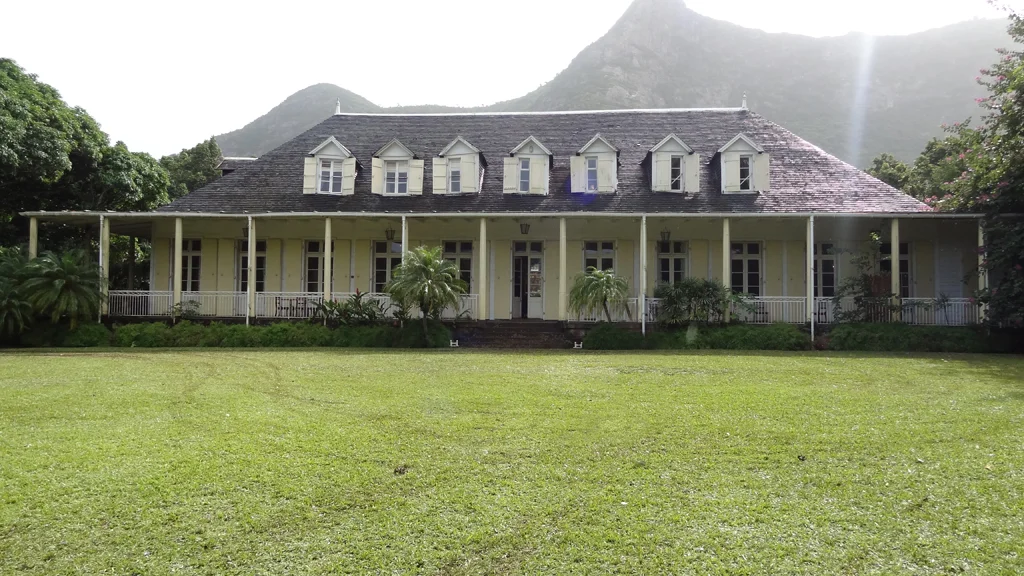
Eureka is a large 19th-century Creole housee century transformed into a house-museum, in Moka, at the foot of Mount Ory.
Visitors can freely explore the enfilade of period-furnished rooms, furniture from the East India Company, an antique piano, a colonial bathroom, and an upper floor that served as a dormitory for the family's children. The house is famous for its 109 doors and windows and its veranda opening onto the park.
The estate does not stop at the house. Behind the garden, a path descends a ravine to the Moka River, which has carved natural pools under several waterfalls.
A restaurant serves Mauritian cuisine under the veranda.
Allow about half a day to do everything without rushing.
About fifteen minutes from Port LouisThe road leaves the hustle and bustle of the capital, climbs towards the plateau, and winds into a tree-lined avenue. At the end, a long wooden house sits on a lawn, with Mount Ory as a backdrop. Eureka is one of the few Creole houses from the sugar era to have remained standing, furnished, and open to the public.
Most visitors come for the house and its famous 109 doors and windows. Many leave without realizing that at the bottom of the garden, a path leads down to the Moka River and its waterfalls. Yet this is one of the two halves of the estate, and probably the one that is least discussed. This article covers both, with up-to-date practical information and, where sources contradict each other, different perspectives rather than a definitive answer.
Summary
- A house born from the sugar era
- 109 doors and windows: architecture designed for the climate
- The house tour
- The waterfalls of the moka River
- The garden and the rest of the estate
- Lunch under the veranda
- Where is Eureka and how do I get there?
- Useful information
- What to see around Eureka
- Frequently Asked Questions
- Photos
A house born from the sugar era
Eureka was built in the 1830s, at a time when the Moka region's economy was based on sugar. It belonged to the same family, the Le Clézios, for over a century before becoming a museum in the 1980s. Beyond this foundation, several aspects of its history vary from one source to another, and it must be clearly stated: no one has definitively settled them with documented evidence.
The construction date is still being discussed.
The sources give two dates: around 1830 for some, around 1836 for the others, none cites any supporting documents or archives. The discrepancy is slight and inconsequential for the visit, but it clearly illustrates how descriptions of the site have been copied from one another for years. Remember "in the 1830s".
Who built the house?
Here again, two versions circulate. The first attributes the construction to a british aristocrat named Mr. CarrWho would have liked to settle near the Reduced, the governor's residence. The second directly assigns the command to Sir Henri Le Clézio — the spelling of the name itself varies, Le Clézio or Leclézio.
These two versions are not equally compatible with the rest of the story, since the Le Clézio family is most often described as having acquired the house in 1856, and not as having had it built. The "British aristocrat then purchase" version is therefore the most consistent, but it is not yet proven.
The name, and the exclamation that supposedly inspired it
The name is said to come from the exclamation attributed to Archimedes, uttered by the man who discovered the house and recognized it as the home of his dreams. Sources vary on the identity of this man. Alexis Jules Eugène Le Clézio and François Alexis Le ClézioThey are sometimes presented as father and son, sometimes as one and the same Person. the anecdote is charming and Systematically repeated; its genealogical details, however, are unreliable.
From Le Clézio to Maroussem
The Le Clézio family built their fortune on the sugar industry and retained ownership of the estate for approximately 120 years. The date when the house was removed from the family's possession is contradictory depending on the source: 1975, 1984, 1985 or 1986.
The most detailed account describes a sale in 1975 to two real estate agents, who supposedly only kept the house for two months before Jacques Planteau de Maroussem and his in-laws bought it back—Jacques's mother-in-law being the granddaughter of Sir Henry Le Clézio, thus bringing the estate back into the family. The transformation into a house-museum, however, is almost always dated to 1986The site is currently run by the Maroussem family.
What these versions have in common is worth noting: Eureka narrowly escaped demolition, like many Creole houses on the island that have since disappeared. Its preservation is far from guaranteed, and this is what most visitors appreciate today. For context, see our page on the history of Mauritius and the one dedicated to the sugar Adventure.
What Eureka Owes to JMG Le Clézio
Nobel laureate Jean-Marie Gustave Le Clézio is descended from this family, and the estate nourishes his Mauritian imagination. One detail, however, often overlooked in tourist summaries: the writer did not live in EurekaThe House belongs to the history of his ancestors, not to his personal biography. It is associated with his work, particularly with Gold digger, and to the formula "Eureka, in its green setting" which is attributed to it.
109 doors and windows: architecture designed for the climate
The house's 109 openings are not a builder's whim: they serve to circulate air. In a tropical climate, before air conditioning, cross ventilation was the only way to make a large house livable. Multiplying doors and windows meant capturing the trade winds and continuously expelling heat.
Doors, or doors and windows?
The figure of 109 is constant from one source to another, but its object is not: most speak of 109 doors and windows, some of 109 doors alone. The first formulation is by far the most widespread and the most likely for a house of this size.
The veranda
The veranda—the local name for a covered porch—runs the entire length of the facade and curves back at the corners. The number of sides it covers varies depending on the description, some mentioning three sides, others a full turn. It is what gives the house its low, elongated silhouette, and it is beneath it that the restaurant tables are located.
It also plays a technical role: by extending far in front of the walls, it protects the woodwork from the rain and keeps the rooms in the shade all day.
The timbers of the framework
The house is built almost entirely of wood. The woods mentioned are ebony and mahogany for the structure and woodwork. one Isolated source claims that some beams are made of tambalacoque, this endemic tree whose history is linked to that of the dodoThe information is not repeated anywhere else and should be considered a hypothesis to be verified on site with the owners — if it is confirmed, it is a remarkable detail.
The house tour
The tour is conducted room by room, first on the ground floor and then upstairs, and lasts on average between 45 minutes and an hour, not including the garden. A guided tour is available in French and English; it is also possible to explore on your own.
The adjoining living rooms and the furniture
The ground floor features several adjoining lounges, a large dining room with a set table, bedrooms, and an old-fashioned bathroom equipped with a colonial-era shower system, which always surprises visitors.
The furnishings are the highlight: pieces from the East India Company, antique maps, porcelain, engravings, paintings, yellowed family photographs, and a Pleyel piano. The collection is not a museum recreation but the actual accumulation of several generations in the same house.
The upper floor and the children's dormitory
The upper floor notably houses a large dormitory. It is believed to have been used to house the seventeen children henry Le Clézio's figure — a number repeated by several sources, without supporting documentation. The total number of rooms in the house, however, is given so contradictorily by different sources — from fourteen to forty — that no figure can be given.
A home more than a museum
It's important to know what to expect: Eureka doesn't operate much like a traditional museum. Signage is minimal, there are no labels in front of every object, and visitors can move around the rooms quite freely. Most visitors appreciate this approach, which gives the impression of entering a family home rather than an institution.
A minority find it difficult and leave frustrated, lacking explanations. If you want to understand what you're watching, take the guided tour rather than the free path: That's where most of the information passes through. Most of the other museums and historical sites of the island operate in a more conventional way.
The waterfalls of the moka River
At the far end of the garden, a path descends into the ravine to the Moka River, which has carved out natural, swirling pools beneath its falls. This is the part of the estate least described, yet it's the one visitors most often cite as their best memory. It's included in the entrance fee.
Access is only through the house
There is no other way in: to reach the waterfalls, you must go through the property and pay the entrance fee. Access via the ravine is closed—the riverbanks are private property, the opposite slope is blocked by the gates of a residence, and the area is monitored. Some visitors report being stopped by a security guard after attempting to walk upstream from outside the property.
This has an important practical consequence: the waterfalls are only accessible during the estate's opening hours., from Monday to Saturday until 4:30 p.m. Some online listings present them as accessible twenty-four hours a day, which is misleading — these are points marked on a map, not a freely accessible site.
How many waterfalls?
The testimonies speak of three or four waterfalls according to visitors. The most likely explanation for this discrepancy is that the last waterfall is significantly more difficult to access than the previous ones, and not everyone attempts it. Several accounts describe a progression: the first two easy, the third moderate, the fourth tricky.
The condition of the trail
The trail is steep, rocky, and slippery, especially after rain—which is often the case at this altitude. Closed-toe shoes with good soles are essential, and flip-flops are not recommended. Both the descent and ascent require a reasonable level of fitness; the route is not suitable for people with reduced mobility or for strollers.
The ravine's vegetation is dense and harbors mosquitoes. Repellent is strongly recommended; this is the most frequent piece of advice given by visitors. See also our page on hiking in Mauritius.
When to go during the day
The advice given on site is to do the stunts firstBefore visiting the house, you'll go inside. It's cooler, less hot, the light is better at the bottom of the ravine, and you'll encounter far fewer people. The house and lunch come next, which reverses the usual order but works much better.
Allow a good hour to an hour and a half for the round trip to the first waterfalls, more if you go all the way to the last one and take a swim. Other waterfalls of the island are more easily accessible, but few are located at the back of a colonial house garden.
The garden and the rest of the estate
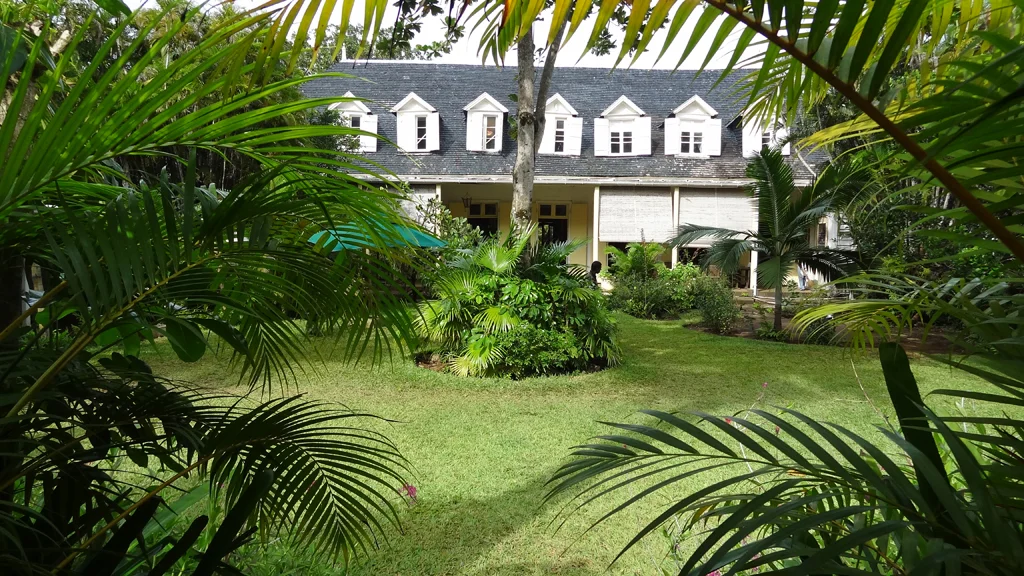
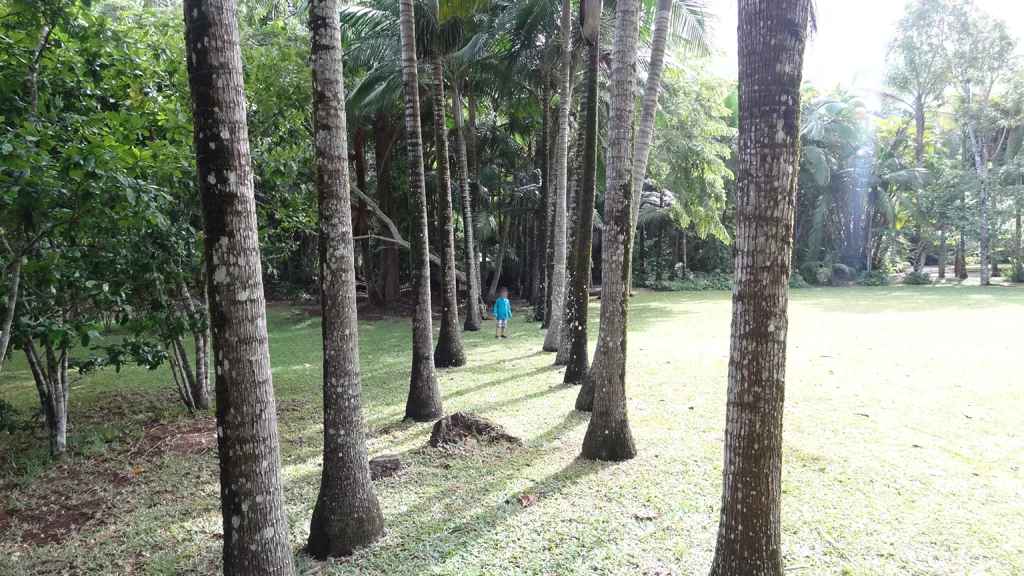
The park can be visited freely and is an integral part of the site's appeal. It brings together dozens of exotic and endemic species, a legacy of the enthusiasm of the 19th-century owners.e century for botany, as well as century-old mango trees. The view of Mount Ory from the lawn is the most photographed view on the estate — some descriptions mention rather the neighboring mountain range as a backdrop, the relief of Moka can be read differently depending on where you stand.
The estate also includes independent cottages located within the grounds. At the time of writing, these accommodations are closed for renovationWith no reopening date announced. A souvenir shop offers Mauritian teas, spices and scented candles.
Lunch under the veranda
Eureka's restaurant serves traditional mauritian cuisine under the veranda, overlooking the garden. it's one Of the most universally appreciated features of the place, to the point that many visitors come as much for the meal as for the restaurant itself.
The map gives pride of place to curries and to dishes that reflect the island's influences. Portions are described as generous. Visitor feedback places a set menu around 500 to 600 rupees and drinks between 150 and 300 rupees, but these amounts come from visitor reviews over time and not from a published menu: treat them as a rough guide, not a fixed price.
Booking is recommended.The restaurant is regularly fully booked. The venue also hosts receptions and weddings, which can sometimes require use of the veranda. To learn more, see our page on mauritian gastronomy.
Useful information
Schedules
The domain is open from 9:00 AM to 4:30 PM Monday to Saturday, and closed on SundayThese Times are those published by the establishment on its professional profile in july 2026, and they are the most reliable available.
Warning: Many travel websites still advertise different opening hours—9am to 5pm, Sunday opening from 9am to 3pm or 3:30pm, or even seven days a week. This information is outdated or incorrect. If in doubt, call.
Prices
The entrance fee is not published on any verifiable official source, and this is the most uncertain point in this article. Visitor testimonials mention 300 rupees or 400 rupees per person depending on the season, while a French-language website advertises €15 per adult and €8 per child aged 5 to 12 — an amount that doesn't match either of the previous two. It's unlikely that these prices are correct.
What consistently stands out is that the ticket grants access to the house, the park, and the waterfalls, and card payments are acceptedThe price of a guided tour may differ from that of self-guided access. Please check the current price by phone before traveling.
How much time should I allow?
Allow approximately one hour for the house alone, two hours for the house and garden, and one half-day full if you add the waterfalls and lunch, this Is the format we recommend: the Area is not well suited to a rushed visit between two other stops.
Accessibility
The property is listed as wheelchair accessible, but this statement requires some qualification. The house is a historic building: it has steps, an upper floor, and some uneven, old flooring. The park is accessible on its flat sections. The waterfall trail, however, is not at all. See our guide to holidays in Mauritius for people with disabilities.
What to pack
- Closed shoes are recommended if you plan to walk down to the waterfalls.
- Mosquito repellent is essential in the ravine.
- Something to dress for: the plateau is cooler and rainier than the coast
- A swimsuit, for natural pools
Contact
Phone : +230 433 8477The estate no longer has its own institutional website — the historically used address is no longer active. Please call for any information regarding prices, opening hours, or restaurant reservations.
Where is Eureka and how do I get there?
Eureka is located in Moka, in the center of the island, on the heights overlooking the river of the same name. It is one of the few major tourist sites of the center of Mauritius, a region that visitors often pass through without stopping.
Access by car
The house is listed as A landmark since moka, but the address appears under several names Depending on The Source: Dr. Georges Leclézio avenue, Eureka Lane, Or Mount ory road. the estate is located off the main road, on a side street, which explains why some visitors spend a while looking For it. rely on the map on this page rather than searching by Name: the online listings for the estate are duplicated and poorly positioned.
Private parking is available on-site, at the entrance to the property. Parking is generally not a problem, even during lunchtime. If you do not have a vehicle, please consult our guide to... car rental in Mauritius.
By taxi or public transport
Moka is well-connected to Port Louis, Curepipe, and Quatre Bornes. Several visitors report having arrived by local bus without difficulty, the last leg being a walk. taxi remains the simplest solution, and ride-hailing apps cover the area.
The climate of the plateau
Moka is located on the central plateau, which is cooler and wetter than the coast. The temperature difference with the coast can be several degrees, and rainfall is significantly more frequent. It's pleasant for hiking, but this makes the waterfall trail slippery for much of the year. See our page on the weather in Mauritius.
What to see around Eureka
Eureka combines easily with other sites in the central and northern regions, all within a thirty-minute drive.
- The Pieter Both, an iconic mountain in the Moka massif, visible from the road
- Port Louis and its Aapravasi Ghat, at a quarter of an hour, to extend the reading of the sugar era
- The Deer Hole and the curepipe Botanical Garden, going back up the plateau
- The Labourdonnais castle and the Aubineaux estateFor those whom colonial residences are interested
Frequently Asked Questions
Is Eureka open on Sundays?
No. The estate is closed on Sundays according to the schedule published by the establishment in July 2026. Several travel websites still advertise Sunday opening: this information is outdated.
Are the waterfalls included in the ticket Price?
Yes. Access to the ravine and waterfalls is included in the entrance fee, just like the house and the park.
Can we go to the waterfalls without going through the house?
No. The estate is the only access point. Other approaches are blocked or private, and the area is monitored. Therefore, the waterfalls are only accessible during Eureka's opening hours, Monday to Saturday until 4:30 pm.
How many waterfalls are there?
Three or four, according to visitors. The difference is likely explained by the increasing difficulty of the trail: the last waterfall is significantly more difficult to reach than the previous ones, and many stop before.
Is it possible to swim?
The river has carved out natural pools beneath the falls, and swimming is popular there—many visitors locate it at the fourth waterfall, the furthest away. The rocks are slippery and the bottom uneven: caution is advised, especially since the site is unsupervised.
Do we need to book in advance?
Not for sightseeing. For lunch, yes: the restaurant is frequently full and reservations are recommended.
Is a guided tour necessary?
It is highly recommended. Signage within the house is minimal, and most of the historical information is conveyed through the guide. This is the difference between a pleasant stroll and a true understanding of the place.
Is it possible to sleep there?
The estate includes independent cottages in the park, but they are closed for renovation at the time of writing, with no reopening date announced.
Did JMG Le Clézio live in Eureka?
No. The writer is descended from the family that owns the estate, and it permeates his work, but he never lived there. This confusion is common in tourist presentations of the site.
How much time should be Allowed?
One hour for the house alone, two hours with the park, half a day if you add the waterfalls and lunch.
Is the site suitable for children?
The house and grounds are easily accessible with children. The waterfall trail, however, is steep and slippery: it's suitable for children who are already comfortable hiking, and definitely not for strollers.
The information in this article is provided for guidance purposes only. The author and publisher accept no responsibility for the accuracy of the information provided. It is recommended that you verify the information directly with local operators or the relevant Mauritian authorities during your stay. See the Terms of Use (Article 12).
(The photos you send will only be used to complete this page and will never be used commercially outside of this site without your permission)
To share your Mauritius vacation photos with friends, family, and colleagues, we offer a free, personalized webpage dedicated to your trip. Simply share the webpage address, for example, www.ilemaurice-im/vacancesdepierreetmarie, with anyone you'd like to share your photos with.
It's very simple, just click on the button below.
More information:
Rent a car
Book a hotel or villa
Buy an airplane ticket
Paid
7-day weather forecast
Opening hours: Monday to Saturday 9:00am – 4:30pm
Closed on sundays
Ride
Accessible to children and strollers (except for the waterfall)
Wheelchair accessible (partially)
Parking
On-site catering
Bus routes: Click here
Your advertisement on this page?
Do you want to display an advertisement for your business on this particular Page (or elsewhere on the Site)?
Thank you for contacting us by click here.
Contribute to and improve this page
We want to provide internet users with the most relevant and complete information, so if you would like to add to or modify this page (text, photo, etc.), or even report an error, please do not hesitate to contact us by sending an email to the following address: contribuer@ilemaurice.im
(remember to clearly indicate the page to which your contribution relates)
(The photos you send will only be used to complete this page and will never be used commercially outside of this site without your permission)
Tested by writing
We visited a few years ago; the house wasn't in perfect condition, and we didn't see the waterfalls.