
Mauritius seen from space in HD
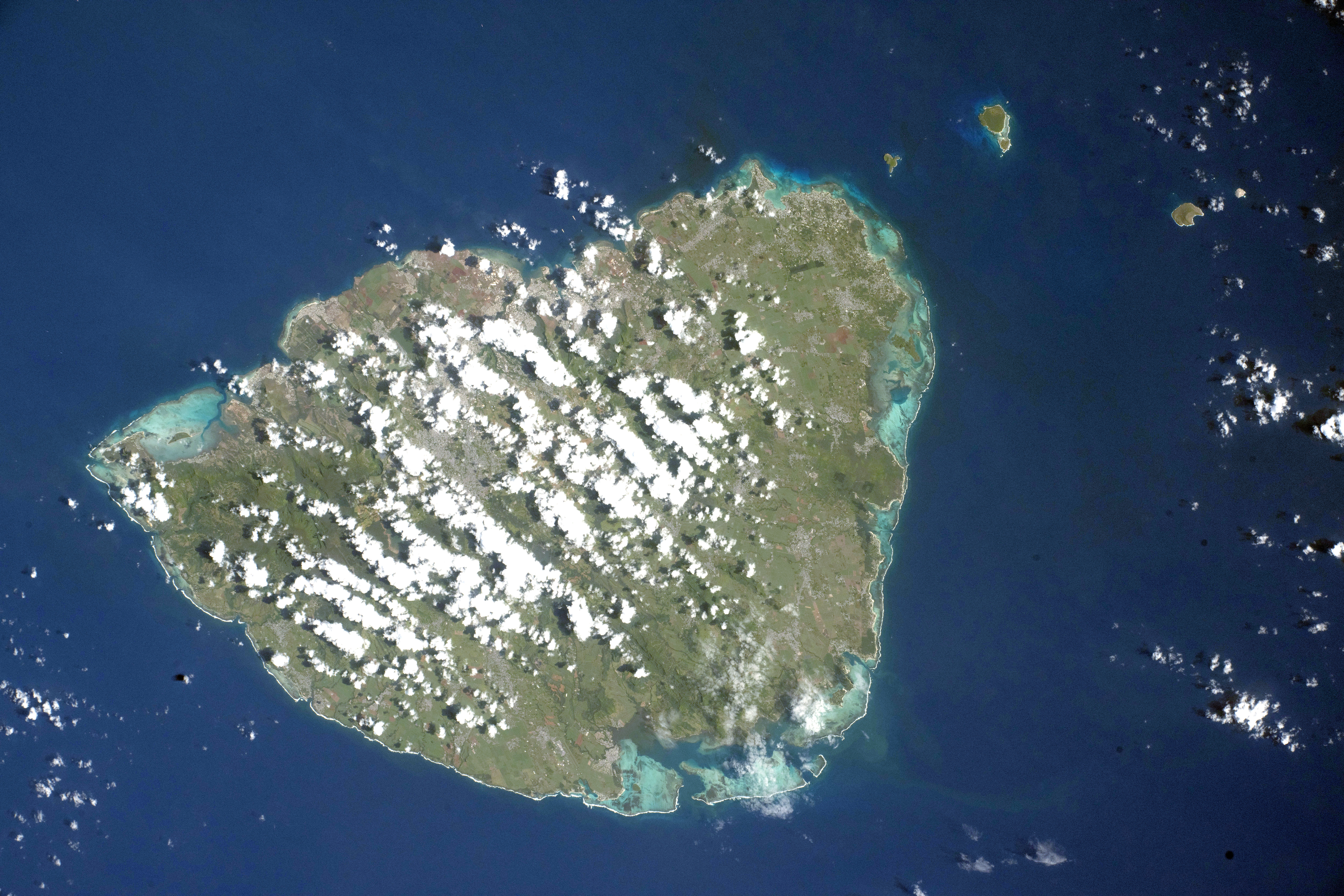
Viewed from the International Space Station, Mauritius is contained entirely in a single image. At first glance, one sees mainly a green mass streaked with clouds, resting on the deep blue of the Indian Ocean. But by zooming in on the photo below, the island reveals itself: its coastline, its lagoon, and its major landmarks gradually come into view. Here is a guide to recognizing Mauritius's iconic locations from orbit.
Recognizing iconic locations from orbit
Before going into detail, a word of honesty: that day, bands of clouds covered part of the island, particularly the central highlands. Some areas therefore remained obscured, and no landmarks were identifiable at that altitude. What could be discerned were the main shapes: the headlands, the bays, the edge of the lagoon, and the white line of the reef.
The north and its islets. At the top of the image, detached from the coast, a few points of land emerge from the blue: these are the northern isletsAmong which the Corner of the Sight, recognizable by its silhouette. Just opposite, on the main island, lies the most touristy region of Mauritius, around Grand Baie and Cape Unhappy, the northernmost point.
The west coast and Port Louis. On the left side of the island, where the terrain softens towards the sea, lies nestled Port LouisThe capital, whose lighter and denser patch contrasts with the surrounding green. This is the leeward coast, drier and more sheltered.
The southwest and Le Morne. At the lower left tip, a peninsula juts out into a lagoon with clearer waters: This is the region of Morne Brabant, listed as a UNESCO World Heritage Site, one of the most iconic landscapes on the island.
The east and Île aux Cerfs. On the right flank, the lagoon widens into a long turquoise band, particularly visible where the clouds part. This is the east coast, fringed by reefs, where you'll find, among other things... deer Island and its renowned lagoon.
The southeast, Mahébourg and Blue Bay. Towards the bottom of the island, a wide indentation marks the entrance to the bay of Mahébourg, the historical cradle Of Mauritius. it is in this region that the marine park of Blue Bay, one of the most beautiful waters on the island.
The wild south. Further down, the coastline changes in character: the light edge of the lagoon disappears, as the coral reef ends. Here, near Gris Gris, the ocean crashes directly against the cliffs, without a lagoon to temper it.
The coral reef. Finally, look at the island's outline: along most of its coastline runs a thin white line, where the ocean waves break. This is the coral reef, which almost entirely encircles Mauritius and creates the lagoon. Its health determines the beauty of these waters, which can be explored up close in snorkeling.
Now it's your turn: zoom in on the photo, move around, and touch the numbered points to identify each location.
 👆 Touchez pour explorer la photo
Photos: Mauritius as seen from the International Space Station. Credit: ESA/NASA – S. Adenot. Images shared on the occasion of World Oceans Day.
The information in this article is given for information purposes Only. the author and publisher assume no responsibility for the accuracy of The information mentioned. it is recommended to verify information directly with local operators or the relevant mauritian authorities during your stay. See the Terms (Article 12).
Info +:
Rent a car
Book hotel or villa
Buy a plane ticket
Paying
7 day Weather forecast
Walk and hike
Accessible child and stroller
Wheelchair accessible
Parking
Public toilets
Fast food outside
Bus routes: Click here
Your advertising on this page?
Want to display an ad for your business on this particular page (or elsewhere on the site)?
Please contact us in click here.
Contribute, improve this page
We want to provide the most relevant and complete information to internet users, so if you want to add something or modify this page (text, Photo, etc.), Or even report an error, do not hesitate to contact us by sending us an email to the following Address: contribuer@ilemaurice.im
(remember to clearly indicate the page concerned by your contribution)
(the photos sent will only be used to complete this page and will never be used commercially outside of this site without your consent)