
Blue Bay
Blue Bay, a white sand beach facing the immense turquoise lagoon of the marine park
 The essentials in a few words
Blue Bay is a public beach in the southeast of Mauritius, near Mahébourg and the airport.
White sand, clear water, calm and shallow lagoon: this is one of the easiest beaches on the island for swimming with children.
The swimming area is delimited by a line of yellow buoys, beyond which boats travel.
The lagoon is part of the blue Bay Marine ParkMarine protected area and Ramsar site.
You can see corals and fish with just a mask, or from a glass-bottom boat which starts from the beach.
Parking right opposite the sand, public toilets, Mauritian food stalls in the parking lot.
In the southeast of Mauritius, a fifteen-minute drive from the airport, Blue Bay boasts a white sand beach on one of the island's most beautiful lagoons. The water shifts from pale green to turquoise, then to deep blue, reaching the white line of waves breaking on the reef. In the middle, the island of Deux Cocos sits atop the lagoon, its small patch of greenery atop the shore. It's one of the most beautiful beaches in Mauritius, and one of the easiest to enjoy: the water remains calm and shallow throughout the swimming area, and children can play safely under the watchful eyes of their parents on the sand.
Beneath the surface begins the Blue Bay Marine Park, 353 hectares protected since the late 1990s and classified as a wetland of international importance. Coral reefs stretch out just a few meters below the surface, surrounded by schools of fish that can be observed with a mask or through the window of a glass-bottom boat. And when it's time to eat, the stalls set up in the parking lot, just opposite the beach, serve simple and inexpensive Mauritian cuisine, which can be enjoyed sitting on the sand, facing the lagoon.
Summary
Blue Bay Lagoon
Blue Bay lives up to its name. From the beach, the lagoon unfolds like a series of colored bands: an almost white green at the edge, where the water barely covers the sand, then a vibrant turquoise, and finally a deep blue where the seabed slopes down. At the very back, a line of white foam stretches across the entire horizon: these are the ocean waves breaking on the coral reef. It is this reef that makes Blue Bay a tranquil basin, untouched by the swell from the open sea.
The water's transparency is the first thing that strikes you. Near the shore, you can see the sand rippling beneath the surface, striated by the sun's reflections, and darker patches dot the seabed. Further out, the lagoon remains relatively shallow, ranging from 1 to 6 meters depending on the location: deep enough for corals to thrive, but shallow enough for sunlight to reach them.
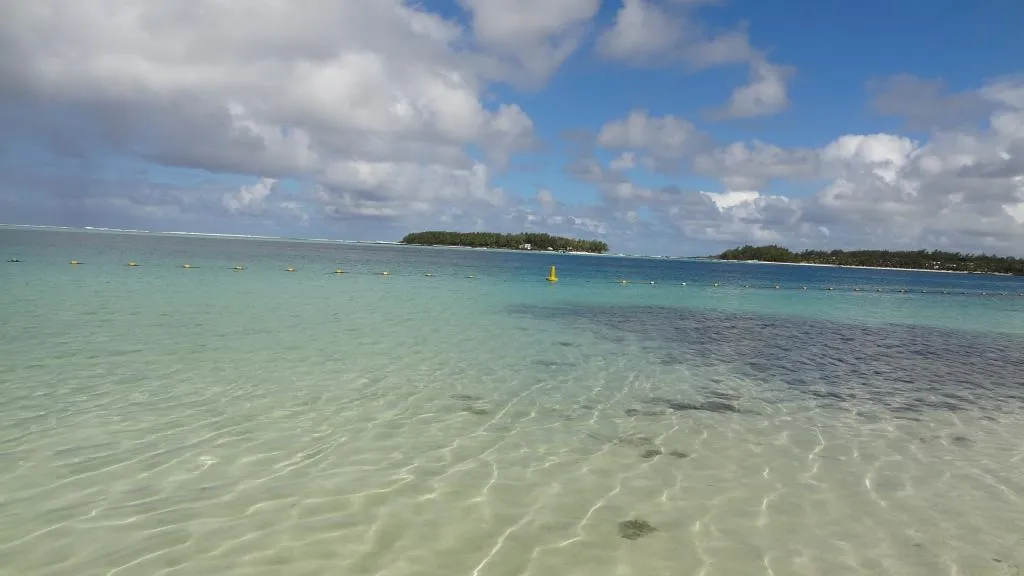
two Coconut Island on the horizon and the Blue Bay lagoon from the shore: a few centimeters of transparent water on the sand, then turquoise and blue all the way to the reef
Two green silhouettes frame the landscape: the island of Deux Cocos, in the middle of the lagoon, and the wooded coast of the neighboring peninsula. Between the two, the eye travels to the reef. It is this panorama, even more than the beach itself, that makes Blue Bay one of the most iconic images of Mauritius.
The beach
Blue Bay's public beach is a strip of fine white sand that forms a large arc around the lagoon and slopes gently down to the water. The sand is clean, with no pebbles or rocks at the water's edge, and entering the lagoon is like stepping into a shallow, flat-bottomed swimming pool.
At the top of the beach, the trees, walls, and houses lining the sand cast their shadows in places. These shadows shift throughout the day: depending on the time of day, they can be found on one side or the other of the bay, varying in width. Often, simply walking along the beach is enough to find a sheltered spot, but a hat and sunscreen remain essential, especially with children.
Facing the beach, a string of yellow buoys traces a line across the water, punctuated by a few large conical buoys. This isn't just for decoration: it marks the boundary of the marine park's swimming area. Within this zone, you can swim without encountering a single boat. Beyond it begin the boat lanes, and this is where the boats that take visitors out onto the lagoon anchor.

Blue Bay beach and its swimming area marked by yellow buoys; beyond, the boats at anchor
The atmosphere changes drastically from day to day. During the week, the beach is quiet, shared between a few families, vacationers from neighboring villas, and touts for boat trips. On weekends and public holidays, Mauritian families settle in for the day, bringing coolers, mats, and cooking pots: Blue Bay then transforms into a large, noisy, and joyful open-air picnic, revealing much about how Mauritians experience their beaches. For a more tranquil beach experience, it's best to come during the week and in the morning.
Like all public beaches in Mauritius, Blue Bay is freely accessible, with no entrance fee. To understand what this status entails, see our guide on access to beaches in Mauritius.
Swimming with children
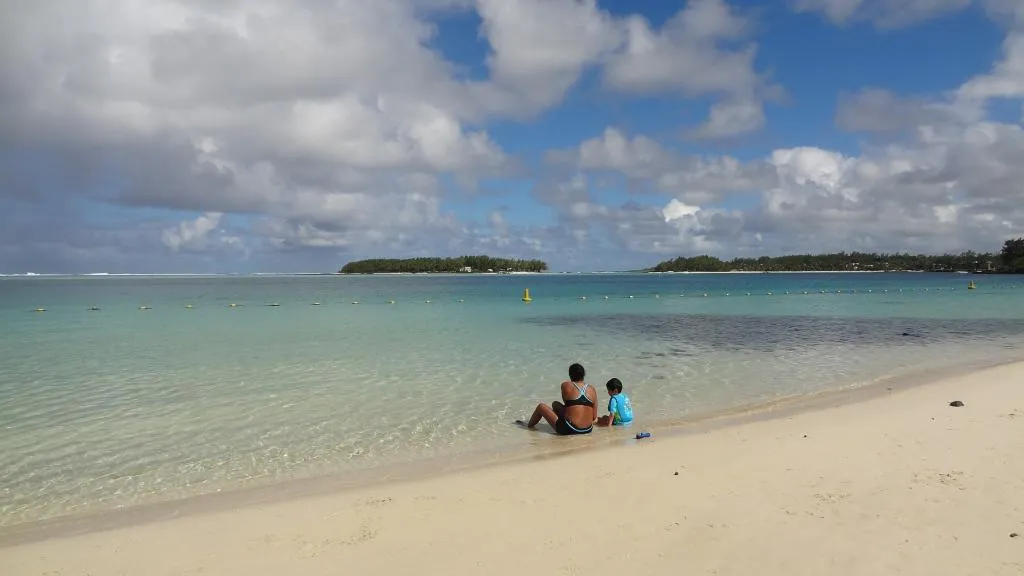
Blue Bay is one of the easiest beaches in Mauritius for swimming with children. The water is shallow throughout the swimming area, the lagoon remains calm thanks to the reef, and no boats are allowed within the area marked by yellow buoys. Toddlers can play sitting in just a few centimeters of water, while older children splash around a little further out without ever losing their footing suddenly.
At the edge of Blue Bay beach, you can sit in a few centimeters of clear water
Some precautions apply to Blue Bay as to any tropical lagoon:
- Water slippers for children who venture towards the dark patches at the bottom, where there may be sea urchins.
- A UV-protective t-shirt, a hat, and sunscreen : the shallow water and white sand reflect a lot of light, and the shadow of the upper beach moves with the time.
- Stay within the buoys Beyond this point, swimming is prohibited and boats are allowed to circulate.
The beach is also accessible with a stroller, as the parking lot is located right in front of the sand.
Blue Bay Marine Park
The Blue Bay lagoon has been protected since the late 1990s. It was first declared a national park in October 1997, then a marine park in June 2000, under the Fisheries and Marine Resources Act of 1998. On January 31, 2008, it became the second Mauritian site listed under the Ramsar Convention, which designates wetlands of international importance. It covers 353 hectares.
This protected status is due to the richness of its marine life: coral reefs between 1 and 6 meters deep, seagrass beds, mangroves, and a whole host of marine life that finds refuge there. The site's Ramsar listing also indicates the presence of the green sea turtle, an endangered species, and the lagoon's role as a nursery for the juveniles of numerous species. The park is also known for a giant brain coral measuring 6 to 7 meters in diameter, which is mentioned in the site's promotional materials.
The published inventories differ significantly. The Ramsar site lists 38 coral species and approximately 72 fish species. A 2012 inventory conducted for the Ministry of Fisheries and the UNDP identifies many more: 108 coral species, 233 fish species, and 201 mollusk species. The discrepancy is mainly due to the survey methods and dates. For visitors, however, it makes no difference: Blue Bay remains one of the best places on the island to see live coral without leaving the lagoon.
The park is not entirely safe, however. On July 25, 2020, the bulk carrier MV Wakashio ran aground on the Pointe d'Esny reef, very close to the park, and spilled several hundred tons of fuel oil into the southeastern lagoon. Official communications at the time indicated that the marine park had been spared thanks to the emergency deployment of floating booms; some press articles, on the contrary, speak of a disrupted ecosystem, and no public study appears to have precisely measured the long-term effects on the park. Furthermore, the marine conservation services of the Ministry of Fisheries maintain coral nurseries within the park to rehabilitate degraded areas.
What you see with a mask
All you need is a mask and snorkel to explore the underwater world of Blue Bay. From the beach, by staying within the swimming area, you can easily find spots where fish gather around the darker patches on the seabed. It's the simplest way to introduce children to underwater observation, without a boat or deep water.
The most spectacular coral reefs are located further out, beyond the swimming area. They can be explored on a boat trip with a snorkeling stop: authorized boats moor at designated buoys, and swimmers enter the water among the fish. For equipment and best practices, see our guide to snorkeling in Mauritius.
Park rules
At Blue Bay, swimming is only permitted in the area marked by yellow buoys. This is the rule that most directly affects visitors, and it is established by the 2001 regulations on marine protected areas. These regulations divide the park into several zones, including two strict conservation areas closest to the beach, a 146-hectare conservation area encompassing Île des Deux Cocos, and a multi-use area beyond the reef.
Throughout the park, the 2001 regulations prohibit, among other things:
- swimming outside the designated swimming area, marked on the wide side by the line of yellow buoys;
- to remove or kill any marine animal or plantDead or alive, including shellfish;
- to feed the fish ;
- to fish or to have fishing equipment on oneselfExcept for fishing from certain sections of the shoreline;
- to throw anything away other than in the designated bins;
- to use a boat, kayak or pedal boat in the swimming area.
Boats, however, must have a permit, use only marked channels, not exceed 3 knots, and only allow swimmers in the water under flag "A" (the white and blue flag indicating divers). This is why boat trips must be booked through an authorized operator: you cannot rent a boat to go out to the coral reefs on your own.
The Fisheries Act 2023, which replaced the 1998 law, adds prohibitions applicable in all Mauritian waters: damaging or removing coral, possessing coral (even dead), possessing sea urchins, and swimming with, feeding, or harassing sea turtles. On this last point, see our guide on dolphin, turtle and whale watching.
The glass-bottom boat
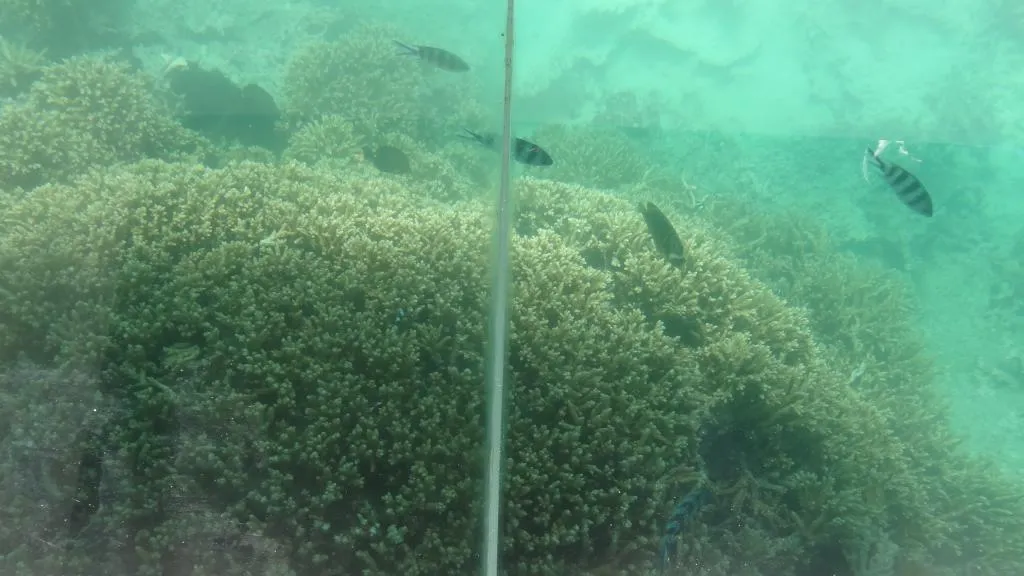
The glass-bottom boat allows you to see the corals of Blue Bay without getting wet. The trips depart directly from the beach and slowly glide over the coral formations, which you discover through the glass hull: large bushes of branching coral, and the fish that swim around them.
The branching corals of the marine park, seen through the glass bottom of the boat
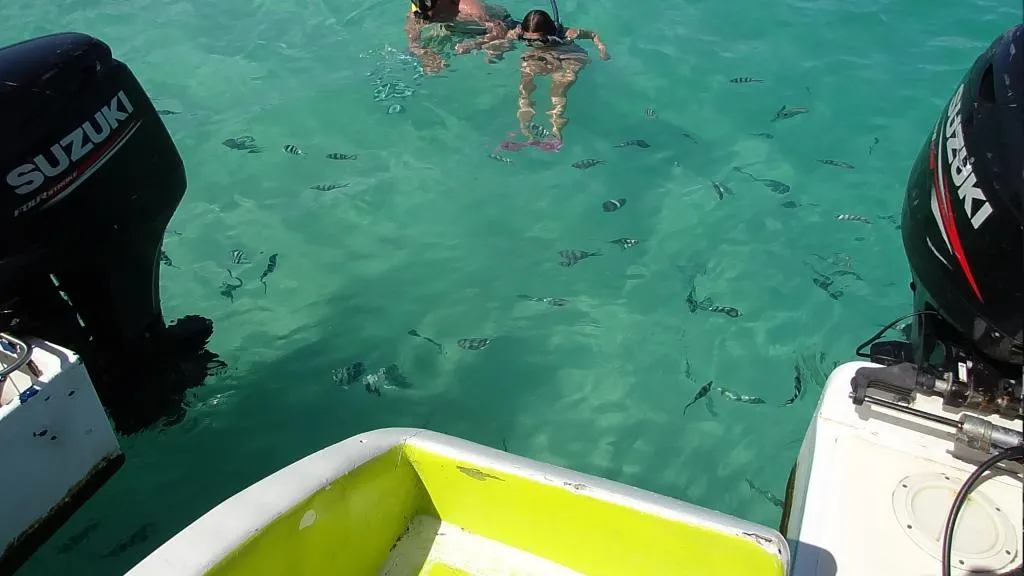
Most trips include a stop for snorkeling. The fish, accustomed to visitors, then come right up to the swimmers, even to the back of the boat.
Snorkeling stop during a glass-bottom boat trip: fish swim around the bathers
Details, duration, and tips for choosing your outing: everything is explained on our dedicated page. glass-bottom boat trip in Blue Bay.
Eat overlooking the lagoon
Blue Bay has an advantage that few beaches on the island can match: you can eat well, cheaply, without leaving the sand. In the parking lot, right across from the beach, a few street food stalls serve Mauritian dishes prepared on the spot. You order at the counter, walk across, and settle down on the sand, your feet almost in the water, facing the vast lagoon.
This is your chance to taste authentic Mauritian cuisine, just like the locals eat it, far from hotel restaurants, and for a fraction of the price. To discover the island's best dishes before ordering, see our feature on mauritian gastronomy.
If you prefer a table, there are a few restaurants in the nearby streets, and Mahébourg, a few kilometers away, offers a wider choice.
Around Blue Bay
Blue Bay combines easily with other sites in the southeast, all just a few minutes away by car or boat.
The Island of Two Coconuts
It's the wooded islet visible from the beach, in the middle of the lagoon. Presented everywhere as a private island, it can only be visited as part of organized day trips, including swimming, snorkeling, and lunch. It lies entirely within the marine park's conservation area.
Pointe d’Esny
Just north of Blue Bay, the public beach of Pointe d'Esny it unfolds as a long stretch of sand lined with villas, facing one of the island's largest lagoons. More discreet than Blue Bay, it's also a kitesurfing spot when the trade winds blow.
Egret Island
Off the coast of Pointe Jérôme, egret Island it is a 26-hectare nature reserve managed by the Mauritian Wildlife Foundation. It can only be visited with a guide, to see the original coastal forest, giant tortoises and endemic birds such as the pink pigeon.
Mahébourg
Less than 6 Kilometers away along the coastal road, Mahébourg is the small historic town in the southeast. Visitors can explore the national history museum, we stroll along the seafront, and the rault biscuit factory he still makes his cassava biscuits there.
To complete these steps in a single day, see our southern circuit: Mahébourg and Blue BayAnd for an overview of the region, see our profile of the south of MauritiusAll the locations are also on our tourist map of Mauritius.
Practical information
Access and parking
Blue Bay is located in the far southeast of Mauritius, in the Grand Port district, about a 15-minute drive from the international airport and less than 6 kilometers from Mahébourg via the coastal road along Pointe d'Esny. The car park is located directly opposite the beach: you can go from your car to the sand in just a few steps.
By bus, local lines connect Blue Bay to the Mahébourg bus station, from where buses depart for the rest of the island. The proximity of the airport makes Blue Bay an ideal stopover on arrival day or before a return flight later in the day.
Toilets and facilities
The beach has public toilets, a car park and food stalls in the car park. It is accessible with a stroller and wheelchair.
Where to sleep
Blue Bay isn't a large resort town like Grand Baie or Flic en Flac. It mainly consists of villas, apartments, and guesthouses, along with a few hotels on the nearby coast. Mahébourg, very close by, offers more budget-friendly options. It's a good base for those seeking tranquility, a stunning lagoon, and proximity to the airport, rather than nightlife.
When to come
Blue Bay can be visited year-round. From April to June and from September to December, temperatures are mild and rainfall moderate, making these the most pleasant times. From June to October, the southeast trade winds blow more strongly on this coast: the beach remains pleasant, but the water can be a bit rougher and cooler. From January to March, it's the hot and humid season, with a risk of cyclones. In terms of crowds, weekdays and mornings are the quietest times. For month-by-month details, see our page on the weather in Mauritius.
Frequently Asked Questions
Is Blue Bay beach suitable for children?
Yes. Blue Bay is one of the easiest beaches in Mauritius for children: the water is calm and shallow throughout the swimming area, and no boats are allowed. Water shoes are recommended for areas where the seabed is darker.
Is there any shade on Blue Bay beach?
Yes, in some places. The trees, walls, and houses at the top of the beach cast their shadows on the sand, but these shift throughout the day: depending on the time of day, you sometimes have to walk along the beach to find a sheltered spot. A hat and sunscreen are still recommended.
Do you have to pay to access Blue Bay beach?
No. Blue Bay is a public beach, freely accessible. Only activities offered by operators, such as boat trips, are subject to a fee.
Is it possible to go snorkeling from Blue Bay beach?
Yes, in the swimming area marked by the yellow buoys, where you can easily spot fish with a mask. The richest coral reefs are located beyond and can be explored on a boat trip with a snorkeling stop.
Is it possible to swim to Deux Cocos Island?
No. In the Blue Bay Marine Park, swimming is only permitted in the area marked by yellow buoys. Beyond that, it is prohibited, and boats are allowed to circulate. Île des Deux Cocos can only be visited as part of an organized excursion.
Can you collect seashells or coral in Blue Bay?
No. The marine park regulations prohibit the removal of any marine animal or plant, dead or alive, including shells. Mauritian law also prohibits the possession of coral, even dead coral, throughout the country.
Where to park in Blue Bay?
The car park is located directly opposite the beach. On weekends and public holidays, it fills up quickly: it's best to arrive early.
Is it possible to eat on Blue Bay Beach?
Yes. Street food stalls set up in the parking lot, right in front of the beach, serve cheap Mauritian dishes, which you can take away to eat on the sand, facing the lagoon.
How long does it take from the airport?
Approximately a 15-minute drive. Blue Bay is one of the closest beaches to the international airport, making it a good stop on arrival or departure day.
How can you see corals if you don't know how to swim?
With the glass-bottom boat, which leaves directly from the beach and flies over the coral reefs of the marine park: you can observe them through the glass hull, without getting wet.



The information in this article is provided for guidance purposes only. The author and publisher accept no responsibility for the accuracy of the information provided. It is recommended that you verify the information directly with local operators or the relevant Mauritian authorities during your stay. See the Terms of Use (Article 12).
(The photos you send will only be used to complete this page and will never be used commercially outside of this site without your permission)
To share your Mauritius vacation photos with friends, family, and colleagues, we offer a free, personalized webpage dedicated to your trip. Simply share the webpage address, for example, www.ilemaurice-im/vacancesdepierreetmarie, with anyone you'd like to share your photos with.
It's very simple, just click on the button below.
Info +:
7-day weather forecast
Public beach
Rent a car
Book a hotel or villa
Buy an airplane ticket
Child and stroller accessible
Parking
Public toilets
Restaurants, Food trucks
Bus routes: Click here
Your advertising on this page?
Want to display an ad for your business on this particular page (or elsewhere on the site)?
Please contact us in click here.
Contribute, improve this page
We want to provide the most relevant and complete information to internet users, so if you want to add something or modify this page (text, Photo, etc.), Or even report an error, do not hesitate to contact us by sending us an email to the following Address: contribuer@ilemaurice.im
(remember to clearly indicate the page concerned by your contribution)
(the photos sent will only be used to complete this page and will never be used commercially outside of this site without your consent)
Tested by writing
One of the most beautiful beaches in Mauritius (a must-see during your holidays in Mauritius), shallow water ideal for children, you can also easily find spots where you can see fish with a mask, it is also the starting point for sea excursions: glass bottom boat (details on the page: glass bottom boat excursion in Blue Bay) and others further afield such as the southern islands (see details on the page excursion to the southern islands).