
Access to beaches in Mauritius, understand everything, complete guide
Access to beaches in Mauritius: what the law really says
“Private Beach”. The sign still exists on certain portions of the Mauritian coastline, and it continues to dissuade entire families from putting down their towels. However, it has no legal value: in Mauritius, no beach is private, and no one can prevent you from going on the shore.
But the principle, stated thus, says both too much and not enough. Because the band unconditionally public is narrower than one imagines: it Is the sand that the sea covers at high tide. beyond this Limit, the dry sand – that where A hotel places its deckchairs, that which sometimes extends for tens of meters in front of a camp – falls Under the public domain, but it can be leased. and there, what The tenant has the right to prohibit is the subject of a legal debate which is not still not decided. It is from this vagueness that almost all misunderstandings and most tensions arise.
This reality is regularly reminded by the authorities, most recently by Shakeel Mohamed, Minister of Housing and Lands, during a press conference held on June 25, 2026 in Ébène. But between the principle and the field, the gap remains real: fences, chains, dissuasive access, guards. And conversely, the right to access the sand does not authorize everything: it is accompanied by precise rules, often ignored, non-compliance with which is punishable by fines and even prison.
This guide takes stock of what Mauritian law actually says: where public domain ends, what you have the right to do on a beach, what is prohibited, what sanctions you incur, and how to react if you are refused access. The subject is complex, the texts sometimes old and their interpretation debated even in the courtrooms: we present here things as we were able to synthesize them from legal texts and official sources. If a point seems inaccurate or misinterpreted, do not hesitate to contact us — we will check it and rectify it.
Summary
- The principle: no beach is private in Mauritius
- Where exactly does the public domain End?
- The disputed point: the leases on the Pas Géométries
- Obstructing passage is an offense
- Declared public beaches and the Beach Authority
- The official map of public beaches and access points
- What is allowed and what is prohibited
- Fires, waste, music: the most ignored rules
- Where the public's rights end
- Sanctions incurred
- What to do if you are denied Access?
- A debate that is not closed
- Frequently asked Questions
- Photos
The principle: no beach is private in Mauritius
The legal basis dates back to the French period. In 1807, General Decaen, then governor of Isle de France, reserved a strip of land along the coast for the State, for reasons of military defense. These reserved lands bear a name that has spanned the centuries: the Geometric Steps. The system was consolidated in 1895 under the name Geometric Steps Act, and it is still in force today.
This text lays down an unambiguous rule: Geometric Steps are part of the public domain. They are inalienable (the State cannot sell them) and imprescriptible (no one can become owner through simple prolonged occupation, even after decades).
The Mauritian Civil Code goes in the same direction: the sea shores and their dependencies fall within the maritime public domain and cannot be alienated.
The consequence is direct: there is no beach in Mauritius where someone would be owner. Neither a hotel, nor a camp, nor an individual can acquire one meter of coastline. A “Private Beach” sign is not based on any ownership title.
But be careful not to draw too hasty a conclusion, the one we often hear: “so The Whole beach is open to everyone”. this is incorrect, And The rest of this article explains why. not being an Owner does not prevent you from being tenant — and a tenant can restrict access to the plot he occupies. The decisive question is therefore not “who owns the beach?” » (the answer is known: to the State), but “how far does the portion go over which no one can stop me from passing? ".
Where exactly does the public domain End?
The strip of sand between these two limits — which we call theforeshore — is the heart of the right of access. This is the portion that is covered by the sea at high tide and exposed at low tide. It is there, and there only, that the passage of the public is unconditionally protected by law.
We must carefully understand what this implies. This strip can be narrow — just a few meters at some sites. The vast carpet of dry sand that you see extending in front of a hotel or a camp, sometimes for several tens of meters, is not part of it: it is located above of the high seas limit. This is the difference between the image we have of a “public beach” and what the law actually guarantees.
Can we encrypt this Band? At least vertically, yes. Mauritius is a so-called coastline microtidal : the tides are very weak there. According to the official tide tables of The Mauritius Meteorological services, the difference between low tide and high tide is most often 30 to 70 centimeters, and it practically never exceeds one meter - whereas it reaches several meters on the European Atlantic coasts. The width of the foreshore then depends on the slope of the sand: with such a slight difference in height, it would most often be limited to a few meters on gently sloping lagoon beaches, and just two or three meters where the beach edge is steeper. Another difficulty, even highlighted by the Law Reform Commission: the high water limit of spring water is not marked by any marking on the ground. In practice, we guess it mainly from the foreshore — that line of algae, twigs and debris that the tide deposits at its highest point. This shows that “walking on the foreshore” often means, very concretely, walking along the water's edge.
Beyond the high seas limit, the Geometric Steps begin, over a width which, according to the text, can never be less than 81 meters and 21 centimeters. These lands belong to the public domain – but, as we will see, they can be rented.
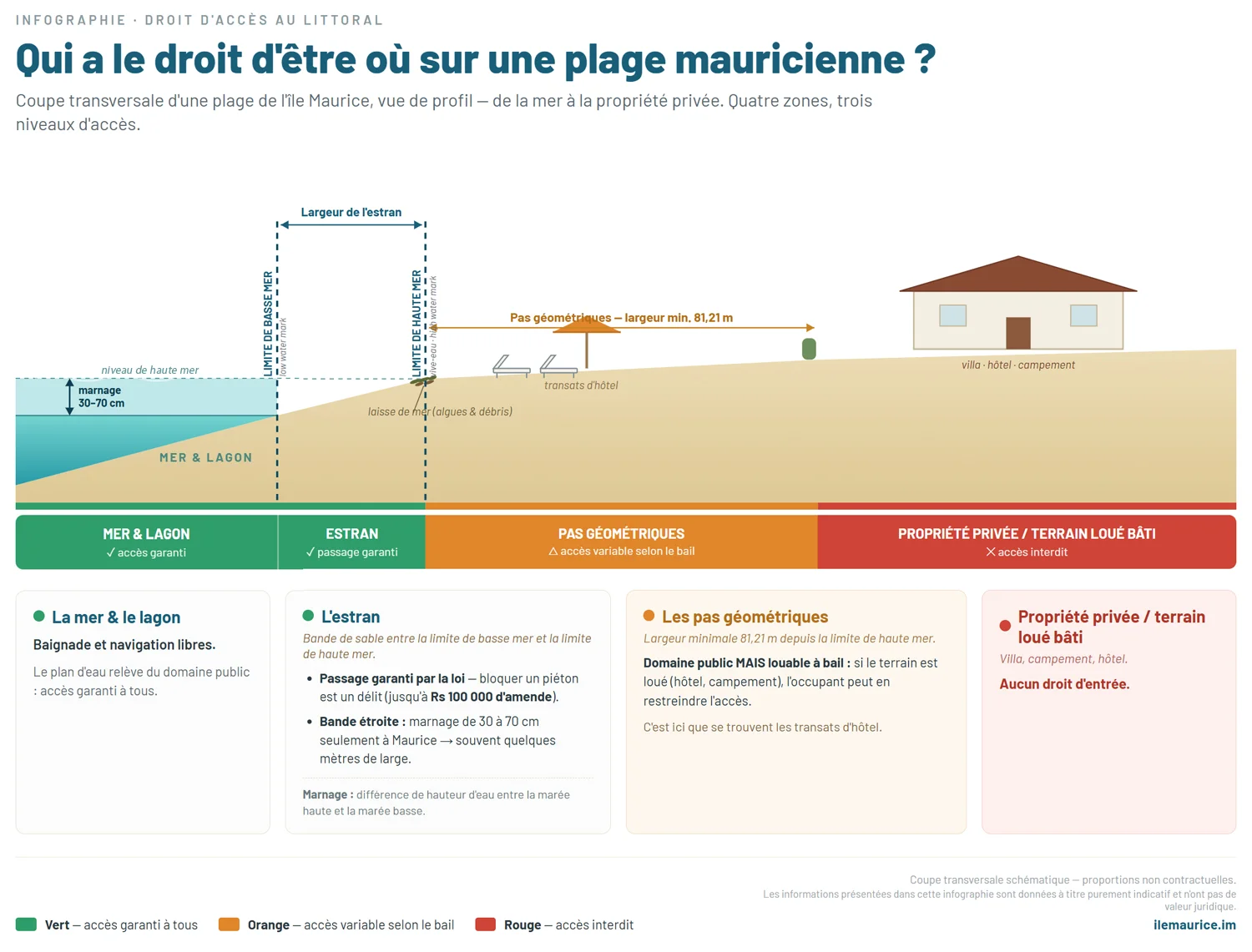
| Zoned | Legal status | Public rights | Can we deny you access? |
|---|---|---|---|
| The sea and the lagoon | Maritime public domain | Free swimming and navigation | Not |
| The foreshore (between low and high tide) | Public domain, inalienable | Free passage guaranteed by criminal law | No — obstruction is a crime |
| Geometric Steps (81.21 m minimum) | Public domain, but rentable by lease | Variable depending on whether the land is rented or not | Yes, on the portion actually rented |
| The declared public beach | Declared by order and published in the Official Journal | Free access and use, supervised by the Beach Authority | Not |
| The land beyond (villa, campsite, hotel) | Private property or rented land | No entry fee | Yes — and it’s perfectly legal |
The disputed point: the leases on the Pas Géométries
Geometric Steps are in the public domain and cannot be sold. But the State can lease — to hotel groups, developers, individuals who build a camp there. The tenant never becomes the owner of the land. The hotly debated question is what exactly his lease allows him to prohibit.
Reading the authorities
For the Law Reform Commission, which looked into the subject in June 2024, the fact that a portion of Pas Géométrie is rented for private use does not erase the public's right: it would still be permitted to walk there, sunbathe there, or even play there, with respect for others. This is also the position forcefully reaffirmed by Minister Shakeel Mohamed on June 25, 2026: according to him, no commercial or private lease gives the right to appropriate the coastline, and lease holders cannot in any way prevent the public from accessing or enjoying the beach — residents and visitors alike.
Reading the occupants
The camp owners and hoteliers put forward an argument which is not without force: they have signed leases, they pay them, and these contracts give them a right to occupy the plot. In their eyes, this right would not be compatible with free passage for the public on the land they occupy. The minister also announced, the day after his press conference, that he would initiate consultations with the Attorney General regarding two amendments that he considered necessary to make to the legislation - which says a lot about the solidity of the current framework.
On the ground, this reading is now displayed in black and white. Some hotels have replaced the "Private Beach" sign with real, carefully written, bilingual legal notices, informing the public that the area in front of the establishment "up to the high tide line" is not a public place but is part of the Geometric Steps over which the hotel holds a lease from the State, invoking the articles 1778-1 to 1778-21 of the Mauritian Civil Code — and that the public is therefore prohibited from settling or stopping there. We have verified this reference in the text of the Code: these articles do indeed exist and govern the construction lease, a lease of 18 to 99 years by which the lessee builds buildings on the lessor's land and which gives him real real estate rights. But none of these twenty-one articles sets out an “exclusive right of occupation” enforceable against the public: they organize the relationship between the State and its tenant (duration, mortgages, charges, repairs), nothing more. The exclusivity displayed by these signs is therefore a matter of interpretation – precisely that which the Law Reform Commission and the ministry dispute. We will also note a revealing detail: these opinions only claim the land until the high seas limit. In doing so, they themselves recognize, implicitly, the free passage on the foreshore.
Which, on the other hand, cannot be discussed
One point escapes any controversy: the right to travel on theforeshore, this strip of sand between the high seas limit and the water. This right is protected by criminal law, and no lease can cancel it. It is the foundation on which you can always lean.
The figures finally give an idea of what is at stake. According to the Law Reform Commission report, about 322 kilometers of Mauritian coastline, 90 kilometers are occupied by hotels, 60 kilometers by private residences, and barely 48 kilometers are classified as public beaches — less than 15% of the coastline officially accessible to the public. Hence the widely shared feeling of a coastline that is closing.
Obstructing passage is an offense
The public's right of passage is not a simple moral recommendation: it is protected by criminal law.
Thesection 110 of the Criminal Code (Supplementary) Act provides that any person who, without legal authorization, obstructs or prevents the free passage of a pedestrian on the shore commits an offense, punishable by fine of up To 100,000 rupees.
The text specifies the definition of the shore: it includes the portion of the coastline covered by the sea at high tide and exposed at low tide. It is indeed the foreshore that is being targeted.
Concretely, installing a chain, a fence or a gate to block the passage on the sand, releasing a dog to dissuade walkers, or posting a guard responsible for repelling the public constitute behaviors likely to fall under the scope of this article. It should be noted, however, that the text reserves the case of "legal authorization" - which refers precisely to the question of leases mentioned above, and explains why the concrete application may prove more complex than it seems.
Declared public beaches and the Beach Authority
Alongside the general regime of Geometric Steps, there is a particular category: declared public beaches. A beach officially becomes public when the minister responsible for housing and lands declares it as such by a notice published in the Official Gazette.
These beaches are managed by the Beach Authority, an organization created by the Beach Authority Act of 2002. Its mission: to control and manage public beaches, provide equipment, regulate the activities that take place there and ensure the safety of users. Since the 2022 amendment, its jurisdiction extends to all the islands of the Republic of Mauritius, and no longer just to Mauritius and Rodrigues.
How many public beaches does the country have? The Law Reform Commission identified 134 officially listed in the Official Journal in August 2022 ; the Beach Authority now indicates that it is managing about 145, forever around 48 kilometers of seafront. These figures require clarification: the same site can be divided into several public beaches in the administrative sense. What the public calls “Flic en Flac beach” would thus correspond to five distinct public beaches, and Pointe aux Piments to nine. The official number therefore says little about the actually accessible length.
It is on these declared beaches that we find, depending on the site, toilets, water points, tables, barbecue areas and regular cleaning. They are also those where the rules of use are the most detailed: they are the subject of specific regulations, the Beach Authority (Use of Public Beach) Regulations 2004.
Most beaches that visitors frequent — Mont Choisy, Belle Mare, Pereybere, Le Morne, Blue Bay or Pointe d’Esny — fall into this category. You will find them all in our guide to the beaches of Mauritius.
The official map of public beaches and access points
Since September 8, 2026, the Ministry of Housing and Lands has published an online map showing, beach by beach, the layout of public beaches and the paths leading to the sea. It can be viewed freely, without registration, at the following address: housing.govmu.org/public_beach/index.htmlNote the address: the abbreviated form housing.govmu.org/public_beach, which is circulating in the press, leads to nothing — the end of the link must be preserved.
This is a real Innovation. until now, a right of access existed in the texts but was nowhere Visible: the person asked to leave had nothing to oppose it except their word. they Now have an official, geolocated document that they can open on their phone.
What the map shows
The map background switches between a standard map and satellite view, allowing you to familiarize yourself with the terrain before going there. Layers are superimposed on top of this, which can be activated or deactivated individually:
- public beachesDrawn in polygons; a click on one of them gives its official name, its area in square meters and the length of its seafront;
- privately owned riverside land — the most instructive layer, since it shows where the public beach ends and where what is not public begins;
- access routes to the sea, with their surface, length, width and indication of vehicle or pedestrian access;
- administrative boundaries Districts, district councils, constituencies.
The system doesn't stop at the screen. Directional signs have been installed along public roads to indicate access points, supplemented by signage along the seafront to guide people back to the road. The National Coast Guard, the police, and emergency services also have access to these routes for faster response times.
What it doesn't yet cover
Coverage is partial, and it's best to know this before opening the map. The ministry announces a first phase focusing on La Preneuse, La Mivoie, Tamarin and Flacq, with a gradual extension to the rest of the territory as the Mapping Section compiles and validates the data.
In reality, the layer of public beaches already extends well beyond these four locations. We have noted 55 routesFrom blue Bay To belle Mare, From flic En flac To le Morne, from Poste La Fayette to Trou d'Eau Douce. By adding up the lengths of seafront shown on the map for each, we would obtain approximately 25 kilometers — roughly half of the 48 kilometers of public beaches identified nationwide. In other words, half of the public coastline remains to be mapped.
The access layer is significantly less advanced: to date, it only covers the district of Black RiverAnd a good number of the points shown are not yet documented—neither the surface, The width, nor the type of access. one Detail deserves to be highlighted, as it perfectly illustrates the subject of this article: Among the access points already recorded, several are described, on the official map itself, as private trails.
What to expect from it, and what not to ask of it
The most straightforward use case is to locate, before setting off, the public access point to the desired beach, and then compare the outline of the public beach with that of the neighboring private properties. No navigation app provides this information: they show sand, not a legal boundary.
Two caveats, however. The map shows the declared public beaches and access points, but not the high seas limit Therefore, it does not replace the reasoning explained above regarding the foreshore, which remains the only guaranteed passage under all circumstances, including in front of rented land. And like all cartographic data, it is dated: a field survey may have aged, especially since the coastline itself is constantly shifting.
It is usefully complemented by our own tools: the ministry's map shows what is public, our tourist map and our beach guide they say what you'll find there once you get there.
What is allowed and what is prohibited
The right of access does not mean that everything is permitted. The 2004 regulations precisely regulate the use of public beaches. Here's the gist, as it appears in the text.
| Activity | What the regulations say |
|---|---|
| Walk, sit, swim, sunbathe, picnic | Authorized and free, for residents and visitors alike |
| Make a fire or barbecue | Only at designated locations. It is forbidden to leave a fire unattended before it is completely extinguished. |
| Come with a dog | Allowed on a leash of up to 2 meters, sufficiently solid so that the animal cannot free itself |
| Play football or volleyball | Only in designated areas for this purpose by the Beach Authority |
| Driving or parking a vehicle (car, motorcycle, bicycle) | Forbidden on the beach, except designated locations |
| Ride a horse | Written authorization required from the Beach Authority, with monthly fee per horse |
| Organize a public event (music, dance, show) | Prior authorization required, to be requested at least 21 days in advance, with deposit and daily fee |
| Use a pedal boat, kayak, board | Prohibited in the swimming area (yellow buoys) and in the buffer zone (red buoys) |
| Dock a boat | Only in anchorage areas designated, except cyclone alert |
| Abandon waste | Forbidden outside of trash cans and designated areas |
| Touch trees, grass, signs, buoys | Forbidden damage the flora or furniture of the beach |
| Camping, pitching a tent | Permission from Beach Authority required. A tent is legally a “structure” within the meaning of section 12A of the 2022 Act (see section on penalties) |
| Erect a structure, put up a sign (including a “Private Beach” sign) | Prohibited without written permission from the Beach Authority — whoever installs it, including local residents |
Fires, waste, music: the most ignored rules
Three subjects systematically come up in complaints, in Mauritius as elsewhere: waste, fires and noise.
Waste
It is the first scourge of Mauritian beaches. After each long weekend or school vacation period, maintenance teams collect several tons of bottles, cans, food scraps, cigarette butts and abandoned bags. Beyond the visual aspect, the consequences are concrete: plastics fragment into microplastics absorbed by fish and fish. sea turtles, leftover food attracts stray dogs and rats, and broken bottles become traps for barefoot children.
The regulations are clear: leaving an object, waste or litter elsewhere than in the receptacles or areas provided constitutes an offense. It is also prohibited to dump any waste, oily liquid, acid or chemical or polluting substance into the marine environment.
Fires and barbecues
The family barbecue is part of the Mauritian way of life, but it obeys a strict rule: fires are only lit at locations designated by the Beach Authority. And we don't leave the place until the fire is completely extinguished. Abandoned embers deteriorate the sand, weaken the roots of the casuarina trees and can trigger fires.
The noise
This is the most delicate point from a legal point of view. Portable speakers broadcasting music at high volume all day long are regularly denounced, both by other users and by local residents. The 2004 regulations do subject “public entertainment” – music, dance, singing, shows – to prior authorization from the Beach Authority. But this device aims at organized events to which the public is invited, and not the music station of a family on a picnic.
The Minister of Housing and Lands himself made it clear, the day after his press conference at the end of June 2026: the authorization requirement would not concern playing music at full volume – any more than pitching a tent or having a barbecue. In other words, ordinary noise pollution is located in a gray area: today it is more a matter of good manners than an easily verbalized fine. This is precisely one of the points on which a strengthening of the framework is called for, and on which the minister has announced that he wants to consult the Attorney General.
Where the public's rights end
The reminder of the public nature of beaches produced another, in the opposite direction: some concluded that access to the sand also opened up the gardens, terraces and facilities of neighboring properties to them. This is false, and it must be said so clearly.
The public domain ends precisely where the property of others begins. The right to walk on the sand never gives the right to cross a fence, go around a hedge, sit on a private lawn, use a tap, a shower, an electrical outlet or a private bathroom.
The testimonies of local residents are similar from one region to another: chains moved, lawns transformed into picnic areas, electrical extension cords plugged in without authorization, terraces occupied for several hours, furniture moved, plants trampled. These behaviors remain the work of a minority, but they fuel growing exasperation — and, ultimately, a risk of direct confrontation in which no one has any interest.
The public's right of access and the right of local residents to peace and quiet in their homes do not conflict: they complement each other. This is the condition for the first to remain defensible.
Sanctions incurred
Please note: the sanctions were significantly increased in 2022. The Beach Authority (Amendment) Act, passed in Parliament in May that year, significantly increased the amounts and expanded the powers of the Beach Authority. The information that can still be found on many sites, based on the 2004 regulations, is therefore outdated.
Three major changes should be noted. Beach Authority officers can now issue fines in the same way as the police. A system offixed fines (Fixed Penalty Notices), payable within 28 days to the district court, was introduced. And the Authority can issue a stop order (Stop Order) to stop an illegal development or activity.
| Offense | Applicable text | Maximum penalty |
|---|---|---|
| Obstruct or prevent the free passage of a pedestrian on the shore | Article 110 of Criminal Code (Supplementary) Act | 100,000 rupees fine |
| Erect a structure or display a sign on a public beach without permission (including a tent) | Article 12A of Beach Authority (Amendment) Act 2022 | 100,000 rupees fine and 2 years of imprisonment |
| Carrying out an activity or business on a public beach without authorization | Beach Authority (Amendment) Act 2022 | 100,000 rupees fine and 2 years of imprisonment |
| Failure to comply with a Stop Order | Beach Authority (Amendment) Act 2022 | 100,000 rupees fine and 2 years of imprisonment |
| Driving, riding or parking a vehicle on a public beach (car, motorcycle, bicycle) | Fixed fine provided for by the 2022 Law | Fixed fine, in the absence of payment the amount would be double |
| Violation of regulations made under the law (waste, fire, uncontrolled dog, damaged flora, etc.) | Regulations made under the Beach Authority Act, as amended in 2022 | Fine raised to 50,000 rupees (compared To 10,000 previously) |
The system of fixed fines would also provide for a gradation: a first offense would be punished by a fine of around 10,000 to 20,000 rupees, accompanied by a prison sentence of up to six months; in the event of a repeat offense, the amount would rise between 20,000 and 50,000 rupees, with a sentence of up to twelve months. In the event of refusal to pay, the offender would have to pay at least double the initial amount.
One point is worth emphasizing, because it turns the panels' argument on its head: displaying a “Private Beach” sign on a public beach without permission is, in itself, an offense under article 12A. the Sign Supposed to keep the public away is itself outside the law.
The question of effective application, however, remains unresolved. The number of fines actually issued each year and the human resources available to them Beach Rangers during attendance peaks are the subject of recurring questions in the mauritian public debate.
What to do if you are denied Access?
You are on a beach, a guard asks you to leave, or a chain blocks your path on the sand. Here is the procedure to follow.
- Keep calm and don't get into conflict. An altercation will not resolve anything and can turn against you.
- Check where you are. Are you on the sand, below the high tide mark? Or have you crossed a fence to set up camp on rented land or private property? The distinction is crucial. Where available, the official map of public beaches allows you to check it on site, from a phone.
- Remember the principle, without aggression. The beaches are in the public domain and obstructing passage on the shore is a criminal offense.
- Document the situation. This is no longer just common-sense advice: by putting its map online, the ministry has expressly invited the public to photograph or film any obstruction observed on an access route—barrier, fence, container, or other structure. Also note the exact location, date, and time.
- Report the facts. This is what Minister Shakeel Mohamed himself invited citizens to do in June 2026. Four official contacts can be reached, their contact details are below.
Obstacles to access can be reported:
- to the Land Police (Land Police), designated by the ministry as the point of contact for reporting obstructions on access roads to the Coastline — Telephone (+230) 401 3744;
- to the police — emergency number 999, or the nearest police station (see our article on emergency numbers in Mauritius);
- to the Beach Authority, which manages public beaches — telephone (+230) 468 6209 to 6212, e-mail beachauthority@intnet.mu;
- the ministry of Housing and Lands (Ministry of Housing and Lands), which manages leases on state land and has the power to intervene — telephone (+230) 401 6808 / 401 6809, Ebène Tower, Ebène.
A piece of common sense advice for visitors: The vast majority of stays take place without the slightest incident of this type. these Situations exist, but they remain the exception, and they concern certain highly built-up sectors of the coast more than developed public beaches.
A debate that is not closed
The recall of the minister in June 2026 does not create any new rights: it reaffirms a principle already enshrined in law and confirmed on several occasions by the Supreme Court. But he didn't limit himself to words. The minister announced that he had officially asked the police commissioner to take action against people who illegally restrict public access to beaches, warned that any illegal installations would be dismantled, and launched a national beach access audit intended to assess their condition, legality and accessibility. He also advised those who have installed “Private Beach” signs to have them removed without delay.
The online publication of the map of public beaches and access pointsThe date of September 8, 2026, is the first visible result of this audit. It does not resolve any of the legal issues discussed above—a line drawn on a map does not determine what a lease permits or prohibits. But it does shift the focus of the discussion: what was previously settled through a power struggle over the sand is now based, at least for part of the coastline, on a document that anyone can access.
The government also says it wants to expand the area of public beaches, and not just defend it: Pomponette beach, in the south, has been re-proclaimed a public beach, the re-proclamation of part of Balaclava beach – removed from the public domain in 2008 and then rented to a hotel operator – is under study, and a coastal path linking several sites on the south coast was recently opened to improve accessibility of the coastline.
The file is not closed yet. From June 2024, the Law Reform Commission had published a working document entitled Criminalization of denial of access to public beaches in Mauritius. In particular, she proposed amending the Beach Authority Act to criminalize denial of public access, with a fine of up to Rs 100,000 and imprisonment of up to two years. It also suggested the creation of a guaranteed public access zone along the coast, a strengthening of beach patrols, as well as a code of good conduct for users. To date, these proposals have not been followed up on - and the consultations announced with the Attorney General show that the legal framework remains, by the authorities' own admission, to be consolidated.
Another, more insidious factor complicates things further: coastal erosion. The high seas limit, on which the entire legal structure rests, is not a fixed line. With the rising waters and the retreat of the coastline, it moves inland. On certain portions of the coastline, the foreshore has shrunk so much that “walking below the high water mark” amounts, in practice, to walking in the water. The law is based on a changing geography – and this is one of the blind spots of the current system.
Frequently asked Questions
Are there private beaches in Mauritius?
No, in the sense that no one owns a beach: the coastline belongs to the public domain of the State, inalienable and imprescriptible, and a “Private Beach” sign has no legal value. But this does not mean that the entire beach is open to you: dry sand above the high water mark can be leased, and its occupant can then restrict access. Only the foreshore – the strip that the sea covers at high tide – is guaranteed to you in all circumstances.
Can I walk past a luxury hotel on the beach?
Yes, along the shore: on the foreshore, that is to say the strip that the sea covers at high tide, your passage cannot be obstructed. On the other hand, the dry sand higher up, where the deckchairs and the beach bar are installed, is generally located on land rented by the hotel: the latter has the right to reserve the use of it for its customers. In practice, we therefore pass near the water, not among the deckchairs.
What is the risk of someone blocking access to a beach?
Article 110 of Criminal Code (Supplementary) Act provides for a fine of up to 100,000 rupees for anyone who, without legal authority, obstructs the free passage of a pedestrian on the shore.
Can you have a barbecue on a mauritian Beach?
Only at locations designated by the Beach Authority. Lighting a fire elsewhere, or leaving a fire unattended before it is completely extinguished, is an offense punishable by a fine and imprisonment.
Can i come to the beach with my Dog?
Yes, provided that the animal is kept on a leash of no more than 2 meters, and that this leash is strong enough so that it cannot break free.
Is camping allowed on public beaches?
It is subject to prior authorization from the Beach Authority. Since the 2022 law, a tent is considered a "structure": pitching one on a public beach without permission would constitute an offense, theoretically punishable by a fine of up to 100,000 rupees and two years' imprisonment. This point caused considerable controversy in Mauritius, and the Minister of Housing and Lands declared in late June 2026 that the permit requirement did not cover pitching a tent. Faced with this uncertainty, prudence dictates that you inquire directly with the Beach Authority — (+230) 468 6209 — before any camping project.
Why are some access points so difficult to Find?
Because the coastline is bordered by land rented by the State to individuals or hotels. These leases confer a right of occupation which allows access to the rented plot to be restricted. Public pedestrian paths remain, but they are sometimes narrow, poorly signposted and wedged between two properties.
How can you tell if a beach is public and where its access is located?
The Ministry of Housing and Lands has published an online map of public beaches and access routes to the sea since September 8, 2026, at housing.govmu.org/public_beach/index.html. The map shows the outline of each public beach, the adjacent private land, and the paths leading to the sea. Coverage remains partial: access points are only documented for the Black River District, and approximately half of the public coastline remains to be mapped.
Does a tenant of land on Pas Géométrie own the beach?
No. Geometric Steps Are in the public domain and cannot be sold. a lease Confers a right of temporary occupation of the leased land, never a right of ownership over the sand.
Important Warning: the legal information presented in this article is given for informational and popularization purposes. They do not constitute legal advice and cannot replace it. Legislation, regulations and their interpretation by the courts may evolve, and the concrete application of the texts may vary depending on the circumstances of each situation. The telephone contact details mentioned are those published by the organizations concerned on the date this article is updated and may change. Anyone faced with a dispute relating to access to the coastline is invited to contact the competent authorities – police, Ministry of Housing and Lands, Beach Authority – or to consult a lawyer. Despite all the care taken in synthesizing the texts, an inaccuracy or a perfectible interpretation remains possible: if you spot one, report it to us, we will check it and correct it. The author and publisher cannot be held responsible for the consequences of a decision taken solely on the basis of this article. See the Terms of Use (Article 12).
Last updated: September 2026
Info +:
7 day Weather forecast
Rent a car
Book a hotel or villa
Buy an airplane ticket
Frequent questions - FAQ
All tourist sites and activities
Complete guide to SIM cards for tourists in Mauritius
Formalities and procedures for coming on vacation to Mauritius
All complete guides
Your advertising on this page?
Want to display an ad for your business on this particular page (or elsewhere on the site)?
Please contact us in click here.
Contribute, improve this page
We want to provide the most relevant and complete information to internet users, so if you want to add something or modify this page (text, Photo, etc.), Or even report an error, do not hesitate to contact us by sending us an email to the following Address: contribuer@ilemaurice.im
(remember to clearly indicate the page concerned by your contribution)
(the photos sent will only be used to complete this page and will never be used commercially outside of this site without your consent)