
The underwater waterfall
The underwater "waterfall" at Le Morne
 The essentials in a few words
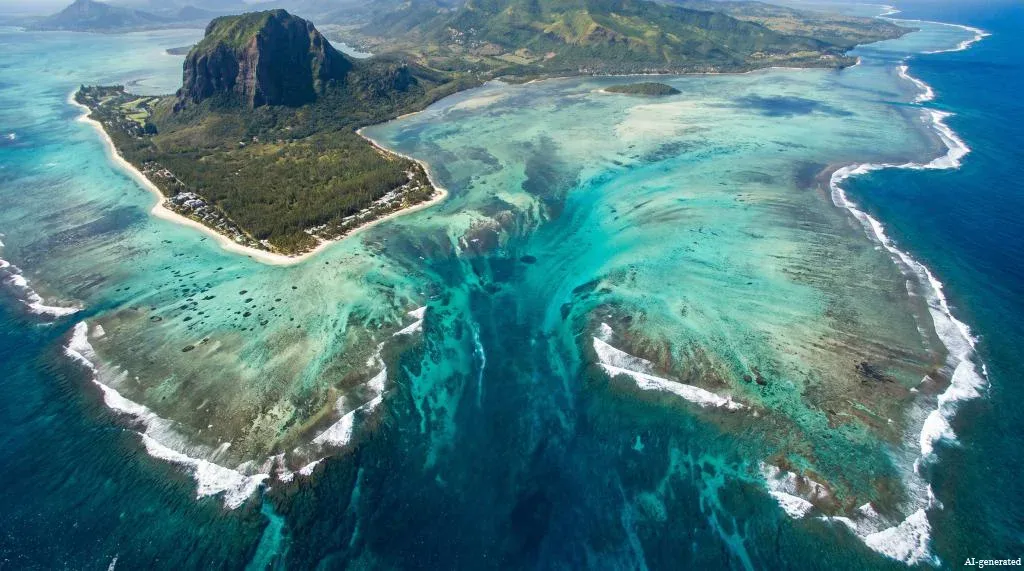
The underwater waterfall of Mauritius is a spectacular optical illusion visible off Le Morne Brabant, in the southwest of the island.
Seen from the sky, the ocean seems to plunge into a vast blue abyss.
In reality, these are deposits of sand and silt that currents carry along an underwater plateau before it plunges abruptly into the depths of the Indian Ocean.
The phenomenon is only perceptible from the air: helicopter, seaplane or ultralight aircraft.
It naturally combines with the silhouette of Le Morne Brabant, a UNESCO World Heritage Site, and with the flyover of the neighbouring sites of Chamarel and the Seven Coloured Earth.
Off the coast of Le Morne Brabant, in the southwest of Mauritius, the ocean seems to recede. Seen from the air, an immense turquoise veil appears to plunge into the abyss, creating what many describe as a giant waterfall cascading beneath the surface. The phenomenon is now one of the most widely shared images of Mauritius, to the point of becoming a visual emblem of the island.
However, this "underwater waterfall" doesn't actually exist. No waterfalls truly flow beneath the Indian Ocean. What the eye perceives is a remarkably powerful optical illusion, created by the convergence of spectacular underwater topography, strong ocean currents, and equatorial light. Understanding how this mirage works, knowing where to observe it and under what conditions, offers one of the most unique experiences of a stay in Mauritius.
Summary
- A unique optical illusion in the world
- The geological explanation of the phenomenon
- Where is the underwater waterfall located?
- A "discovery" born from aerial photography
- How to observe the underwater waterfall
- When to go: weather, season, ideal time
- How much does a flight cost?
- What else is there to see during the flyover?
- How to take great photos of underwater waterfalls
- Are there other underwater waterfalls in the world?
- Frequently Asked Questions
- Photos
A unique optical illusion in the world
The first instinct when seeing aerial images of the underwater waterfall is to look for the waterfall itself. Nothing in the landscape resembles a stream, and yet the eye clearly perceives movement, a spill, a substance that seems to plunge into the blue void. This is precisely what the illusion produces: a brain accustomed to terrestrial landscapes interprets a marine scene according to the visual codes of a classic waterfall.
Three elements contribute to this effect. First, highly contrasting color gradients, from the lagoon's luminous turquoise to the deep blue of the open sea, simulate a change in water level. Second, trails of suspended sand create vertical lines, like a curtain of moving water. Finally, the underwater slope itself, whose abrupt break evokes a cliff beneath the surface.
The phenomenon only works above a sufficient altitude, generally around three hundred meters. Below that, the viewing angle is too shallow for the illusion to occur. From a boat or in the water, nothing seems out of the ordinary: the sea is beautiful, clear, sometimes choppy near the coral reef, but no "waterfall" is visible. It is this dependence on altitude that kept the phenomenon hidden from view for so long, until the rise of popular aerial photography.
The geological explanation of the phenomenon
Mauritius is of volcanic origin. It was formed approximately eight to ten million years ago by the activity of a hotspot in the Earth's mantle, which brought magma to the surface, eventually forming what we now call an island above sea level. Like most oceanic volcanoes, Mauritius rests on an underwater base much larger than its emerged portion. This base forms a plateau that surrounds the island for several kilometers before abruptly giving way to the abyssal plain.
To the southwest, near Le Morne Brabant, this rupture is particularly pronounced. The continental shelf, which remains at a depth of around 150 meters, collapses in just a few kilometers, plunging to over 4,000 meters into the ocean trench. The slope is steep enough that, on a geological scale, it constitutes a veritable underwater embankment. It is on this embankment that the phenomenon occurs.
The mechanism is purely sedimentary. Coral sand and silt, produced by the erosion of reefs and shallow seabeds, constantly accumulate on the shelf. Ocean currents in the Indian Ocean, combined with tides and waves, push these sediments offshore. When these suspended particles reach the edge of the shelf, they slide down the underwater slope towards the depths. It is this constant movement, viewed from above, that creates the characteristic streaks that the eye interprets as a waterfall.
We must therefore imagine a natural conveyor belt, slow but continuous: the coral reef produces sand, the currents carry it offshore, the sand crosses the edge and descends towards the abyss. What we photograph from the sky is not a waterfall, but a river of sand suspended in the water.
Where is the underwater waterfall located?
The underwater waterfall is located at the southwestern tip of Mauritius, off the peninsula of Morne BrabantThis peninsula forms the southwest corner of the island, between Tamarin Bay to the north and Le Morne Bay to the south. The precise area of the phenomenon is located just beyond the reef drop-off, a few kilometers offshore.
Le Morne Brabant itself dominates the landscape. This basalt mountain rises to 556 meters and has a distinctive, almost trapezoidal silhouette, recognizable from afar. A UNESCO World Heritage Site since 2008, it has become a symbol of Mauritian history: its steep cliffs and caves served as a refuge for runaway slaves fleeing the plantations in the 18th and 19th centuries. hiking up Le Morne Brabant It remains one of the most beautiful on the island and allows you to take in the whole area from which the phenomenon is visible.
At the base of Le Morne stretches a long public beach, the Le Morne beachframed by one of Mauritius' largest lagoons, this configuration partly explains the phenomenon: the reef barrier is very extensive here and produces a large quantity of the coral sand that feeds the underwater slope. The peninsula thus forms a coherent geographical framework, where the underwater waterfall appears as the submerged extension of the terrestrial landscape.
A "discovery" born from aerial photography
The underwater waterfall is one of those phenomena that nature had concealed until technology made it possible to see them. The geological mechanism has existed for hundreds of thousands of years, but it was necessary to ascend several hundred meters to observe it. The first aerial photographs of Le Morne Brabant date back to the mid-20th century, but it was the rise of popular aerial photography in the 2010s that brought the phenomenon to wider public attention.
The images then proliferated on social media, where the vertical format and color contrast work particularly well. Today, the underwater waterfall features in almost every photo report about Mauritius and is often the first image that travelers have in mind before their trip. Its viral spread has transformed a remarkable geological phenomenon into a full-fledged tourist attraction, on par with the Land of Seven Colors of Chamarel.
This recent story also explains a paradox: the underwater waterfall is world-famous, yet many Mauritians themselves have never seen it with their own eyes. To contemplate it, one must take to the air, which requires a specific budget and approach. The phenomenon thus belongs to that category of Mauritian landscapes that can only be discovered through a different kind of walk: it requires preparation.
When to go: weather, season, ideal time
Observing the underwater waterfall depends on three main weather conditions: visibility, sky conditions, and sea conditions. Rough seas blur color contrasts, overcast skies dull the blues, and salt spray reduces image sharpness. Therefore, the dry season offers the best chance of a successful flyover.
In Mauritius, the dry season runs roughly from May to November. During this period, temperatures are milder, rainfall is less frequent, and the skies are generally clearer, especially on the west coast where Le Morne is located. The wet season, from December to April, sees more tropical downpours and coincides with cyclone season, which can lead to flight cancellations. To plan your trip, it's worth consulting the dedicated page on the weather in Mauritius before setting the dates.
During the day, the morning is generally considered the best time to fly. The trade winds are weaker, the sea is calmer, and the light remains soft without overpowering the contrasts. In the mid- to late morning, the sun rises just enough to penetrate the water and reveal the subtle color variations without producing harsh reflections on the surface. Early afternoon flights can also be very successful, provided the thermal winds haven't yet stirred up the sea. Conversely, the end of the day, despite the flattering light, often results in a choppier sea and duller underwater colors.
How much does a flight cost?
Prices vary considerably depending on the mode of transport chosen, the flight duration, whether the experience is private or shared, and the package selected. For guidance only, and subject to full verification at the time of booking, the following approximate prices can be considered.
A short microlight flight would typically be the most affordable option, with a budget of around a few thousand Mauritian rupees per passenger. A shared helicopter flight would represent a mid-range option, generally costing tens of thousands of rupees per passenger. A seaplane flight, especially a private or tandem option, would be the most luxurious and could cost tens of thousands of rupees per passenger, or even more depending on the duration and options chosen.
These wide price ranges reflect the extreme variability of offers and the price fluctuations from one season to the next. It is strongly recommended to compare several proposals, carefully read what is included in the price (transfers from the hotel, professional photos, actual flight time over the phenomenon), and prioritize operators with all the necessary permits. For a family or couple, it may be worthwhile to book a longer package that also covers Chamarel and the south coast: the marginal cost of the extra minutes is often significant, and the overall experience is enriched.
What else is there to see during the flyover?
The area overflown during the underwater waterfall viewing tour boasts some of Mauritius' most beautiful scenery. Taking advantage of the altitude to discover the hinterland and the south coast transforms a themed flight into a true aerial tour of the island. Several sites are particularly well-suited to this bird's-eye view.
Le Morne Brabant itself offers a breathtaking view from the air. Seen from the sky, the mountain reveals its flat summit and near-vertical walls, which explain why it was able to serve as an inviolable refuge for so long. The contrast between the dark rock, the green of the lower slopes, and the blue of the lagoon is unforgettable.
Further north, the Chamarel waterfallThis time, a very real and terrestrial waterfall plunges approximately one hundred meters into a verdant valley. Seen from the air, it reveals the geological structure of the region and the beauty of the surrounding tropical vegetation.
Nearby, the Seven Coloured Earth is another highlight. This geological wonder, made up of volcanic sand dunes in a wide variety of natural hues, takes on a new dimension when viewed from the air. The shades of ochre, red, violet, and green unfold like a painter's palette and perfectly complement the blue palette of the underwater waterfall.
Depending on the package, the flight may also include the rugged south coast, the cliffs of Maconde, Tamarin Bay, and sometimes the mountainous interior of the island. Some operators even offer complete north-south crossings, transforming the experience into a true aerial exploration of the country.
How to take great photos of underwater waterfalls
The phenomenon is extremely photogenic, but it requires some care to capture its full impact. The first rule is to take advantage of verticality. The best views of the underwater waterfall are those taken almost directly above the phenomenon, or from a slightly downward angle that reveals the edge of the plateau. An image taken from too low an angle loses the illusion.
Light plays a crucial role. Light that is too low, at the beginning or end of the day, produces white reflections on the water's surface and obscures the colors in the depths. Light that is too direct, at midday, flattens the contrasts. The ideal time is generally mid-morning, when the sun penetrates the water column without producing too much reflection.
In terms of equipment, a compact camera or a recent smartphone is perfectly adequate. Wide-angle lenses are particularly well-suited for capturing the entire phenomenon and its context, from the coral reef to the deep blue of the open sea. For more advanced photographers, a polarizing filter can help reduce surface reflections and reveal gradations underwater, provided the aircraft or helicopter allows it.
A few practical precautions can help avoid ruining your shot. It's best to clean your lens before the flight, avoid placing the camera directly against the window (which can produce unwanted reflections), turn off the flash, and anticipate flights over the area by checking the pilot's planned flight path before takeoff. Many travelers regret filming relentlessly at the expense of enjoying the view: alternating between the two, or choosing one recording mode at a time, often results in more satisfying memories.
Are there other underwater waterfalls in the world?
The underwater waterfall in Mauritius is not the only marine phenomenon to bear this name, but it is undoubtedly the most accessible and visually spectacular. Two distinctions are necessary.
The first concerns true underwater waterfalls, in the physical sense of the term. There is at least one major one, in the Denmark Strait, between Greenland and Iceland. There, masses of cold, dense water plunge beneath less dense water in a drop considered the highest in the world, several thousand meters. This purely oceanographic phenomenon is not visible to the naked eye: it is measured and modeled. Therefore, in terms of experience, it has nothing to do with what one sees in Mauritius.
The second category includes optical illusions similar to that of Le Morne. A few coastal areas around the world, particularly near steep continental shelves surrounded by sand-producing reefs, exhibit related phenomena. However, none has achieved the international renown of the Mauritian site, largely because the combination of parameters—underwater slope, currents, coral sand quality, water transparency, and ease of aerial access—is particularly favorable here. The underwater waterfall of Mauritius thus stands as a textbook example, where a natural illusion achieves a degree of visual clarity rarely equaled elsewhere.
Frequently Asked Questions
Can the underwater waterfall be seen from the beach or by boat?
No. The phenomenon is an optical illusion that only occurs at a significant altitude, generally above three hundred meters. From the beach, the lagoon, or a boat, the sea appears completely normal and no waterfall is visible.
Is the underwater waterfall visible all year round?
The phenomenon is constant, as it is linked to an ongoing geological and sedimentary process. However, its visibility depends on weather conditions. The dry season, from May to November, offers the best chance of clear skies and calm seas. The wet and cyclone season, from December to April, can lead to flight cancellations.
What is the best time for the flyover?
The morning, usually mid-morning, is considered the best time. Light penetrates the water column, winds are weaker, and the sea is calmer. Late afternoon often brings rougher seas and less distinct underwater colors.
How long is a flight to see the underwater waterfall?
Flight times vary depending on the mode and package chosen. A short flight in a microlight or helicopter typically lasts from fifteen to thirty minutes. More comprehensive seaplane packages generally last from forty minutes to over an hour and often include other sites such as Chamarel or the Seven Coloured Earths.
Is the flight accessible to children?
Helicopter and seaplane flights are generally open to children from a certain age, determined by each operator, and subject to certain weight or accompanying adult requirements. Ultralight flights, on the other hand, are less frequently accessible to very young children. It's best to check directly with the operator you choose.
Can a drone be used to photograph the underwater waterfall?
The use of a drone is strongly discouraged and heavily restricted by regulations. The distance to be covered over the water exceeds the reasonable range of consumer drones, and the Le Morne area is subject to special protections. Prior consultation of the official guide on drone regulations in Mauritius is essential.
Does the underwater waterfall pose a danger to bathers or swimmers?
No. The phenomenon occurs beyond the coral reef, in an area where swimming is prohibited. Mauritian lagoons, including Le Morne, remain safe in designated areas. The currents associated with this phenomenon occur at greater depths and do not affect recreational swimming.
Is it better to choose a helicopter or a seaplane?
Both options offer high-quality, albeit different, experiences. The helicopter prioritizes comfort, stability, and an unobstructed view from an enclosed cabin. The seaplane adds the dimension of taking off and landing on water, and often allows for longer flights with multiple passes over the phenomenon. The choice largely depends on budget, sensitivity to movement, and preference for a more or less immersive experience.
Is it better to book in advance or on site?
During peak season, particularly in July, August, and around the Christmas holidays, advance booking is highly recommended. The best time slots, mid-morning and in good weather, fill up quickly. Outside of peak season, booking a few days in advance is generally sufficient.
The information in this article is provided for guidance purposes only. The author and publisher accept no responsibility for the accuracy of the information provided. It is recommended that you verify the information directly with local operators or the relevant Mauritian authorities during your stay. See the Terms of Use (Article 12).
(The photos you send will only be used to complete this page and will never be used commercially outside of this site without your permission)
To share your Mauritius vacation photos with friends, family, and colleagues, we offer a free, personalized webpage dedicated to your trip. Simply share the webpage address, for example, www.ilemaurice-im/vacancesdepierreetmarie, with anyone you'd like to share your photos with.
It's very simple, just click on the button below.
Information:
Rent a car
Book a hotel or villa
Buy an airplane ticket
Paid
7-day weather forecast
Child-friendly
Your advertisement on this page?
Do you want to display an advertisement for your business on this particular page (or elsewhere on the site)?
Thank you for contacting us by clicking here.
Contribute to and improve this page
We want to provide internet users with the most relevant and complete information, so if you would like to add to or modify this page (text, photo, etc.), or even report an error, please do not hesitate to contact us by sending an email to the following address: contribute@ilemaurice.im
(remember to clearly indicate the page to which your contribution relates)
(The photos you send will only be used to complete this page and will never be used commercially outside of this site without your permission)
Not yet tested by the editorial team
If you would like to tell us about this place, this activity, etc., please send us an email to the following address: visit@ilemaurice.im
How to observe the underwater waterfall
The underwater waterfall can only be viewed from the air. Four types of flights are available in Mauritius, each with its own characteristics in terms of comfort, duration, price and visual experience.
By helicopter
A helicopter flight remains the most popular way to experience the underwater waterfall. Aircraft depart from the international airport, helipads in the south or north, or directly from certain hotels. Flights dedicated to viewing the waterfall typically last fifteen to thirty minutes for a short tour, and longer for a longer tour that also covers Chamarel and the south coast. The enclosed cabin offers excellent comfort, the stability is very good, and the flight altitude allows you to fully appreciate the phenomenon. It's the preferred option for travelers seeking a comfortable experience, and also ideal for passengers sensitive to movement.
By seaplane
Seaplanes offer a rarer experience, often described as the most complete. Taking off from the water in a Mauritian lagoon is an integral part of the experience. Seaplanes generally fly at lower altitudes than helicopters, allowing for a gradual approach to the underwater waterfall, with several passes possible depending on the chosen package. Flights typically last between forty minutes and over an hour for longer options. Some operators offer "duo" packages, with two aircraft flying side-by-side to ensure each passenger has an unobstructed view.
In an ultralight aircraft
The microlight, or ultralight motorized aircraft, is for travelers seeking a more immersive experience. The cabin is open or has extensive windows, the sensation of flight is more direct, and photography is often easier than from a helicopter. Flights typically last between twenty and thirty minutes for a circuit around Le Morne. Comfort is less, and the flight is more susceptible to weather conditions, but the experience-to-price ratio is often considered excellent. This mode of transport is recommended for passengers comfortable with movement.
And the drone?
The idea of using a personal drone to photograph the underwater waterfall naturally comes to mind, but it runs into several practical limitations. The distance between the shore and the area to be flown over far exceeds the reasonable range of most consumer drones, and losing the device over the ocean is almost guaranteed in case of a problem. Above all, Mauritian regulations strictly govern the use of drones, particularly in the Le Morne area, a UNESCO World Heritage Site. Before any attempt, it is essential to consult the Complete guide to drone regulations in Mauritius to find out about the required permits and no-fly zones.