
Land of 7 colors
The land of seven colors in Chamarel: Waves of red and purple in the heart of the forest
 The essentials in a few words
The Seven Coloured Earths are located in Chamarel, in the Black River district of southwest Mauritius. These are hills of bare earth in shades of red, brown, ochre, grey, and purple, all within a small area, which you can explore via a wooden boardwalk. The site is part of a paid geopark that also includes the Chamarel Waterfall viewpoint, a giant Aldabra tortoise park, an endemic garden, a shop, and a café. Allow about an hour for the entire site, and half a day if you plan to explore the surrounding area further. The colours are best seen in the mid-morning and late afternoon, on a clear day.
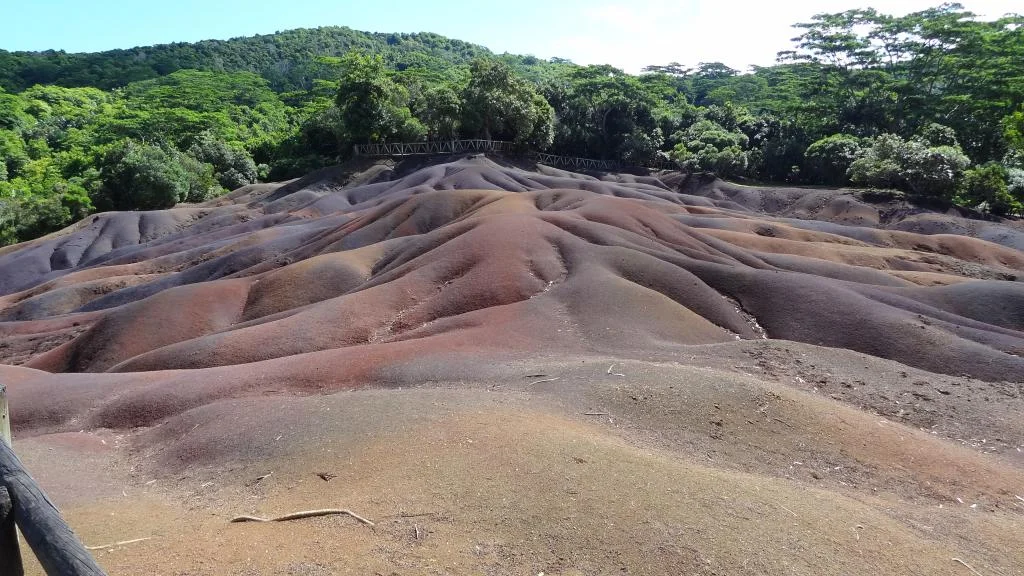
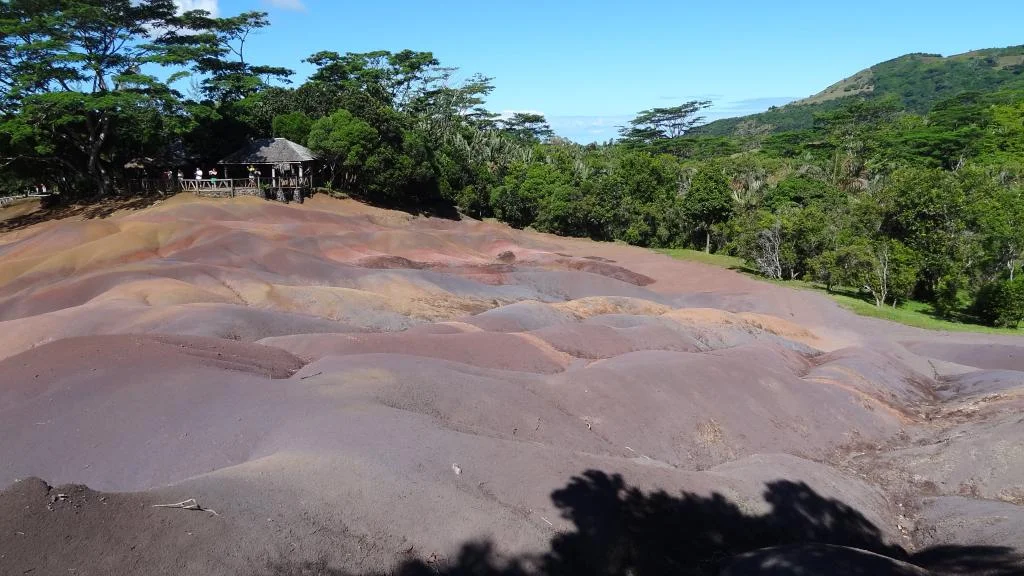
There are landscapes that seem retouched until you see them with your own eyes. At Chamarel, the forest suddenly opens onto a clearing of bare hills, undulating like waves stopped mid-race. The earth is red, brown, ochre, violet, and nothing grows there: the trees stop abruptly a few meters away, as if they refuse to set foot on the ground. You walk along the wooden boardwalk that borders the site, take ten steps, and the colors are already different.
It's a small place, and perhaps that's what's most surprising: you expect a desert, but instead you find a clearing that you can admire from a path that runs alongside it, a leisurely half-hour stroll, with the green line of the southwestern mountains in the background. But you don't come here for the size of it. You come to see a land that changes color before your eyes throughout the morning, and which hasn't changed a bit in decades.
Summary
- What you see upon arrival
- Where do colors come from?
- Three common misconceptions
- A site known since 1879
- The giant tortoises of Aldabra
- What the ticket covers in addition to the dunes
- When to come to see the colors
- Access, opening hours and prices
- Things you need to know before you come
- Around Chamarel
- Frequently asked questions about the seven coloured earth
- Photos
What you see upon arrival
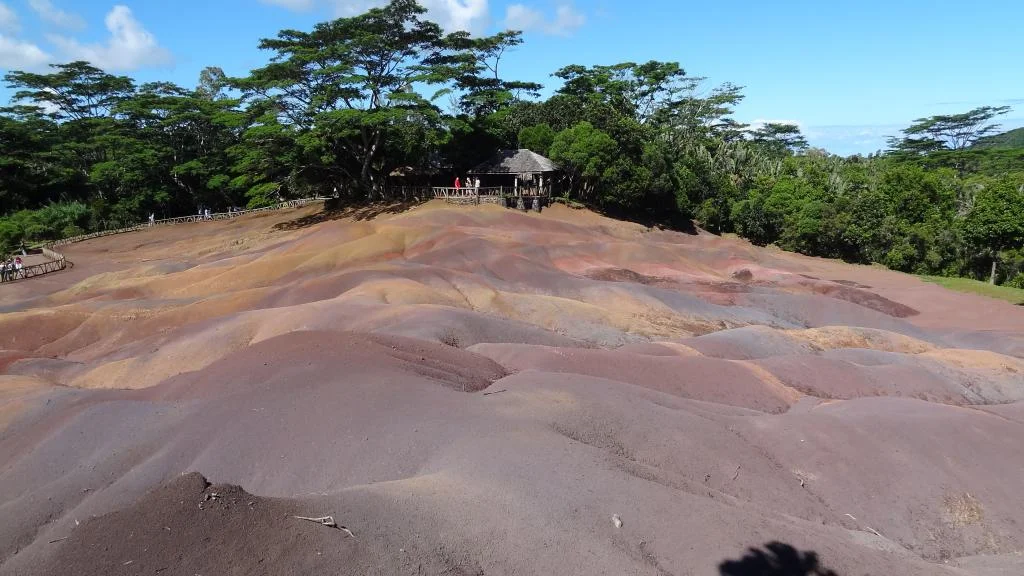
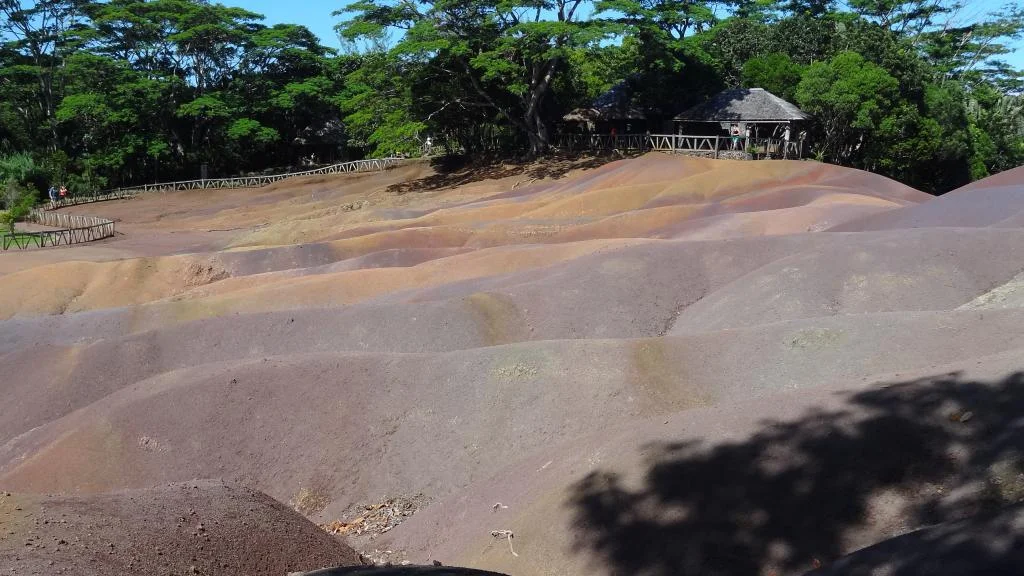
The site forms a series of rounded mounds, without a blade of grass, on a plot of land of approximately 7,500 m² — the equivalent of a large football field. You don't walk on it: a dirt path bordered by a log railing runs alongside the colored earth, with a thatched hut and a platform overlooking the crest, from which you can take in the whole area.
One point that is rarely mentioned: this path does not encircle the entire site. The operator refers to it as a "Dunes Walk" and invites visitors to stroll around the dunes, but their own aerial views show a fence that only follows part of the perimeter, with the forest closing off the rest. A complete circuit was not possible a few years ago, and we have not been able to confirm whether it is still possible today: if this is important to you, ask at the entrance.
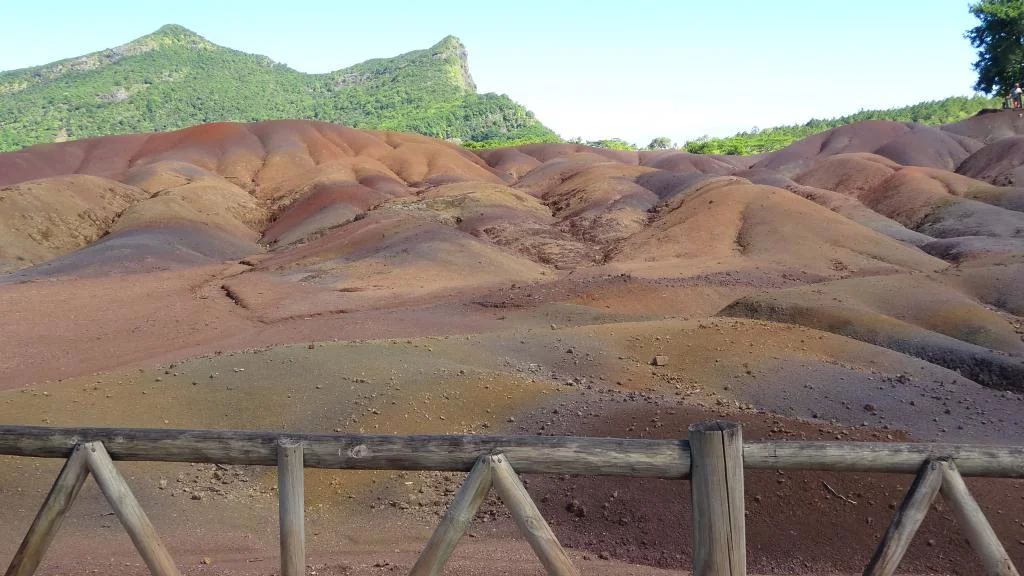
Seen from above, the colors flow like streams: brick-red bands, others almost violet, pale ochre passages that turn yellow when the sun hits them. Seen from below, at fence level, entire hillsides change hue, with the green peaks of the massif in the background. And the strangest contrast remains this: this barren land, surrounded on all sides by a dense, tall forest that seems to stop at an invisible border.
The name promises seven colors. In reality, one can distinguish more of a series of continuous shades, from red to purple through brown, orange, yellow and bluish greys, the exact number of which depends mainly on the time you are there.
Where do colors come from?
The colors of Chamarel come from the chemical weathering of basalt, and not from a flow of colored lava or volcanic ash. This is the conclusion of the only scientific study published on the site, which appeared in 2010 in the Journal of African Earth Sciences under the signature of HC Sheth, CP Johnson and CD Ollier.
The mechanism is the same as in all tropical soils: in a hot and very humid climate, rainwater slowly decomposes volcanic rock deep down. Silica and soluble elements are leached and carried away; only the most resistant compounds remain, primarily iron and aluminum compounds. These are the secondary iron oxides and hydroxidesFormed during this alteration, which color the earth.
Red, yellow, brown: two iron minerals, not one
Simply saying "iron oxide" doesn't explain much, since almost all of Mauritius rests on red lateritic soil. The reason for the different hues just a few meters apart is that the iron doesn't always crystallize in the same form.hematiteAn anhydrous iron oxide gives the bright red color, and it is so opaque that a small amount is enough to mask the Rest. goethiteIron hydroxide produces yellow and brown. Intermediate shades, orange or tawny, correspond to mixtures of the two.
The proportion between these two minerals depends on local conditions: humidity, drainage, soil acidity, organic matter, and temperature. This is a well-established mechanism in tropical soil science—however, it has not been measured sample by sample at Chamarel, and we therefore present it as the most robust explanation available, not as a definitive record.
Blue and purple: the element of uncertainty
The bluish and purple hues are attributed to aluminum by the website operator and by almost all pages that discuss the subject. This explanation warrants a caveat: aluminum compounds in tropical soils, gibbsite in particular, are white to gray and lighten the soil rather than turning it blue. Furthermore, large-crystal hematite produces reddish-purple hues, which is at least as plausible an explanation for the purple.
We cannot make a definitive judgment, and no one seems capable of doing so today: the 2010 study, moreover, describes shades of red, brown, gray, and purple without linking each one to a specific mineral. The color-by-color lists found in brochures and infographics—limonite for yellow, magnesium for brown, copper for blue, sulfur for yellow, depending on the version—are not based on any published analysis and contradict each other from one source to another. They should be taken for what they are: reconstructions.
The sand that sorts itself
The most frequently recounted curiosity about the site is that the colors don't mix permanently: if you shake powders of different hues together, they eventually reorganize into distinct layers. The operator explains this by a repulsive effect between the iron and aluminum particles. Again, this explanation is repeated everywhere without any scientific evidence to support it; sorting by density and grain size, as occurs in any agitated mixture of powders, explains it at least as well.
Three common misconceptions
These are not sand dunes
The word "dunes" is misleading: nothing has been deposited here by wind or water. What we see is rock weathered in place, a saprolite, which outcrops to such an extent that in places the fissures of the original basalt remain intact. The landscape is one of convex slopes separated by small ravines carved by runoff, not that of a dune ridge.
This is not a volcanic eruption
The seven coloured earths are not the direct product of an eruption, nor are they a deposit of volcanic ash. These two widely held explanations are explicitly dismissed by the 2010 Study. The basalt is indeed of volcanic origin, but it is the climate, over hundreds of thousands of years, that has created the colours.
The landscape owes a great deal to man
This is the least known, and most disturbing, aspect of the image of an untouched wonder: according to the same study, the gullies that so clearly define the landscape are the result of deforestation and the subsequent sheet erosion—in other words, human alteration of the landscape. The colored earth itself was already there; it is its exposure and current shape that are due to deforestation. Vegetation does not regenerate because the soil, stripped of its topsoil and regularly eroded by rain, no longer offers anything for roots to take hold.
A testimony gathered from someone who knew the site as a child sheds light on the rest of the story: back then, one could run freely on the colored earth, and many visitors left with a handful of soil as a souvenir. It was this repeated removal and trampling that led to the installation of the barriers that now prohibit access to the ground.
Finally, the site is regularly presented as unique in the world. The authors of the study point to comparable formations in Papua New Guinea and believe they could be common in well-watered tropical regions with volcanic substrates, simply poorly described until now. Rare, spectacular, and remarkably well-presented: yes. Unique: there is no evidence to support this claim.
A site known since 1879
The Seven Coloured Earth was first described in 1879, and has only been open to the public since the late 1960s — so it is a recent attraction on an island scale, on land that was privately owned long before.
The name Chamarel dates back to 1786: two French brothers, Toussaint-Antoine and Charles-Antoine de Chazal de Chamarel, obtained a concession on this site called "Le Nuage". Charles-Antoine attempted to grow sugarcane, cotton, and indigo there until his departure from Mauritius in 1815. The estate now belongs to Case Noyale Ltd. and is operated by Cap d'Abondance Ltd., both companies within the Rogers Group.
The site is one of the most frequented on the island: the Mauritian magazine Presence cited the figure of 435,000 visitors for the year 2018 alone. This is an old order of magnitude, but it gives a good idea of what to expect in high season and in the middle of the day.
The giant tortoises of Aldabra
An enclosure of giant Aldabra tortoises sits beside the colorful hills, in the shade of large trees, and is included in the entrance fee. These are the largest land tortoises in the world, native to the Aldabra Atoll in the Seychelles — so they are not Mauritian, even though they have replaced the extinct endemic giant tortoises here.
They graze, move at their own pace, and pay little attention to visitors. The park staff feeds them in the morning; visitors are asked not to feed them themselves. With children, this is often the part of the visit they remember best.
What the ticket covers in addition to the dunes
The ticket grants access to three distinct attractions: the viewpoint overlooking Chamarel Waterfall, the Coloured Earth, and the Turtle Park with its garden of endemic plants. It also includes a café and a gift shop located within the park. This makes the price significantly more reasonable: you're not paying an entrance fee for a single attraction covering 7,500 square meters.
There chamarel waterfallThe island's highest single-fall waterfall, plunging approximately 100 meters, can be admired from two viewpoints along the road leading to the colorful land. We have dedicated a separate article to it. Please note: the descent to the base of the waterfall is not included in the ticket price and it is forbidden to attempt it alone.
However, two neighboring sites often confused with the geopark are not not included: Ebony Forest and the lavilléon estate Have their own ticket office.
When to come to see the colors
The colors are most visible in clear weather, mid-morning and late afternoon, when the light hits from the side and highlights the relief. At midday, the light flattens the nuances and the land appears more uniform; on cloudy days, the overall effect is duller but still visible.
Two common-sense points: Chamarel is at a high altitude and it rains considerably more there than on the coast, so a downpour can arrive quickly even when the weather is fine in Flic en Flac. And since the park is on the route of organized excursions, midday is the busiest time. Arriving early solves both problems.
Access, opening hours and prices
How to get there
The entrance to the geopark is located on the Chamarel road, in the Black River district. The easiest access is by car, coming up from the west coast via Case Noyale or from Le Morne. Tickets can be purchased from your vehicle at a drive-through booth located at the main entrance.
Once you've passed the ticket office, there's still some walking to do within the grounds: 1.5 km to the waterfall viewpoint, and 3 km to the colored earth, with parking at each stop. On foot, it's a 6 km round trip, with some elevation gain. Minibuses, cars, scooters, motorcycles, bicycles, and taxis are permitted; 60-seat coaches cannot access the area. If you don't have your own vehicle, our guide to car rental in Mauritius will help you get organized.
Schedules
The geopark is open every day, including Sundays and public holidays, with seasonal hours: from October to May from 8:30 am to 5:30 pm, last ticket sold at 5:00 pm; from June to September from 8:30 am to 5:00 pm. The café and shop open at 9:30 am and close at 5:00 pm.
Prices
At the time of writing, the official ticketing website displays 800 rupees per non-resident adult and 400 rupees per child aged 5 to 11Entry is free for children under 5. Mauritian residents pay 400 rupees per adult and 200 rupees per child, upon presentation of an identity document or residence permit.
Please note: the official website's FAQ page still lists prices as 750 and 375 rupees for non-residents. The official ticket office is the only reliable source of information, and prices at a private site may change without notice: check before you go. There are no guided tours offered, but the park provides a mobile app and information panels are located along the route.
Things you need to know before you come
Park rules
Three activities are strictly prohibited in the geopark: picnicking, bringing pets, and collecting plants. Drones are also prohibited, except with prior authorization from the operator, as are commercial photo shoots. Personal photography and videography are, of course, permitted.
Accessibility
The park is not suitable for people with reduced mobility: the operator himself indicates that the paths are made of basalt rock and present a difficulty, while announcing renovation work intended to improve this aspect. However, the colored earth remains visible from the platform and the immediate vicinity of the parking lot, which already allows visitors to see the main features.
Payment
The park only accepts Mauritian rupees in cash, bank cards (excluding Diners Club), and local mobile payments. Foreign currency is not accepted at the ticket office, café, or gift shop. Tickets must be paid for in a single transaction; cash and card payments are not permitted.
Plan the day
Since picnics are prohibited and the shop and café are located inside the park, entry is not permitted solely for consumption; a ticket is still required. Be sure to wear good walking shoes, bring sun protection as the site offers no shade, and a light jacket or umbrella during the rainy season.
Around Chamarel
Chamarel is rarely visited alone: It's one of the highlights of a day in the west of MauritiusJust a few minutes from the geopark, the chamarel's point of view open free of charge on the coast and the bay of Le Morne. le morne Brabant Mountain, a world heritage site, is about a twenty-minute drive away.
To situate all these places in relation to each other and to plan your route, the tourist map of Mauritius remains the simplest way.
Frequently asked questions about the seven coloured earth
Where do the colors of the chamarel soil Come From?
The colors of the Chamarel soil result from the chemical weathering of basalt under a humid tropical climate, which left iron oxides and hydroxides in place. Hematite produces the red, goethite the yellow and brown; the bluish and violet hues are generally attributed to aluminum, although no published analysis has confirmed this.
Is the land of seven colors unique in the World?
The seven-coloured earth of Chamarel is probably not unique in the world: the study published in 2010 in the Journal of African Earth Sciences points to comparable formations in Papua New Guinea and believes they could exist in other well-watered tropical regions with volcanic substrate.
How much does it cost to enter the Seven Coloured Earths of Chamarel?
Entry to the Chamarel Geopark costs 800 rupees per non-resident adult and 400 rupees per child aged 5 to 11; children under 5 are free. Mauritian residents pay 400 and 200 rupees respectively. This ticket includes access to the Coloured Earth, the waterfall viewpoint, and the turtle park.
Is the Chamarel waterfall included in the ticket?
The geopark ticket includes access to the two viewpoints overlooking the Chamarel waterfall, but not the descent to the foot of the falls, which is prohibited independently and can only be done with a specialized provider.
How much time should be allowed for the Visit?
Allow approximately one hour to explore the entire geopark by car: the viewpoint overlooking the waterfall, the walk along the coloured earth, and the turtle park. There's no time limit for your visit, which can be extended if you take the time to stop at the café and the gift shop.
Is it possible to walk there from the entrance?
It is possible to reach the Coloured Earth on foot from the main entrance of the geopark: the walk is 3 km one way, or 6 km round trip, with some elevation gain and a stop at the waterfall viewpoint. Most visitors make this journey by car.
Can we walk on colored earth?
Walking on the colored earth of Chamarel is prohibited: it is protected by barriers and can only be viewed from the path and platform built above. This protection was put in place after years of trampling and soil removal by visitors.
Is the Seven Coloured Earth accessible by wheelchair?
The Chamarel Geopark is not wheelchair accessible: its paths are made of basalt rock, and the operator acknowledges the difficulty, while announcing improvement work. The site remains visible from the parking area and the viewing platform.
Is it possible to have a picnic on site?
Picnics are not allowed within the Chamarel Geopark. Sandwiches, paninis, and drinks are sold at the café located near the colored earth.
Is it possible to fly a drone over the site?
The use of a drone is prohibited in the Chamarel geopark without prior authorization from the operator, which must be requested before the visit.
Can we pay in euros at the entrance?
The Chamarel Geopark does not accept any foreign currency in cash: payment is made in Mauritian rupees, by bank card or by local mobile payment, in a single transaction for entrance tickets.
What is the best time of day to see the colors?
The colors of Chamarel are best seen in the mid-morning and late afternoon on clear days, when the low-angled light highlights the landscape. Midday washes out the nuances and also coincides with peak visitor numbers.

The information in this article is for guidance purposes only. The author and publisher accept no responsibility for the accuracy of the information provided. Prices and opening hours of a private site may change without notice: it is recommended that you check them directly with the operator before your visit. See the Terms (Article 12). Last updated: August 2026.
(the photos sent will only be used to complete this page and will never be commercially operated outside this site without your agreement)
To share your Mauritius vacation photos with friends, family, and colleagues, we offer a free, personalized webpage dedicated to your trip. Simply share the webpage address, for example, www.ilemaurice-im/vacancesdepierreetmarie, with anyone you'd like to share your photos with.
It's very simple, just click on the button below.
Info +:
Rent a car
Book a hotel or villa
Buy a plane ticket
Paying
7-day weather forecast
Walk and hike
Accessible child and stroller
Parking
Bathroom
Restoration
Bus routes: Click here
Your advertising on this page?
Do you want to display an advertisement for your activity on this particular Page (or elsewhere on the Site)?
Please contact us in click here.
Contribute, improve this page
We want to provide the most relevant and complete information to Internet users, so if you want to provide additional or modification to this page (text, photo, etc.), or even report an error, do not hesitate to contact us by sending us an email to the following address: contribuer@ilemaurice.im
(remember to clearly indicate the page to which your contribution relates)
(The photos you send will only be used to complete this page and will never be used commercially outside of this site without your permission)
Tested by writing
A very pretty spot, one of the must-sees when you come on vacation to Mauritius, especially as it's coupled with a visit to the Chamarel waterfall.