
Botany and nature
The frangipani tree in Mauritius
The frangipani tree in Mauritius, the flower that perfumes tropical evenings
 The essentials in a few words
- The frangipani (genus Plumeria) is a small tree native to tropical America, which has become one of the most common trees in Mauritian gardens.
- Its five-petaled waxy flowers are white with a yellow center, pink or red, and very fragrant, especially in the evening.
- In the southern hemisphere, flowering runs roughly from October to June; in winter, many trees lose their leaves.
- Its milky sap is irritating to the skin and eyes, and toxic if swallowed.
- Cuttings and flowers cannot be packed in the suitcase: health regulations upon arrival in Europe and Reunion Island prohibit them.
Five petals as thick as wax, spiraling around a golden-yellow center: the frangipani flower is undoubtedly the most recognizable of the tropics. In Mauritius, the tree is part of the everyday scenery, in courtyards, village gardens, and hotel walkways. During the warm season, its thick, gnarled branches are topped with clusters of white, yellow, pink, or red flowers, and its fragrance, already present during the day, becomes even more intense at nightfall.
Behind this picture-postcard image lies a plant from tropical America, a name borrowed from an Italian noble family, a sacred flower from Bali to Laos, and a curious trick: the frangipani attracts moths with the promise of nectar it doesn't actually produce. Here's how to recognize it, when to see it bloom, what its flowers tell us around the world, and why it's best left to Mauritius.
Summary
Recognizing a frangipani
A frangipani tree is easily recognizable from afar by Its silhouette. its branches, as thick as a wrist, light gray and somewhat fleshy, divide into successive forks, forming a sort of candelabra. The leaves, long and veined like a fishbone, do not grow along the branches: they cluster in A rosette at the very tips, and it is in the center of each rosette that the flower clusters emerge. on a Mature tree, one can thus see dozens of small clusters resting at the ends of the branches, above a crown of large green leaves.
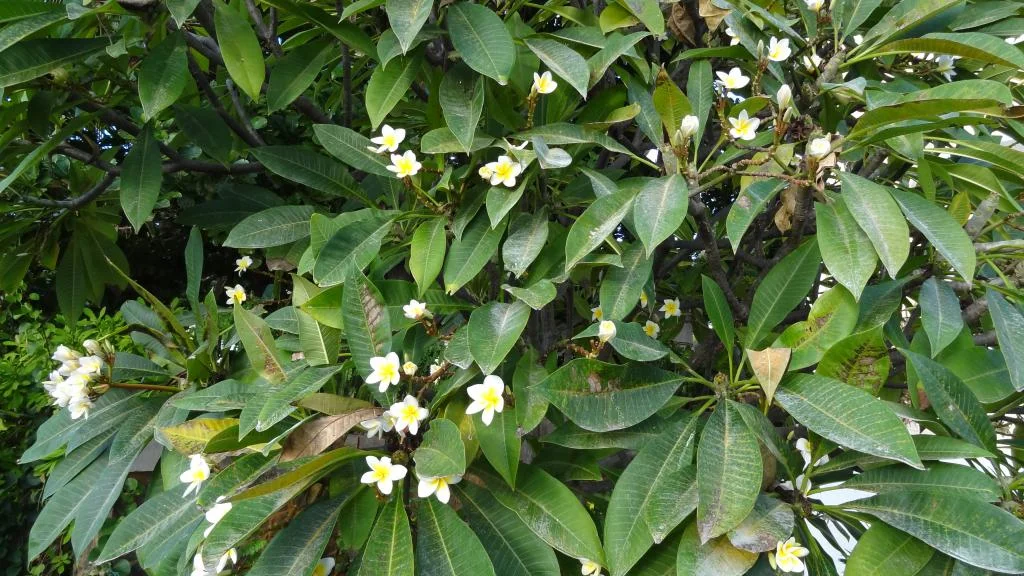
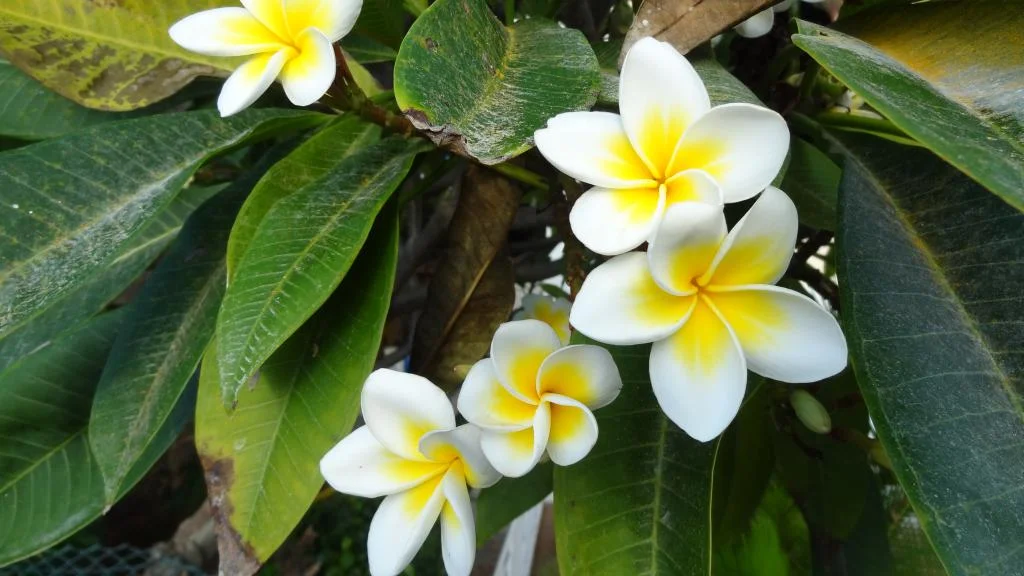
The flower itself is unlike any other. Its five petals, thick and smooth to the touch, slightly overlap and all twist in the same direction, like the blades of a small propeller. The center is almost always yellow, and the color lightens towards the edge of the petals.
White, yellow, pink or red
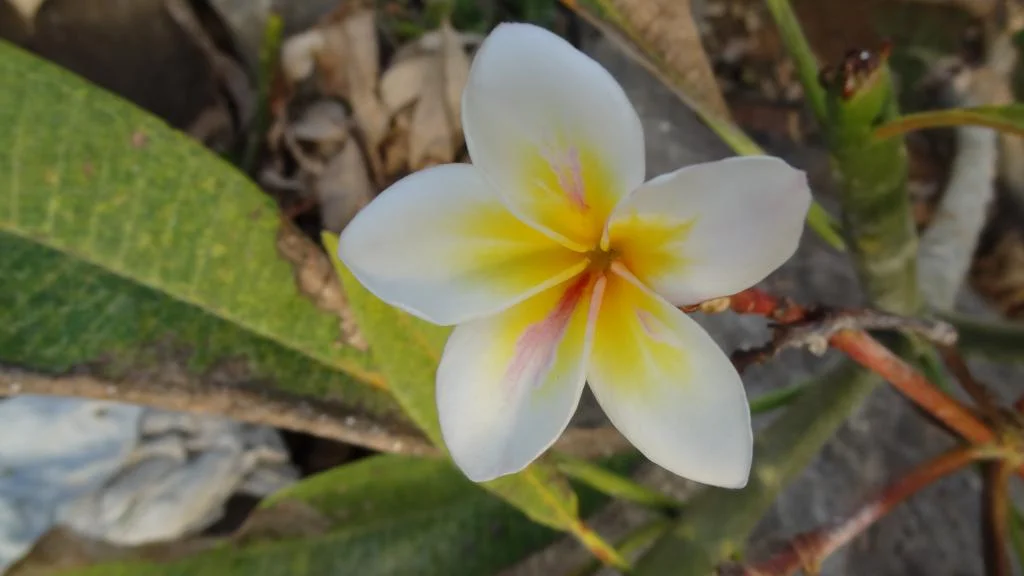
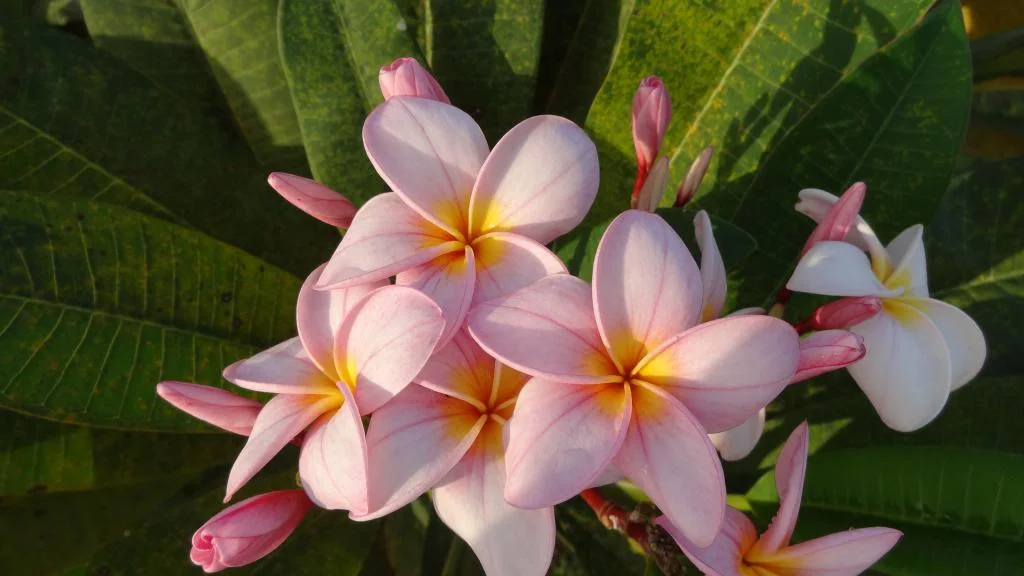
The most common form has white flowers with a bright yellow center. Other varieties include pink flowers veined with a deeper pink, always with an orange-yellow center, as well as red flowers and white flowers with fine pink streaks across the center. On some rose bushes, the unopened buds are a much darker pink than the open flower, giving the same bouquet two different shades.

Two leaf silhouettes
The genre Plumeria it comprises about ten species, but two main types are found in tropical gardens. Plumeria rubra it has pointed leaves of a rather dull green; it offers the widest range of colors, from white to dark red, and it loses its leaves during the cooler season. Plumeria obtusaThe frangipani, sometimes called Singapore frangipani, has shorter leaves, rounded at the tip and glossy green; its flowers are most often white, and it retains more of its foliage. The trees photographed for this article have pointed leaves: they belong to the first group.
A fragrance that promises what it doesn't deliver.
The frangipani's fragrance is what makes it beloved wherever it grows, and it's also a trick. Its flowers don't produce nectar. Their scent, much stronger at night, attracts hawk-moths, large nocturnal moths with long proboscises, which flit from flower to flower in search of a reward they never find. Along the way, they carry pollen. Botanists call this decoy pollination: the flower tricks its pollinator to reproduce.
This is why frangipani trees are more noticeable at the end of the day, when returning from the beach or dining on a terrace, than during the hot midday hours.
When to see the frangipani trees in bloom in Mauritius
In the Southern Hemisphere, where the seasons are similar to those of Mauritius, frangipani trees generally bloom from October to June. Flowering begins with the return of warmer weather in the southern spring and continues into autumn: the photos in this article were taken in mid-May, and the trees were still covered in blossoms. During the southern winter, from June to August, most pointed-leaved frangipani trees lose all or part of their foliage and flower only sparsely; their bare branches then have a deadwood appearance, which is short-lived.
In other words, a stay between October and May offers a good chance of seeing frangipani trees in bloom. They then accompany other trees typical of the Mauritian summer, starting with the flamboyantWhich blushes as Christmas approaches.
Where to see them
There's no need to look for a specific location: the frangipani is a garden tree, and it's in inhabited areas that you'll find it. Courtyards, public gardens, hotel and villa parks: you only need to look up while passing through a village to see them. Because it propagates very easily from cuttings, it has spread from garden to garden.
An American flower with an Italian name
The frangipani tree is not native to the Indian Ocean. The genus Plumeria it originated in the tropical and subtropical regions of America, from Mexico to the Caribbean, before being planted on all tropical continents, where it has become perfectly acclimatized. Its scientific name pays homage to Charles Plumier, a 17th-century French botanist.e century who explored the West Indies.
Its common name has a more romantic history, and several versions exist. the most Widespread links it to muzio frangipani, An Italian marquis of the 16th Century.e in the 19th century, a man is said to have created an almond-based perfume intended for scenting gloves; the flower's scent, discovered later, is said to have been reminiscent of this perfume. Another version, published in 1867 by the English perfumer Septimus Piesse, portrays Mercutio Frangipani as a sailor in Christopher Columbus's crew who supposedly smelled the flowers as they approached Antigua. This second story is now considered a fabrication, concocted to advertise Piesse's perfumes. The name Frangipani also gave rise to the word frangipane, the almond cream used by pastry chefs.
A sacred flower throughout the tropics
Wherever it has been planted, the frangipani has been adopted by local traditions, and not always in the same way.
- In Laos, the frangipani, called dok champa, is the national flower.
- In Sri LankaIt is nicknamed the flower of the temples; it is considered sacred there.
- In IndiaThe tree is often planted near temples and is used in the composition of champa incense; in Bengal, the white flower is associated with funerals.
- In BaliThe flower, called jepun, enters the small baskets of offerings placed each day in front of temples, houses and shops.
- In JavaOn the contrary, the frangipani is the tree of cemeteries; it is also planted around graves in Malaysia and the Philippines.
- In HawaiiThe flowers are used to make flower necklaces, leiThe flower worn behind the ear is said to indicate whether one is single or already engaged; the most common version places the flower on the right for singles and on the left for people in a relationship, but the reverse is also read.
- In Palermo, in Sicily, where he arrived at the beginning of the 19the in the 19th century, the frangipani became a symbol of the city, and tradition dictates that a mother should offer a flower to her daughter when she gets married.
In Mauritius as in Hawaii, its flowers, firm enough to keep their shape once picked, are also used to make welcome necklaces.
Picking, touching, bringing back: what you need to know
Beware of the sap
Like many plants in its family, the oleander, the frangipani contains a sticky, white latex. This latex flows out as soon as a stem, leaf, or flower stalk is broken. It is highly irritating to the skin and eyes, and toxic if swallowed. If you pick a flower, avoid touching your eyes before washing your hands, and keep young children and animals away from broken branches.
The easiest way is to gather the fallen flowers: they detach whole, retain their shape and fragrance for some time, and don't leak any sap. In a private garden or a hotel garden, ask before taking any.
A cutting in the suitcase? No
Frangipani is very easy to propagate from cuttings, and the temptation to bring back a branch is common. This is a bad idea. Upon arrival in the European Union, live plants, including cuttings, cannot enter without a phytosanitary certificate, and non-compliant products are confiscated. In Réunion, all fresh plants are prohibited in luggage, including cut flowers. Details of these rules, and what can be safely brought back, can be found in our guide. what can and cannot you bring back in your suitcase from Mauritius?.
If you're keen to have a frangipani tree at home, it's best to buy it from a garden center when you get back. Outside the tropics, it's grown in a pot and must be overwintered indoors.
Frequently Asked Questions
When do frangipani trees bloom in Mauritius?
Frangipani trees bloom in Mauritius during the warm season. In the Southern Hemisphere, the flowering period generally runs from October to June, with trees still in full bloom by mid-May. In winter, from June to August, many lose their leaves and produce few flowers.
Where can I see frangipani trees in Mauritius?
Wherever there are gardens. The frangipani is a very common ornamental tree in Mauritius: it can be seen in courtyards, village gardens, and hotel grounds. It's not necessary to go to a specific location.
Why does the frangipani tree smell stronger in the evening?
Because its fragrance appeals to moths. The flower does not produce nectar; its scent, more intense at night, attracts sphinx moths, which pollinate it while searching for food they cannot find.
Is the frangipani flower poisonous?
It's mainly the sap that's the problem. The white latex that flows from broken stems is irritating to the skin and eyes, and toxic if swallowed. A fallen flower can be handled without worry; simply wash your hands and avoid putting it in your mouth.
Is it possible to bring back a frangipani cutting from Mauritius?
No, unless you have a phytosanitary certificate. Upon arrival in the European Union, cuttings and live plants without a certificate are confiscated, and in Réunion, all fresh plants are prohibited in luggage. It's best to buy a frangipani from a garden center on your return.
Frangipani and tiare, are they the same Flower?
No. The tiare, symbol of Tahiti, is a gardenia (Gardenia taitensis), with white, star-shaped flowers, lacking a yellow center. The frangipani belongs to a completely different genus, Plumeria, and is recognizable by its waxy petals arranged in a helix around a yellow center.
Where does the name frangipani come From?
The name is most often associated with Muzio Frangipani, an Italian marquis of the 16th century.e century, creator of an almond perfume whose scent was said to evoke the notes of the flower. Another story, that of a sailor in Christopher Columbus's crew named Mercutio Frangipani, is considered a 19th-century advertising invention.e century.
The information in this article is provided for guidance purposes only. The author and publisher accept no responsibility for the accuracy of the information provided. It is recommended that you verify the information directly with local operators or the relevant Mauritian authorities during your stay. See the Terms of Use (Article 12).
(The photos you send will only be used to complete this page and will never be used commercially outside of this site without your permission)
To share your Mauritius vacation photos with friends, family, and colleagues, we offer a free, personalized webpage dedicated to your trip. Simply share the webpage address, for example, www.ilemaurice-im/vacancesdepierreetmarie, with anyone you'd like to share your photos with.
It's very simple, just click on the button below.
More information:
Rent a car
Book a hotel or villa
Buy an airplane ticket
Paid
7-day weather forecast
Walking and hiking
Child and stroller accessible
Wheelchair accessible
Parking
Public toilets
Fast food outside
Bus routes: Click here
Your advertisement on this page?
Do you want to display an advertisement for your business on this particular Page (or elsewhere on the Site)?
Thank you for contacting us in clicking here.
Contribute to and improve this page
We want to provide internet users with the most relevant and complete information, so if you would like to add to or modify this page (text, photo, etc.), or even report an error, please do not hesitate to contact us by sending an email to the following address: contribuer@ilemaurice.im
(remember to clearly indicate the page to which your contribution relates)
(The photos you send will only be used to complete this page and will never be used commercially outside of this site without your permission)