
Sega
Sega from Mauritius: music, dance and history of a living heritage
 The essentials in a few words
Sega is the traditional music and dance of Mauritius, inherited from African and Malagasy slaves. Its most authentic form, the sega tipik, is based on three Instruments: the ravanne (a large goatskin drum), the maravanne and the triangle. The songs, in Creole, tell of love and everyday life, to a rhythm that accelerates as the dancers sway their hips without ever touching. Recognized by UNESCO in 2014, séga is experienced both in hotel shows and, more spontaneously, on beaches on Sundays or at family celebrations. It is the most direct expression of Mauritian joie de vivre and cultural fusion.
All it takes is a wood fire, a few voices, and the rumble of a ravanne drum for séga to come alive. On a beach at sunset, in a village courtyard, or on a hotel stage, this music born of slavery has become the sonic soul of Mauritius: a rhythm that gradually builds, hips that sway, Creole lyrics that speak of love and everyday life. Sega is not simply folk entertainment. It is a living memory, recognized by UNESCO, that all Mauritians carry within them.
Understanding sega music means grasping a large part of Mauritian identity: its cultural mix, its painful history, and its remarkable ability to transform suffering into joy. Here's everything you need to know before experiencing authentic sega music firsthand.
Summary
- What is sega?
- In its Origins: the music of slaves
- The instruments of the Sega Tipik
- The dance: the hip roll
- Ti Frère, Serge Lebrasse and the great voices
- From séga to seggae: Kaya and the new generations
- Sega recognized by UNESCO
- The Rodrigues drum sega
- Where to see and experience sega music in Mauritius
- Frequently Asked Questions
What is sega?
Sega is simultaneously a music, a song, and a dance. In Mauritius, its traditional form has a specific name in Creole: the sega tipik (typical sega). We also talk about sega ravanne, named after the instrument that is its beating heart.
Musically, séga tipik follows a highly recognizable structure: the songs begin slowly in a minor key, then the rhythm gradually accelerates until it reaches a joyful trance. The soloist improvises the lyrics, most often in Mauritian Creole, and the audience joins in on the choruses. It's a music of sharing, designed to be danced to, sung together, and experienced as a group rather than passively listened to.
Culturally, séga holds a place in Mauritius comparable to that of maloya in Réunion: that of a foundational music, long confined to modest communities before becoming a unifying national symbol. All Mauritians, regardless of their origin, know how to dance séga.
In its Origins: the music of slaves
The roots of séga go back to the period of slavery, starting in the 18th century. This music, of essentially Afro-Malagasy origin, was born from the mixing of practices of men and women deported from the east coast of Africa and Madagascar to work on sugar cane plantations.
In the evenings, after work, these enslaved people would gather around a large fire. Sega music was a way to evoke their distant homeland, to remember, to sing their sorrows like a lament—a role similar to that played by the blues in the United States. It was also a space of rediscovered freedom, for one night, far from the gaze of their masters. The first colonists and missionaries viewed these gatherings with great suspicion and openly disapproved of these moments when people let themselves go to the sound of the ravanne drum.
The exact origin of The word "séga" remains uncertain. Several hypotheses circulate: It may come from chegaThe name "séga" could refer to a dance from the Mozambique region, or perhaps to a Swahili term. Similarly, the word "ravanne" might be of Tamil origin. This element of mystery perfectly illustrates the profound nature of séga: a blend of memories from several continents.
This story remains very present in the mauritian landscape. The Morne BrabantThe refuge for runaway slaves is now a World Heritage Site, a symbol of resistance to slavery. This exploration can also be extended by... slave Route monument or through the commemorations surrounding theabolition of slaveryCelebrated every year on February 1st.
The instruments of the Sega Tipik
Authentic séga tipik is based on a trio of traditional instruments. No need for amplification or sophisticated equipment: a ravanne, a few voices and a campfire are enough to bring it to life.
The ravanne, the soul of sega
The ravanne is the centerpiece, the only truly indispensable instrument. It is a large frame drum, made of a wooden hoop over which a goatskin is stretched — the famous "lapo cabri" in Creole. Its diameter generally varies from 30 to 70 centimeters.
Unlike most drums, the ravanne is struck vertically with both hands. The player—the ravanne player—places it on their thigh, sitting, squatting, or standing with one leg slightly raised to keep their hands free. An essential detail: the drumhead must be regularly warmed over the fire to remain taut and resonate fully. It is precisely for this reason that sega has always been played around a wood fire.
In its most elaborate form, séga is played with several ravannes with complementary roles: a smaller, higher-pitched solo ravanne, a rhythmic ravanne, and a larger, lower-pitched bass ravanne to create depth in the rhythm.
The maravanne and the triangle
There maravanne it is a flat, rectangular box, traditionally made from dried sugarcane stalks and filled with seeds. When shaken, it produces a rattling sound similar to that of maracas, which lays down the rhythmic foundation.
THE triangleThe sideways strike adds a sharp, metallic punctuation that structures the tempo. Together, the ravanne, maravanne, and triangle form the immediately recognizable sonic signature of séga tipik.
Ancient and modern instruments
Other instruments, rarer today, used to accompany the sega: the bobreA musical bow connected to a calabash serving as a resonator, or the makalapo. Over time, séga has also incorporated Western instruments—guitar, accordion, violin—giving rise to more modern forms that some call "variety séga." A movement to return to its roots now seeks to preserve séga tipik in its most stripped-down form.
The dance: the hip roll
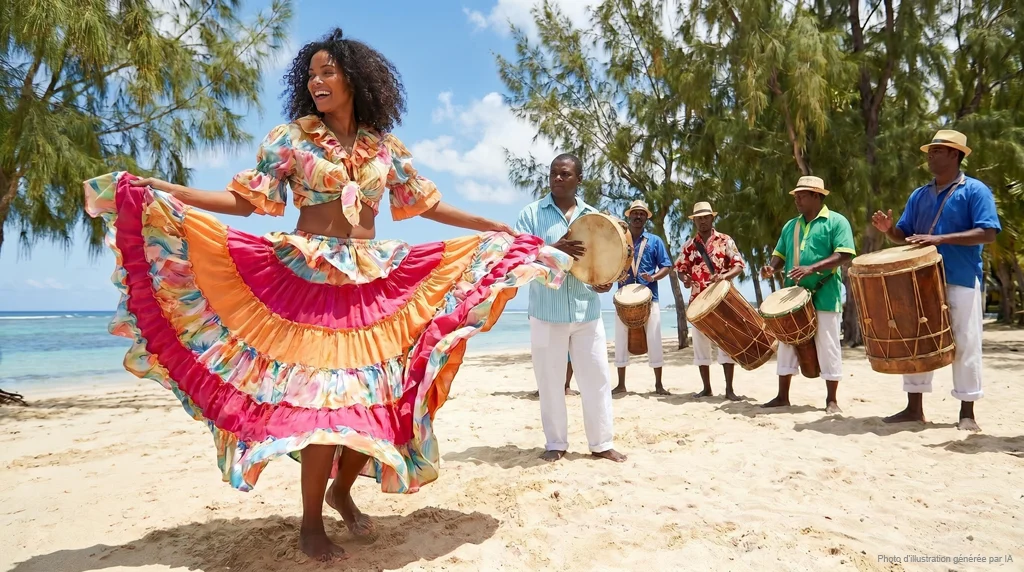
Sega music is inseparable from its dance. The dancers move around each other with small, gliding steps, never lifting their feet high, undulating their hips and hands to the rhythm of the percussion. The woman twirls a wide, colorful, ruffled skirt, while the man accompanies her in a choreography of gentle touches.
It is often described as a "dance of desire": the partners draw closer, circle each other, and brush against one another without ever touching. This restrained sensuality, both playful and elegant, is an integral part of the spirit of séga.
The traditional women's costume—a full, colorful skirt and a tied top—accentuates every hip movement and plays with the light. As the ravanne drum speeds up, the dance intensifies, becoming a collective celebration where young and old join in the movement.
The lyrics, however, are almost always in mauritian creoleSometimes mixed with other languages, they tell stories of love, jealousy, everyday miseries and joys, with a keen sense of phrasing and humor. Understanding a few words of Creole allows you to grasp the full flavor of a séga song.
Ti Frère, Serge Lebrasse and the great voices
If traditional sega music has survived to this day, it is largely thanks to a handful of figures who carried it and made it known beyond the villages.
The most iconic is undoubtedly Ti Frère, whose real name was Jean-Alphonse Ravaton, considered the "king Of séga". he gained Recognition On the island from the 1960s onwards, Notably thanks to songs that have become classics such as Roseda and AnitaHe helped to make séga tipik part of the common heritage of Mauritians.
Other names have left their mark on the history of this music, including Serge Lebrasse and Michel Legris, who brought séga to international prominence. Later, in the 1990s, the group Cassiya it enjoyed immense popular success and accompanied an entire generation. it was Also after the independence of Mauritius in 1968 that séga truly gained national recognition, becoming a shared source of pride rather than a music relegated to the margins.
From séga to seggae: Kaya and the new generations
Sega music did not remain static. In the 1980s, a young artist from Roche-Bois, in Port-Louis, would profoundly renew it: Joseph Reginald Topize, better known as Kaya — a name borrowed from an album by his idol Bob Marley.
With his group Racinetatane, Kaya blends the rhythms of séga and Jamaican reggae to create an entirely new genre: the seggaeThe name says it all: it contains "séga," surrounded by the spirit of reggae. His lyrics in Creole, delivered with a magnetic stage presence, speak of love, unity, social justice, and identity. Tracks like Simé lalimier or Singing love have become veritable anthems throughout the Indian Ocean.
Kaya's fate took a tragic turn: arrested after smoking cannabis at a concert, he died in custody on February 21, 1999, at only 38 years old, in circumstances that shocked the country and sparked several days of riots. Even today, February 21st is marked by a national tribute to seggae and his memory. Seggae itself has become one of the island's most popular genres, carried on by numerous contemporary artists.
Sega recognized by UNESCO
The recognition of sega music took a major turn on November 27, 2014, when the mauritian séga tipik has been inscribed on UNESCO's Representative List of the Intangible Cultural Heritage of Humanity. This inscription officially recognizes séga as a performing art, a vector of cohesion and identity.
UNESCO's description highlights the defining characteristics of séga: songs in minor keys with accelerating rhythms, dancers swaying their hips and hands, a soloist improvising in Creole, all accompanied by the drum, rattle, and triangle. The lyrics, rooted in everyday life, speak of love and life's challenges.
Mauritius now boasts three expressions linked to séga music or to Creole and Bhojpuri culture inscribed on UNESCO's Intangible Cultural Heritage list: séga tipik (2014), geet gawai—songs and wedding rituals of Indian origin—inscribed in 2016, and séga tambour de Rodrigues (2017). The séga tambour des Chagos was added in 2019 to the list of cultural heritage in need of urgent safeguarding. This international recognition has strengthened national pride and the transmission of séga, which is now even taught in schools.
The Rodrigues drum sega
Rodrigues Island, which is part of the Republic of Mauritius, has its own variant: the sega drumMore jerky and more hammered than Mauritian séga tipik, it also draws its origins from the resistance of maroon slaves, who used it as a means of communication and rebellion in the remote regions of the island.
Sega drum is played with a drum that is struck energetically, accompanied by The Triangle (the "triyang"), the box, and other percussion instruments. Rodrigues also has a second traditional form, the sega kordeon, played on the accordion. Deeply rooted in daily life — family celebrations, village festivals, ceremonies — the séga tambour has become a true emblem of Rodriguan identity, carried by many groups who take care to pass it on to younger generations.
For travelers seeking authenticity, Rodrigues offers a sega experience that is often more spontaneous and intimate than in Mauritius. A visit to the island, for example during an excursion to thecoconut IslandThis could be an opportunity to hear a séga tambour resonate up close to its players.
Where to see and experience sega music in Mauritius
Good news for visitors: sega Music can be experienced everywhere in mauritius, Provided you know where to look. here Are the main opportunities to discover it.
Shows in hotels
Most seaside hotels regularly host Sega evenings, often featuring dancers in traditional costumes and musicians. This is the most accessible and comfortable way to experience Sega for the first time. While the performance is sometimes a bit staged for the audience, it remains an excellent introduction, especially for families.
On the beach, on sunday
For a more authentic experience, nothing beats a public beach on a Sunday or public holiday. Mauritian families spend the day there, and it's not uncommon for a group to bring out their ravanne drums in the late afternoon for a spontaneous, joyful séga performance, free from any tourist crowd. This is where you truly grasp what séga is all about: a collective and impromptu celebration.
Festivals and major events
Several events are celebrating sega music. Kreol International FestivalA highlight of Creole culture, it is given pride of place every year during the celebrations of the national holidayMarch 12th, like the tribute to Kaya on February 21st, are also highlights for hearing séga and seggae music. In the capital, the esplanade of Caudan Waterfront port-Louis regularly hosts musical events.
In the villages, in the evening
Finally, by venturing away from the major tourist areas, you might be lucky enough, as night falls, to stumble upon locals playing traditional sega music around a campfire. This is the rarest and most precious experience—the one that directly connects the traveler to the origins of this music.
Frequently Asked Questions
What is the difference between sega and seggae?
Sega is the traditional music of Mauritius, inherited from the slaves, played on the ravanne drum. Seggae is a more recent genre, created in the 1980s by Kaya, which blends the rhythm of sega with that of Jamaican reggae, often with politically charged lyrics.
What is séga tipik?
"Séga tipik" means "typical séga" in Creole: it is the traditional and purest form of séga, played solely with the ravanne, the maravanne, and the triangle, without modern instruments. This is the form that has been inscribed on UNESCO's Intangible Cultural Heritage list since 2014.
What are the instruments of sega Music?
Sega tipik relies on three instruments: the ravanne (a large goatskin drum, played with both hands), the maravanne (a flat box filled with seeds, producing a rattling sound), and the triangle. The ravanne is the only truly essential instrument.
Why is the ravanne heated over the Fire?
The goatskin stretched over the frame loosens with humidity and coolness. Heating it tightens it again so that it resonates fully. This is why séga is traditionally played around a wood fire.
Where can one see a sega show in Mauritius?
The easiest way is to attend an evening organized by a hotel. For a more authentic atmosphere, public beaches on Sundays, village festivals, and major festivals like the Kreol International Festival offer great opportunities to discover séga in its natural setting.
Is Sega difficult to dance?
Sega is first and foremost a dance of pleasure and sharing: there are no codified steps to memorize. The essential thing is to let your hips sway to the rhythm of the ravanne. In Mauritius, visitors are readily encouraged to join in the dance.
Who was Kaya?
Joseph Réginald Topize, known As Kaya (1960-1999), was a mauritian singer born In roche-Bois, considered the creator of seggae. His death in detention in 1999 deeply affected the country. every February 21st, mauritius Pays tribute to him.
(The photos you send will only be used to complete this page and will never be used commercially outside of this site without your permission)
The information in this article is provided for guidance purposes only. The author and publisher accept no responsibility for the accuracy of the information provided. It is recommended that you verify the information directly with local operators or the relevant Mauritian authorities during your stay. See the Terms of Use (Article 12).
More information:
7-day weather forecast
Rent a car
Book a hotel or villa
Buy an airplane ticket
Frequent questions - FAQ
All tourist sites and activities
Complete guide to SIM cards for tourists in Mauritius
Formalities and procedures for coming on vacation to Mauritius
All the complete guides
Bus routes: Click here
Your advertisement on this page?
Do you want to display an advertisement for your business on this particular Page (or elsewhere on the Site)?
Thank you for contacting us by clicking here.
Contribute to and improve this page
We want to provide internet users with the most relevant and complete information, so if you would like to add to or modify this page (text, photo, etc.), or even report an error, please do not hesitate to contact us by sending an email to the following address: contribuer@ilemaurice.im
(remember to clearly indicate the page to which your contribution relates)
(The photos you send will only be used to complete this page and will never be used commercially outside of this site without your permission)