
Museums - historic sites
National history museum - Mahébourg
The Mahébourg Museum: From pirate gold to the flag that went to the moon
 The essentials in a few words
The National History Museum of Mahébourg presents the whole history of Mauritius: the treasures of the shipwrecks of the Dutch period (the Banda of Pieter Both, the pirate ship Speaker), the bell of the Saint-Géran, the dodo and extinct birds, slavery and the slave trade, the naval battle of Grand Port of 1810 and the arms of Surcouf, and pieces as unexpected as the armchair of Charles Telfair or a Mauritian flag taken to the Moon by Apollo 11.
He occupies the Robillard house, a colonial residence built around 1772, whose grounds house an old railway car.
Entry was free.
The museum has been closed for renovation since December 15, 2025, with no known reopening date.
Gold and silver coins from Mexico, Holland, Austria, and Mughal India, recovered from the wreck of a pirate ship. Chinese porcelain salvaged from the shipwreck in which Pieter Both perished in 1615. The bell of the Saint-Géran, whose shipwreck inspired Paul and VirginiaThe cannons, maps, and models of the Battle of Grand Port, the only French naval victory inscribed on the Arc de Triomphe, are on display. The National History Museum in Mahébourg recounts four centuries of Mauritian history, from shipwrecks during the Dutch period to the 20th century, including stories of the dodo, slavery, and privateers. It also holds some surprises: the armchair of naturalist Charles Telfair, an old railway carriage, and a small Mauritian flag that traveled to the Moon and back with Apollo 11.
These collections are housed in the Robillard House, a late 18th-century colonial residence located at the end of a palm-lined avenue on the Royal Road in Mahébourg. Inside, on red-painted wooden floors, the pieces are displayed in glass cases lined with scarlet fabric. The house itself has a place in history: in August 1810, during the Battle of Grand Port, it served as a hospital for both sides, and the two opposing commanders were treated there under the same roof.
Please Note: the museum has been closed since December 15, 2025. it is undergoing a complete renovation, as its roof is in danger of collapsing. As of September 2026, no reopening date has been announced. Do not travel to visit it without first verifying that it has reopened: all details are available in the section Closure and renovation: where does the museum stand?This article describes the museum as we visited it in 2024; the presentation of the collections will be redesigned during the renovations and may be different upon reopening.
Summary
- What the sea has given back: the Banda, the Speaker and the Saint-Géran
- The dodo and the extinct birds
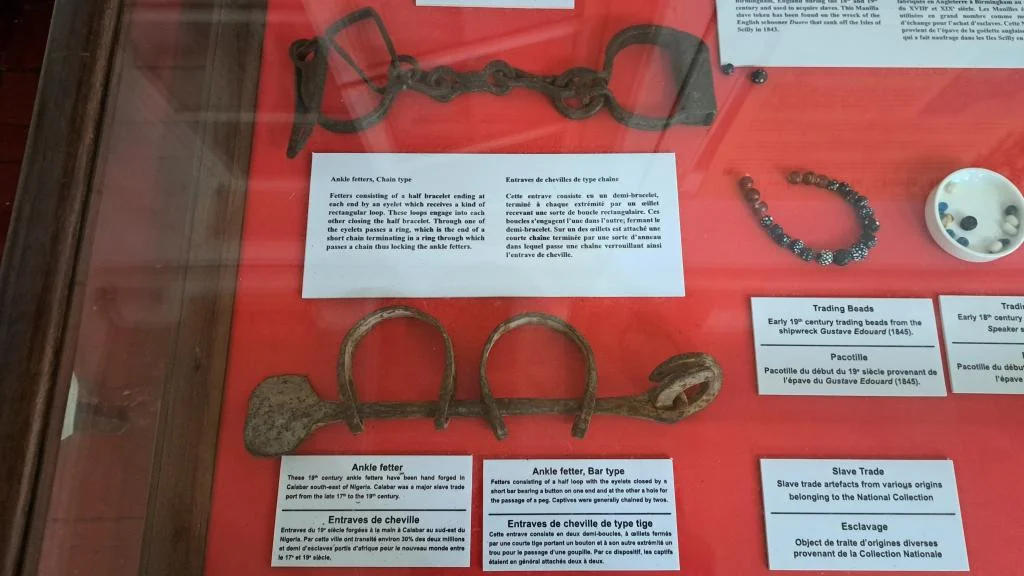
- Slavery and the slave trade
- The battle of Grand Port and the corsairs
- Unexpected objects
- The Robillard house, a museum in an 18th-century residence
- Closure and renovation: where does the museum stand?
- Practical information
- Frequently Asked Questions
- Photos
What the sea has given back: the Banda, the Speaker and the Saint-Géran
Before becoming a colony, Mauritius was a stopover, and its reefs sank many ships. Three famous wrecks have yielded some of the museum's finest artifacts.
The Banda and the death of Pieter Both (1615)
In a display case filled with sand, dozens of blue and white Chinese porcelain bowls, cups, and plates are placed among pieces of gnawed wood and coral concretions. They come from the Banda, the ship of Pieter Both, Governor-General of the Dutch East Indies. On Christmas Day 1614, he left Asia to return to Holland with a fleet of four ships laden with merchandise. In early March 1615, at the height of cyclone season, the fleet reached Mauritius, then uninhabited. A storm arose, and Pieter Both drowned when the Banda sank.

The museum's information panel states that the wreck was discovered in 1979 off the west coast, near Medina. Tradition, however, placed the tragedy on the reefs of Baie du Tombeau, north of Port Louis: the location remains debated, as we explain in our article on pieter Both's mountain, which bears his name.
The Speaker's Gold, the ship of the pirate John Bowen (1702)
This is undoubtedly the most fascinating display case in the museum. Against a red background are arranged coins from all over the world: a Spanish eight-real coin minted in Mexico City, a leeuwendaalder a silver coin minted in Dordrecht in 1602, an Austrian thaler from 1695, a French écu, gold coins from the Ottoman Empire, small gold ingots, a silver rupee minted during the reign of the Mughal emperor Aurangzeb and mounted as a pendant on a chain. Nearby are glass beads, some made in Venice, which served as currency, a bronze statuette from southern India, a navigational compass, and fragments of clay pipes.
This disparate treasure belongs to the Speaker, a former slave ship turned pirate vessel under the command of John Bowen. As the exhibition label explains, the diversity of the coins stems from the number of ships of all nationalities that it had captured. At the very beginning of 1702 (January 7, according to the archaeologists who studied the wreck), the Speaker ran aground on a reef off the east coast, near Roches Island. Mauritius was then under Dutch control and poorly defended: Bowen and most of his men reached land, negotiated with Governor Roelof Deodati, and managed to leave the island two months later, in early March 1702.
The wreck was located in 1979 by French archaeologists Jacques Dumas and Patrick Lizé. It has been the subject of further campaigns since, in partnership with the Mauritius Museums Council: an inventory carried out at the museum in 2019 recorded more than 1,700 objects, and an underwater mission in 2021 found 32 cannons and several anchors on the site.
The bell of Saint-Géran (1744)
On the night of August 17-18, 1744, the Saint-Géran, a ship of the French East India Company, was wrecked on the reefs off Amber Island, in the northeast. This shipwreck inspired Bernardin de Saint-Pierre's novel Paul and VirginiaThe wreck was discovered in 1966 by Mauritian divers, who recovered the bell: it was then displayed at the Mahébourg Museum. The story of the shipwreck is recounted in our article on the Saint-Géran memorial, at Poudre d'Or.
The dodo and the extinct birds
It's impossible to tell the story of Maurice without mentioning the dodo. The museum displays a reproduction of the famous "Edwards' Dodo," painted by Roelandt Savery around 1626 and donated to the British Museum in London by George Edwards. The information panel describes it, along with the one from Surat, as the most faithful representation of the bird. Nearby, a panel presents another, less well-known, extinct species: the red hen (Aphanapteryx bonasia), a bird with a woodcock-like beak that lived only in Mauritius. Like the dodo, it became extinct at the end of the 17th century, around 1675, less due to hunting than to predators introduced by the Dutch: rats, dogs, and wild pigs. To learn all about the island's emblematic bird, see our article on the dodo.
Slavery and the slave trade
Part of the museum is dedicated to slavery, on which the island's economy depended until its abolition in 1835. A panel from the Mauritius Museums Council explains in simple terms how slaves were brought to Mauritius: torn from their land, crammed into the holds with the merchandise, without space, air, or light, many died during the crossing. It reproduces the plan of the hold of a slave ship drawn by C. Montembert in 1827, where hundreds of figures are lined up in tight rows, like merchandise.
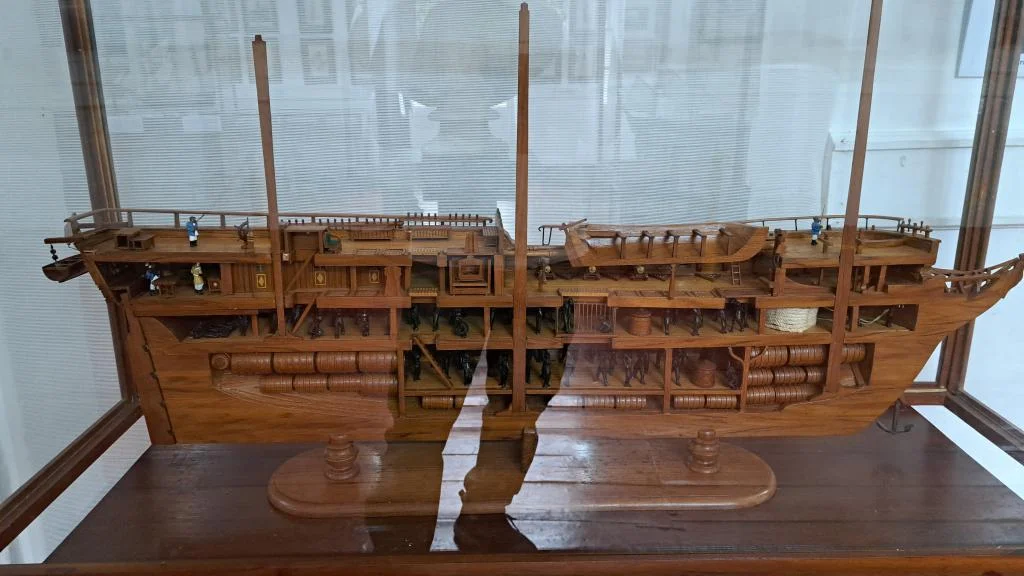
In a nearby display case, a large cross-section model of a slave ship makes the situation even more concrete: on the deck, armed guards; in the hold and even in the bilge, between the barrels, the captives.

The panel on the slave trade, with the plan of the tween deck of a slave ship drawn by Montembert in 1827.
The battle of Grand Port and the corsairs
The museum originated from naval relics, and the Battle of Grand Port remains one of its major themes. In late August 1810, in the bay off Mahébourg, Captain Guy-Victor Duperré's French squadron inflicted a resounding defeat on the British: their frigates ran aground on the lagoon's shoals, and the battle became the only French naval victory inscribed on the Arc de Triomphe. The museum evokes it through period cannons and cannonballs, nautical charts, navigational instruments, ship models, engravings, and illustrations of the battle. The full story is in our article on the battle of Grand PortAnd the most astonishing episode, that of the two enemy commanders being treated in the house itself, is recounted further down, in the section on the robillard House.
The privateers who roamed the Indian Ocean from Mauritius (then known as Île de France) also have their place, with the arms attributed to Robert Surcouf. According to The MauritianThe museum also featured 19th-century lithographs by Alfred Richard and documents relating to the sinking of the British cargo ship Trevessa in 1923.
Unexpected objects
The Mauritian flag that went to the Moon
In a red display case, a small Mauritian flag with four stripes—red, blue, yellow, and green—is sealed in a transparent block, beneath a few tiny fragments of lunar rock. The label explains that it was presented to the Mauritian people by US President Richard Nixon: this flag traveled to the Moon and back aboard Apollo 11 in July 1969, and that the fragments were brought back by the crew of that first lunar landing. Like other countries, Mauritius received this gift from the American people after the mission, barely a year after its independence.
The mauritian flag carried to the Moon by Apollo 11, along with fragments of lunar rock given by Nixon
Charles Telfair's armchair
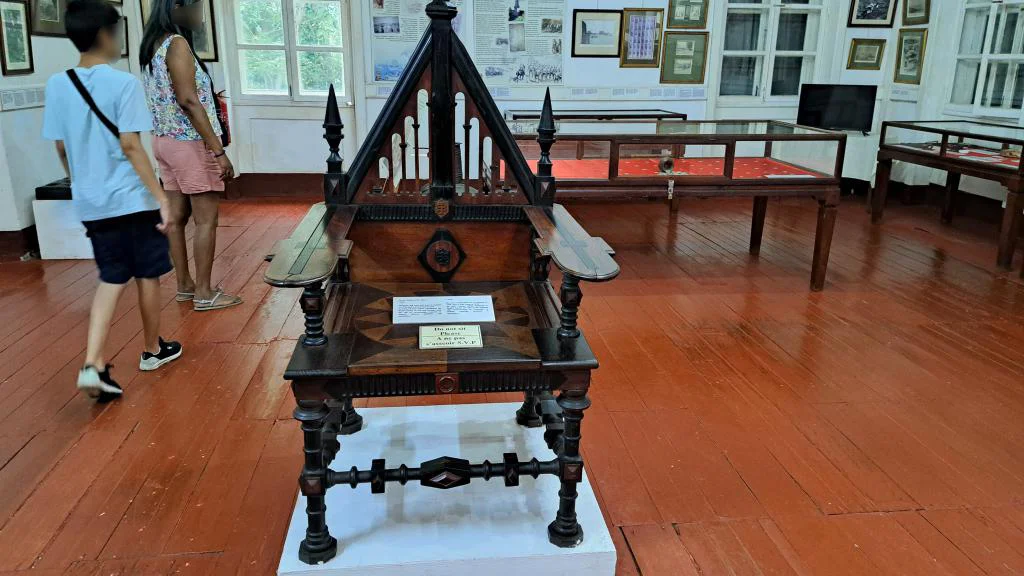
In the center of a room stands a carved armchair with a high, triangular back, made of dark inlaid wood. It belonged to Charles Telfair (1778-1833), a physician and naturalist born in Ireland and who died in Port Louis. In 1829, the information panel reminds us, Telfair founded the Royal Society of Arts and Sciences to encourage research in natural history, medicine, and agriculture. A small sign, in English and French, clearly states that sitting in it is forbidden.
Charles Telfair Armchair
A car from the old railway
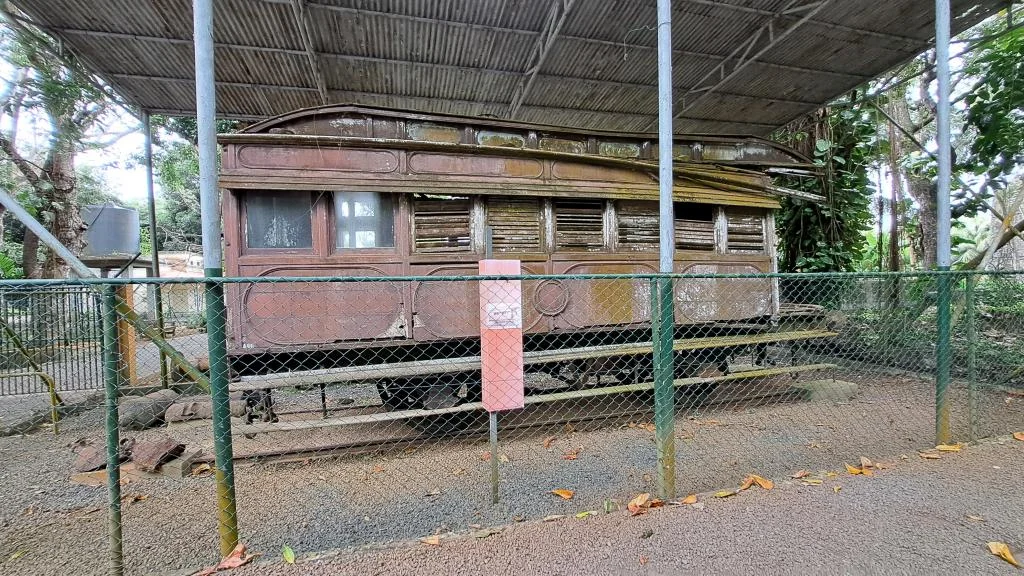
In the park, under a corrugated iron shelter and behind a wire fence, rests an old passenger car with louvered windows, badly damaged by time. It is a rare relic of the railway that crisscrossed Mauritius for a century. The Midlands line, which connected Port Louis to Mahébourg, opened in 1865. The last passenger train ran in 1956; the transport of sugar and goods continued until 1964, then the network was dismantled and sold for scrap.
The Robillard house, a museum in an 18th-century residence
Even before entering, the museum takes in its own image. The house sits at the end of a wide, shaded driveway, bisected by flowerbeds, an old cannon pointed towards the entrance, and a fountain. Two levels of windows with grey shutters, a wrought-iron balcony, a high, sloping roof, a porch opening into two symmetrical staircases: a late 18th-century manor house.
August 1810: Two enemy commanders treated under the same roof
For several days at the end of August 1810, the cannons of the Battle of Grand Port thundered just a few kilometers from the house. It then became a field hospital for both fleets. The wounded, French and British alike, were brought there, including the two commanders: Duperré, hit in the face by grapeshot, and the English captain Nesbit Willoughby, who lost an eye in the fighting. Two adversaries who had been shelling each other the day before found themselves being treated side by side, in the same house.
From Robillard to Gheude
The house was built around 1772, according to the most frequently cited date, on an estate bordering the la chaux river. At That Time, it belonged to Jean de Robillard, a naval officer who became commander of the Grand Port district, after whom it is Named. The MauritianHe became its sole owner in 1771 and died there in 1809, a year before his house housed the wounded from Grand Port. Other accounts claim he also received the wounded there in 1810: the sources disagree on this point.
The property then passed through several hands in the 19th century, eventually reaching the Gheude family, who gave it its other name: Château Gheude. The Mauritian state bought it back after the Second World War to establish a museum there.
A museum that has changed its name several times
The museum opened to the public on September 15, 1950. It initially housed naval relics, hence the name naval museum by which name many still know it, and later as the historical and naval museum. After a major renovation that began in 1998, it reopened on August 2, 2000 under its current name of national history museum (National History Museum). All these names refer to the same place. It is under the jurisdiction of the Mauritius Museums Council, the public body that manages the island's national museums.
Closure and renovation: where does the museum stand?
The National History Museum of Mahébourg has been closed to the public since December 15, 2025.And no reopening date had been announced as of our last check in September 2026.
The cause is the house's severely deteriorated shingle roof. When we visited in 2024, it was already covered with a green tarp; according to L'ExpressIt had been in place for over three years at the time of the closure. The Council of Ministers acknowledged the closure on December 12, 2025, to protect the collections during the cyclone season while awaiting roof replacement. It had initially been announced as a one-year closure.
The project was subsequently expanded. In April 2026, responding to a parliamentary question, the Minister of Arts and Culture explained that the government was abandoning piecemeal repairs in favor of a complete renovation: roof repairs, replacement of wooden structures damaged by damp, general site rehabilitation, and a redesigned exhibition layout with support from France. The 2026-2027 budget allocated 100 million rupees for this purpose. On July 8, 2026, the Minister visited the building with a technical delegation to prepare the tender process. The work is expected to last approximately one year once this process is complete; therefore, a closure much longer than initially announced is anticipated.
The museum is also among the sites included in the declaration of intent for the preservation of heritage signed in April 2025 between the Ministry of Arts and Culture, the French Embassy, Business Mauritius and the association SOS Patrimoine en péril, alongside the Pamplemousses Garden and the former Supreme Court.
Where are the collections during the renovations?
At the time of the closure, the government announced the transfer of the most valuable coins to the port louis natural history MuseumAnd others to the People's Museum of Mauritius in Pointe-Canon, Mahébourg. The aim was to safeguard them: there is no indication that they are on public display there, and the Mauritius Museums Council website lists the Pointe-Canon museum as temporarily closed as well. Therefore, don't expect to see the Saint-Géran bell or the Speaker's treasury anywhere else during the renovations.
Practical information
Address and access
The museum is located on the Royal Road in Mahébourg, in the southeast of the island, on the banks of the La Chaux River. You will find the museum on our tourist map, along with the other sites in the southeast.
Prices and opening hours
The entrance was free before the closure. The opening hours published by the Mauritius Museums Council, valid until December 15, 2025, were as follows:
- monday, Tuesday, Thursday, Friday and Saturday: 9am to 4pm;
- wednesday: 11am to 4pm;
- sundays and public holidays: 9am to 12pm.
These times and free admission may change upon reopening: check them before your visit.
To find out about the reopening
The museum is under the jurisdiction of the Mauritius Museums Council. Its published contact details are (+230) 631 9329 and the email addresses mhg.museum@orange.mu and mimuse@intnet.mu. The official website, mauritiusmuseums.govmu.org, indicates the opening status of each museum.
On site
The museum occupies two levels of the house, plus the grounds where the cannon and railway carriage are located. The labels are written in English and French.
Things to see in Mahébourg while waiting for the reopening
If you're traveling through the southeast, the rest of the city is worth a visit: its waterfront, market, and Creole houses are described in our article on MahébourgThe Dutch history of the bay can also be read in Vieux Grand Port, at Fort Frederik Hendrik and its museumManaged by the same organization: check that it's open before you go. And just a few minutes away, the lagoon of Blue Bay offers one of the most beautiful beaches on the island.
Frequently Asked Questions
Is the Mahébourg museum open?
No. The mahébourg national history museum Has been closed for renovation since december 15, 2025, And no reopening date had been announced as of september 2026.
When will the Mahébourg museum reopen?
No date has been announced. As of July 2026, the tender for the works was still being prepared, and the project is expected to last approximately one year once it begins. Check with the Mauritius Museums Council before making any trip.
Can the collections be viewed elsewhere during the Renovations?
Not to our knowledge. The most valuable pieces have been placed in safekeeping at the Natural History Museum in Port Louis and others at the People's Museum of Mauritius in Pointe-Canon, but there is no indication that they are on public display there.
Is there an entrance fee for the museum?
Before its closure, entry was free. The conditions for visiting upon reopening are not yet known.
Naval museum, historical museum, national history museum: Are they all the same Place?
Yes. Opened in 1950, the Mahébourg museum was initially called the Naval Museum, then the Historical and Naval Museum, before adopting its current name, the National History Museum, in 2000. It occupies the Robillard house, also known as Gheude Castle.
Why is the Robillard house linked to the Battle of Grand Port?
In August 1810, during the Battle of Grand Port, fought in the nearby bay, the house served as a field hospital for both sides. The two enemy commanders, the Frenchman Duperré and the Englishman Willoughby, both wounded, were treated there.
What is the Speaker?
A pirate ship commanded by John Bowen, wrecked on the east coast of Mauritius in early 1702. Its Wreck, discovered in 1979, Yielded gold and silver coins from all over the world, which were exhibited at the mahébourg Museum before its closure.
Is the bell of Saint-Géran in the Mahébourg museum?
It was on display there before the closure. During the renovations, it is not visible.




The information in this article is for guidance purposes only. The author and publisher accept no responsibility for the accuracy of the information provided. It is recommended that you verify information directly with local operators or the relevant Mauritian authorities during your stay, particularly regarding the reopening of the museum with the Mauritius Museums Council. See the Terms (Article 12).
(The photos you send will only be used to complete this page and will never be used commercially outside of this site without your permission)
To share your Mauritius vacation photos with friends, family, and colleagues, we offer a free, personalized webpage dedicated to your trip. Simply share the webpage address, for example, www.ilemaurice-im/vacancesdepierreetmarie, with anyone you'd like to share your photos with.
It's very simple, just click on the button below.
Info +:
CLOSED FOR RENOVATIONS
7-day weather forecast
Rent a car
Book a hotel or villa
Buy a plane ticket
Free
wednesday: 11am to 4pm;
sundays and public holidays: 9am to 12pm.
Ride
Child-friendly
Wheelchair accessible (exterior only)
Parking
Public toilets
Bus routes: Click here
Your advertising on this page?
Do you want to display an advertisement for your activity on this particular Page (or elsewhere on the Site)?
Please contact us in click here.
Contribute, improve this page
We want to provide the most relevant and complete information to Internet users, so if you want to provide additional or modification to this page (text, photo, etc.), or even report an error, do not hesitate to contact us by sending us an email to the following address: contribuer@ilemaurice.im
(Remember to indicate the page concerned by your contribution)
(the photos sent will only be used to complete this page and will never be commercially operated outside this site without your agreement)