
Coral Spawning in Mauritius, the Pink Sea
When the Mauritian lagoon turns pink
 The essentials in a few words
Coral spawning is a massive, synchronized reproduction event: entire colonies release their gametes on the same night, a few hours after sunset. Carried to the surface by the current, these gametes color the shoreline pink or red, most often at sunrise. In Mauritius, this phenomenon can be observed between October and December on the southeast coast, with Blue Bay and Pointe d'Esny as prime locations. The exact date varies each year, depending on the lunar cycle, water temperature, and coral species. No reliable calendar yet exists for the island. Observing the coral from the beach is free and requires no equipment.
Key milestones for the 2026 Season — Egg-laying generally occurs in the days following a full moon in late austral spring. The lunar dates of the season should be monitored, but not considered as egg-laying dates:
- Full moon of October 26, 2026 — the one most often cited for Maurice
- Full moon of November 24, 2026
- Full moon of December 24, 2026
The window of opportunity to watch is the week following each of these dates. The year-to-year difference is significant: in 2025, the October full moon fell on the 7th, compared to the 26th in 2026, a difference of almost three weeks. A trip timed to coincide with last year's dates would completely miss it.
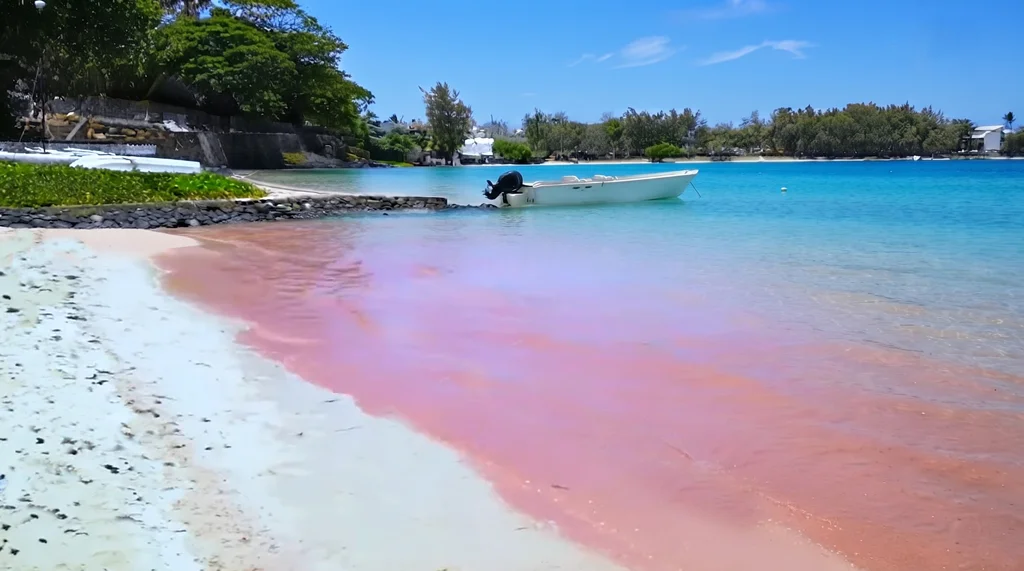
A few nights a year, at the start of the southern summer, the corals of the Mauritian lagoon release their eggs and sperm all at once into the dark water. Billions of tiny colored beads rise to the surface, gather together, and drift with the current. At dawn, those strolling along the beaches of the southeast find the water no longer turquoise: a pink, sometimes distinctly red, trail runs along the shoreline and stretches for hundreds of meters. The spectacle can be seen from the sand, without a mask, without a boat, and without a guide.
This pink hue isn't algae, pollution, or salt deposits, even though all three explanations circulate every year on Mauritian social media. It's the reef's spawning, one of the most spectacular events in the living world, and one of the most difficult to witness: it lasts only a few hours, its date changes every year, and no one in Mauritius can yet predict it to the exact day. This page explains what happens underwater, what determines the date, where to position yourself for a chance to see it, and what Mauritian scientists are currently researching.
Summary
- What's happening in the lagoon
- When to Observe it: what really determines the date
- Where to observe it in Mauritius
- How to proceed on site
- What mauritian scientists are still looking for
- Why this egg matters to Maurice
- The same phenomenon elsewhere in the world
- What science explains, and what it doesn't explain
- Frequently Asked Questions
- Photos
What's happening in the lagoon
Sexual reproduction, synchronized to the night
Coral spawning is a sexual reproduction event during which entire colonies simultaneously release their gametes—eggs and male cells—into the water column. Coral is a sessile animal: it cannot seek out a mate. Its only strategy is to release its reproductive cells at the same time as its neighbors, so that mating occurs in open water.
In Acropora, the most widespread genus in Mauritian lagoons, the colonies are hermaphroditic: they release clusters containing both eggs and sperm, which rise to the surface before separating and merging. These colonies reproduce only once or twice a year. This is what makes the event so brief and so difficult to observe.
Synchronization is vital. By releasing all eggs at the same time, colonies massively increase the probability that an egg will encounter a male cell before being dispersed by the current or swallowed by a predator. A colony that laid eggs alone, on a different night, would leave no offspring.
Why does water turn pink?
The color comes from the gametes themselves, which are white, yellow, orange, or pink depending on the species, and float because they are rich in lipids. When millions of colonies release their color on the same night, the surface of the lagoon becomes covered with a film of these particles. The current and the rising tide then gather them against the shore, where they form a continuous band, sometimes several meters wide.
This is why the phenomenon is visible from the beach, even though the spawning itself occurred at night and underwater. What we see in the morning is not the spawn itself, but rather what it left behind. The coloration fades within a few hours, as soon as the tide recedes and the gametes disperse or sink.
What happens to these billions of cells
Once released, the gametes begin a journey where almost everything is lost. The stages are as follows:
- Fertilization it takes place in the first few hours, in open water, before the current has diluted the pool of gametes.
- Larval development transforms the fertilized egg into a swimming larva called a planula, which drifts for a few days to several weeks.
- The installation requires that the planula find a hard, clean and well-lit substrate on which to attach itself. A bottom covered with sediment or algae is unusable for it.
- Growth it then takes years, sometimes decades, before the young coral participates in spawning.
The survival rate is extremely low: Only a tiny fraction of the larvae will reach Adulthood. this is precisely why production must be measured in Billions. each egg-laying is like a lottery ticket bought in vast quantities.
When to Observe it: what really determines the date
There is no fixed date, and that is the most important point.
No calendar date occurs every year. Travel websites often claim that egg-laying takes place "early October" or "between October 7th and 10th": this is incorrect, and following this advice leads to visiting at the wrong time. Egg-laying is synchronized with the lunar cycle, which shifts by about eleven days from one year to the next. A date that worked one year will fall on a different date the following year.
The best method is to start with the full moon of the season and monitor the days that follow. This is also what the inhabitants of the southeast do, alerting each other and sharing observations in real time on social media.
The three factors that trigger egg-laying
Three signals combine, and all three must be brought together.
- The season and the water temperature. The warming of the lagoon at the start of the southern summer is the underlying signal. It determines the month, and it explains why Mauritian egg-laying is concentrated between October and December.
- The lunar cycle. Moonlight regulates this fine synchronization, to within a few days. Corals possess photosensitive proteins capable of perceiving these variations in nighttime light.
- The hour of the night. The release almost always occurs after sunset, within a window of a few hours. The darkness puts the gametes out of reach of diurnal predators for the duration of fertilization.
This has been observed in previous years
Observations reported by the Mauritian press and local residents give an idea of the actual dispersion of dates, and the uselessness of a fixed calendar:
- 2020 — pink sea reported in early November, in the Pointe-Jérôme and Mahébourg region, after the full moon of October 31.
- 2021 — phenomenon observed at Pointe d'Esny and Blue Bay around October 25, after the full moon of the 20th.
- 2023 — egg-laying monitored at Blue Bay in november, with scientific support from eco-Sud on site.
- 2025 — colouring announced then observed in early October, and again in early November: two episodes in the same season.
These episodes span approximately six weeks depending on the year, and a single season can include several episodes. The only constant is that the window opens in October and closes in December.
How long is the show?
The coloration visible from the shore lasts for a few hours, rarely more than a day. Locals in the southeast describe the water as distinctly pink at sunrise, fading as the morning progresses. For a visitor, this means arriving early and on the right day—hence the importance of monitoring local reports rather than taking a chance.
Where to observe it in Mauritius
Blue Bay, the reference site
The marine park of Blue BayThe lagoon in the southeast of the island, near Mahébourg, is the site where spawning is most regularly observed and the only one monitored in an organized manner by scientific teams. The lagoon there boasts a higher density of live coral than the island average, protected by its marine park status. The public beach allows visitors to view the water from the shore without any special equipment or procedures.
Pointe d'Esny
The beach of Pointe d'EsnyBlue Bay, the immediate neighbor of the island, is another place where the pink sea is reported almost every season. It has provided some of the most widely circulated images of the phenomenon. The shoreline is lined with private properties for much of its length: it's best to aim for public access points.
The rest of the southeast coast and the east
Other beaches in the southeast and east can receive the gametes, depending on the current's direction that night. The coloration doesn't necessarily appear where the spawning took place; it appears where the current pushes the slick. This is also why scientists are now searching for other spawning sites outside of Blue Bay. To locate these beaches and prepare for a trip, the interactive tourist map covers all the locations in the region, and our portrait of south of Mauritius provides the context of the sector.
How to proceed on site
From the shore, in the morning
Head to the beach early in the morning, as close as possible to sunrise, in the days following a full moon from october to december. it's The only way to observe the moon that requires Nothing: no equipment, no reservation, no expense.
Some practical points: the colour is best seen from a slightly elevated point or by moving away from a few dozen metres, because a pink sheet seen too close blends with the background; a raking light of early morning makes it stand out more than a sun at its zenith; and an overcast sky or a choppy sea can make it almost invisible.
Snorkeling or night diving
Observing the show itself requires being in the water at night, a few hours after sunset, which is a guided outing and not a personal initiative. Entering the water at night in a lagoon, even a shallow one, is not something to be undertaken lightly: visual landmarks are absent, currents are difficult to read, and the fragile reef can be unintentionally damaged.
The best course of action is to contact a dive center on the southeast coast in advance; they will be able to tell you if a dive trip is possible during your stay. Our page on snorkeling in Mauritius provides the basics, and the regulations for diving in Mauritius specifies the framework applicable to supervised outings.
Actions that protect the reef
A reef spawning is at its most vulnerable time. Precautions can be summarized in a few points:
- Never touch or collect anything, including gametes.
- Do not walk on the coral, including parts that appear dead.
- Avoid disturbing the sediment: a larva needs a clean surface to attach itself to.
- Limit underwater lighting and sudden movements, which disrupt the emission.
- Avoid using sunscreens that are not compatible with the marine environment before entering the water.
- Reporting an observation to local associations: these reports directly contribute to scientific monitoring.
What mauritian scientists are still looking for
A laying schedule is currently being developed.
Since 2025, a Mauritian program has been monitoring coral spawning to establish the precise, yet missing, calendar. It involves the NGO Eco-Sud, the international organization Secore, and the oceanarium. Odysseo in Port-Louis and the University of Mauritius. Its head, biologist Gaëlle Quéré, summarizes the objective of the first year as follows: to understand which species lay eggs, and when they lay eggs.
The program also aims to identify other mass spawning sites besides Blue Bay, so far the only one identified as such. Ultimately, the goal is to collect gametes to produce young corals and replant them on degraded reefs—a different approach from coral fragmentation, which clones existing colonies where sexual reproduction renews genetic diversity.
What this changes for a visitor
This means that, to date, no one in Mauritius can announce a laying date in advance, and any website claiming otherwise is presenting information that local scientists do not yet have. It also means that the coming seasons should provide much more precise indicators as observations accumulate. Reporting to associations contributes to this process.
Why this egg matters to Maurice
What the reefs do for the island
Mauritius is encircled by an almost continuous barrier of fringing reefs, which explains the very existence of the lagoon and its calm waters. Their role goes far beyond mere scenery:
- Coastal protection : the reef breaks the swell before it reaches the coast and limits beach erosion.
- Biodiversity Coral reefs are home to about a quarter of the world's marine life while covering less than 1% of the ocean's surface.
- Economy : they support seaside tourism and coastal fishing, two pillars of Mauritian activity.
- Food : they provide a share of the resources for local artisanal fishing.
The 2025 whitewash
In March 2025, a bleaching event affected approximately 80% of the corals in Mauritian waters during a peak in ocean temperature. Bleaching occurs when a coral stressed by heat expels the symbiotic algae that nourish it and give it its color: it turns white and dies if the situation persists.
This is what gives the spawning observed in the following months its distinctive character. The fact that a largely bleached reef is still able to reproduce indicates that some of the colonies have survived. Fishermen in the southeast echo this sentiment when they comment on the return of the pink water: the corals retain their ability to reproduce.
What is being attempted to save them
Several initiatives are underway in Mauritius: coral nurseries that cultivate fragments before replanting them, the scientific monitoring of spawning described above, the marine protected area status of certain sectors including Blue Bay, and awareness campaigns targeting both residents and visitors. None of these measures alone can offset ocean warming, but they maintain living reef nuclei from which recolonization can begin.
The same phenomenon elsewhere in the world
Synchronized spawning is not unique to Mauritius: it occurs wherever there are coral reefs, at different times depending on the latitude and hemisphere.
- The Great Barrier Reef, in Australia, is the most studied site in the world for this phenomenon, observed there in november and december.
- The Caribbean they lay their main eggs in august and september, also in the days following a full moon.
- The Indian Ocean — Reunion Island, the Maldives, the Seychelles — observe it in roughly the same window as Mauritius, between September and December.
- Southeast Asia follows its own cycles, generally in spring or autumn depending on the archipelago.
Not all species on the same reef spawn at the same time: some spawn several times a year, others much less frequently, and a single species can shift its spawning from one site to another. This is one of the reasons why establishing a local spawning calendar requires several years of observation.
What science explains, and what it doesn't explain
Internal clocks set to the sky
Corals possess daily and monthly biological rhythms that regulate their functions, including gamete maturation. The perception of moonlight, via photosensitive proteins, provides the monthly cue; temperature variations provide the seasonal cue; and nightfall triggers the emission itself. Recent studies are also focusing on the interplay of light and shadow around the full moon, rather than the full moon alone.
The details of the mechanism remain partially unknown. In particular, it is unclear to what extent the colonies coordinate with each other through chemical signals, and why in some years egg-laying is split into two episodes a month apart.
What global warming disrupts
Climate change is acting on several of these factors simultaneously. Warmer waters earlier in the season can shift or desynchronize the emission of spores between neighboring colonies, which is enough to cause fertilization to fail. Bleaching events weaken surviving colonies and reduce their reproductive efforts the following year. Ocean acidification, linked to CO₂ absorption, complicates the formation of calcareous skeletons in young corals. And the general degradation of the seabed reduces the clean surfaces on which a larva can attach.
The mauritian monitoring of egg-laying also serves this purpose: to Measure, season after season, whether the reef is still keeping its appointment.
Frequently Asked Questions
What date should we come to see the pink sea in 2026?
No dates can be guaranteed. the Window of opportunity covers the week following each of the full moons of the season: october 26, November 24, And december 24, 2026. a Stay Timed to coincide with these periods offers a chance, not a guarantee.
Is pink water dangerous for swimming?
No. These are coral reproductive cells, harmless to the touch. The phenomenon has nothing to do with pollution or a proliferation of toxic algae. The only precaution is not to disturb the area and not to collect anything.
Can the phenomenon be seen from the beach, without Equipment?
Yes, and it is even the most common method of observation. What we see then is the slick of gametes brought towards the edge, and not the spawning itself, which took place the previous night underwater.
Why is my photo less spectacular than the ones circulating?
The intensity varies enormously from one episode to another, depending on the size of the emission, the current, the tide, and the light at the time. The highly saturated images circulating correspond to particularly dense episodes, captured in the right place at the right time.
Does this phenomenon occur anywhere other Than Blue bay And pointe D'Esny?
Yes, but these two southeastern sites are the focus of reported observations. Ongoing research aims precisely to identify other mass nesting sites around the island.
Is it safe to dive during egg-laying?
Only as part of a guided night dive organized by a dive center. Advance booking is required, and the dive will depend on sea conditions.
Does egg-laying occur every year?
Yes, the cycle repeats itself every season. Its magnitude, however, varies depending on the state of the reef: a massive bleaching event like the one in March 2025 reduces the number of colonies capable of laying eggs.
How can we know that it has just Happened?
Reports initially circulate locally: mauritian Pages and groups dedicated to nature, residents of the southeast coast, fishermen, and environmental associations. This is the fastest source, and the only truly reliable one in real time.
[/et_pb_code] The information in this article is for guidance only. Coral spawning is an unpredictable natural phenomenon: no date, intensity, or visibility can be guaranteed, and the lunar markers mentioned are not spawning dates. Any nighttime dives must be conducted under the supervision of a professional. The author and publisher accept no responsibility for the accuracy of the information provided. It is recommended that you verify the information directly with local operators or the relevant Mauritian authorities during your stay. See the Terms and Conditions (Article 12).
(The photos you send will only be used to complete this page and will never be used commercially outside of this site without your permission)
To share photos of your Mauritius vacation with your friends, family, and colleagues, we offer the option of creating a free, personalized page dedicated to your stay. All you need to do is forward the address of this page, for example, www.ilemaurice-im/vacancesdepierreetmarie, to those with whom you wish to share your photos.
To do this, nothing could be simpler, click on the button below.
More info:
Rent a car
Book a hotel or villa
Buy a plane ticket
Paid
7-day weather forecast
Walking and hiking
Child and stroller accessible
Wheelchair accessible
Parking
Public toilets
Fast food outside
Bus routes: Click here
Your advertising on this page?
Want to display an advertisement for your business on this particular page (or elsewhere on the site)?
Please contact us at click here.
Contribute, improve this page
We want to provide the most relevant and complete information to Internet users, so if you want to add or modify this page (text, photo, etc.), or even report an error, do not hesitate to contact us by sending us an email to the following address: contribuer@ilemaurice.im
(remember to clearly indicate the page concerned by your contribution)
(the photos sent will only be used to complete this page and will never be used commercially outside of this site without your agreement)
Your opinions / Testimonials
Be the first to leave a review using the form below