
Money, holiday budget in Mauritius: complete guide
(last updated february 2026 — If Some information is no longer up to date, do not hesitate to contact us, we will correct this page)
Before leaving for Mauritius, one question systematically arises: how much should you plan for, how to pay on site, and how to avoid losing money on exchange? This complete guide answers all these questions, from the exchange rate to tips for saving on a daily basis, including accepted payment methods, pitfalls to avoid, and an FAQ that answers travelers' most frequent doubts.
Contents
- The Mauritian rupee: the local currency
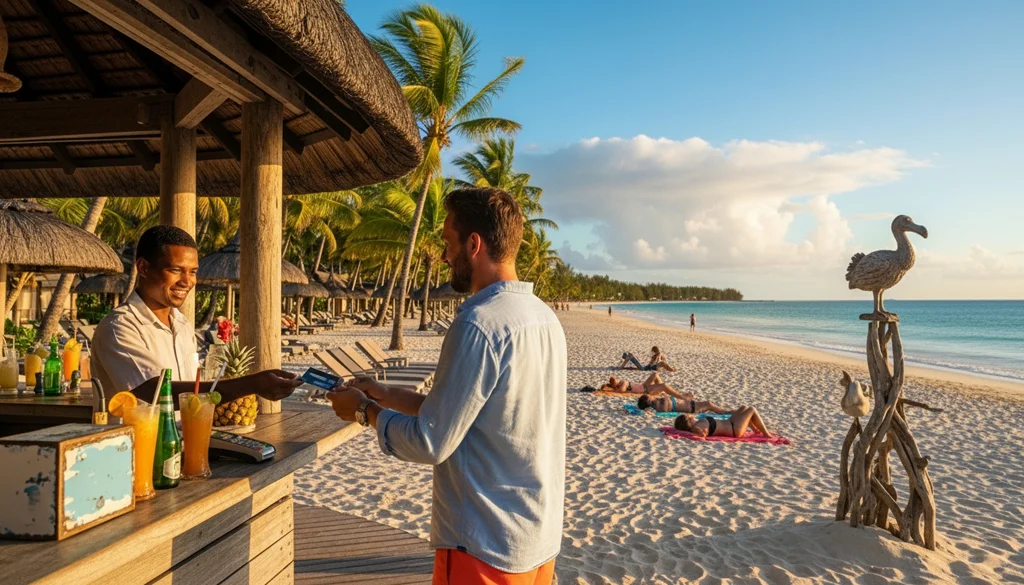
- How to pay in Mauritius?
- Where and how to change your Euros?
- What budget should you plan for your stay?
- Indicative prices in Mauritius
- Tips and VAT
- Where and how to negotiate prices?
- Traps to avoid
- Tips for optimizing your budget
- If there is a problem with your money
- FAQ – Frequently asked questions
1. The Mauritian rupee: the local currency
The official currency of Mauritius is mauritian rupee, whose international code is WALL and the symbol Rs or ₨. Some useful points to know before leaving:
- The tickets exist in denominations of 25, 50, 100, 200, 500, 1000 and 2000 rupees. The denominations of 500 and 1,000 Rs are the most common on a daily basis.
- The pieces range from 5 cents to 10 rupees. In practice, those below 1 rupee are rarely used in current transactions.
- Always keep a few small denomination notes (25, 50, 100 Rs) for street food, bus transport or small purchases in markets.
- The mauritian rupee is not convertible outside Mauritius: French banks generally do not take it back. Spend your rupees before you come in or limit your withdrawals to what you need.
The EUR/MUR exchange rate
In 2026, the exchange rate oscillates around 1 euro = 54 to 56 mauritian rupees. To simplify your calculations on site, remember that dividing the price in rupees by 55 gives a good approximation in euros. The rate varies depending on the service provider (bank, exchange office, ATM) and can change slightly from one week to the next.
- 100 rupees ≈ €1.80
- 1,000 rupees ≈ €18
- 5,000 rupees ≈ €90
Before you leave, simply type “100 MUR in EUR” in Google to get real-time conversion.
Quick conversion table (1 € ≈ 55 MUR)
| Rupees (MUR) | Euros (€) approximately | Practical reference |
|---|---|---|
| 50 Rs | ~€0.90 | Dholl puri, mineral water |
| 100 Rs | ~€1.80 | Street food, local beer |
| 200 Rs | ~€3.60 | Meals in a restaurant |
| 500 Rs | ~€9 | Complete local restaurant meal |
| 1,000 Rs | ~€18 | Short taxi ride + meal |
| 2,000 Rs | ~€36 | 1 day Car rental (low cost) |
| 5,000 Rs | ~€90 | Comfortable daily budget |
| 10,000 Rs | ~€180 | Typical ATM Withdrawal Limit |
Indicative rate based on €1 ≈ MUR 55 (February 2026). Check the current rate before you leave.
2. How to pay in Mauritius?
Mauritius is relatively well equipped for card payment in tourist areas, but cash remains indispensable as soon as you get off the beaten track. A good strategy combines the two.
The bank card
Visa and Mastercard are accepted in the vast majority of hotels, luxury restaurants, shops in tourist areas and supermarkets. On the other hand, in popular markets, street food, public transport and small village shops, cash is often the only option.
- Inform your bank before departure to avoid blocking your card from the first payment in Mauritius.
- Check and raise your payment and withdrawal limits if you plan to make large on-site expenses (hotel, car rental).
- Some merchants charge a 2-3% surcharge for paying by card — in this case, pay with cash.
- American Express is not widely accepted, except in large international hotels.
- If a distributor or merchant offers you to pay in euros rather than rupees: always refuse. The rate applied will be very unfavorable (this is the DCC — Dynamic Currency Conversion) and you can lose between 5 and 10% on the transaction.
Withdrawals from automatic teller machines (ATM)
Vending machines are present in all cities, tourist areas, supermarkets and shopping centers. Density is good in the north (Grand Baie, Pereybere), the west (Flic en Flac, Black River), the center (Quatre Bornes, Rose Hill, Curepipe) and the capital Port-Louis. In rural areas and the south of the island (excluding Mahébourg), bring cash in advance as ATMs may be rare or temporarily out of service.
- Withdrawal limit: most ATMs limit withdrawals to 10,000 to 15,000 rupees per transaction (≈ €180 to €270). Group your withdrawals to limit fixed fees.
- Reliable banks: favor ATMs backed by large, recognized banks — MCB (Mauritius Commercial Bank), SBM (State Bank of Mauritius), Absa (ex-Barclays), HSBC. Avoid isolated or uncrowded ATMs.
- Cover the keyboard when entering your code. In case of suspicious card reader (skimming), go to another ATM.
- Remove always in mauritian rupees, never in euros if the option is offered to you.
Bank fees depending on card type
| Card type | Usual withdrawal fees | Payment fees |
|---|---|---|
| Traditional French bank (Crédit Agricole, BNP, Société Générale, LCL, etc.) | 3 to 5 € fixed + 2 to 3.5% Of the amount | 1.5 to 3% Of the amount |
| Visa Premier / Gold Mastercard | Often reduced or included in the pack – check your contract | Often 0 to 1.5% |
| Online banking (BoursoBank, Fortuneo, Hello bank!…) | Free or 1–2% Depending on contract | Free or very low |
| Revolut, Wise, N26 | Free up to the monthly cap ✅ | Free (interbank rate) ✅ |
If you regularly travel abroad, opening an account with a neobank (Revolut, Wise, etc.) solely for travel is a very good idea. For a 10-day stay with frequent withdrawals, you can save €30 to €60 in bank fees compared to a traditional bank.
How much to bring in cash?
There is no universal rule, but here is a reasonable estimate depending on your travel profile:
| Profile | Recommended liquid / day | Main use |
|---|---|---|
| 🎒 Small budget (buses, markets, restaurants) | 1,500 to 2,500 Rs (≈ €27–45) | Bus transport, street food, markets |
| 😊 Average budget (restaurants + mixed activities) | 2,500 to 4,500 Rs (≈ €45–80) | Meals, excursions, small purchases |
| ⭐ Comfort / luxury (payment mainly by card) | 1,000 to 2,000 Rs (≈ €18–36) | Tips, deals, unexpected expenses |
In practice: withdrawing Rs 10,000 upon arrival (excluding the airport) comfortably covers 3 to 4 days for a couple with an average budget.
3. Where and how to change your Euros?
There are several options available to you for obtaining Mauritian rupees. They are not equivalent in terms of rate, practicality or security.
Option 1: Withdraw directly from on-site ATMs (recommended)
This is generally the most advantageous solution if you have a fee-free card abroad. You benefit from the Visa or Mastercard interbank rate, very close to the official market rate, available 24 hours a day and without significant cash handling.
Option 2: Private exchange offices on the island
Private exchange offices (called money changers) generally offer better rates than banks and are more flexible on schedules. You will find them in tourist areas: in Grand Baie (around Super U and Rue Royale), in Port-Louis (Caudan Waterfront, city center) and in the main seaside villages. Always compare the rate offered to the current rate on Google before changing a large amount.
- Absolutely avoid exchange offices at SSR Airport : rates are systematically lower. Only exchange the bare minimum there if you need a few rupees for the first fee — limit yourself to €50.
- Never change your euros with a street seller or an unofficial person: high risk of counterfeit notes or bad accounts.
Option 3: Mauritian banks
Major banks like MCB and SBM offer the official rate with a secure transaction. Constraints: limited hours (generally 9 a.m.–3 p.m. on weekdays, closed on weekends and public holidays), possible queues, some agencies require presentation of passport for exchange.
Option 4: Change before departure to France
Some exchange offices in France offer Mauritian rupees, but the rates are often less attractive than in Mauritius. This option can be useful just to have a small safety net upon arrival. Limit yourself to €50 to €100 changed before leaving.
What to remember about foreign exchange
- Do not change at the airport (except in an absolute emergency, small amount).
- Always refuse to pay in euros when a merchant or distributor offers it to you.
- Never change with an unofficial person.
- Compare the offered rate to today's rate on Google before a major exchange.
- At the end of the stay, spend your remaining rupees — they are practically inconvertible in France.
4. What budget should you plan for your stay?
Mauritius enjoys a reputation as an expensive destination. This is partly justified for 4 and 5 star hotel complexes, which are among the most expensive in Africa. But once this bias is put aside, the cost of daily living is significantly lower than in France — meals, transport, shopping, local activities are much cheaper as soon as you leave the high-end tourist infrastructure. The heaviest expenditure item remains plane ticket.
Plane tickets
A round trip from Paris costs on average 900 to 1000 € per person in economy class. Main companies serving Mauritius from France: Air Mauritius (direct flights from CDG), Corsair (from Paris Orly, often competitive), Emirates, Air France and British Airways (with stopover). Book 3 to 6 months in advance for the best deals. High season periods (Christmas, New Year, July-August) can see prices practically double.
Tip: Google Flights or Skyscanner alerts notify you when a fare drops. Tuesday or Wednesday flights are often cheaper than weekend departures. Flight+hotel packages offered by tour operators can be very advantageous for stays in 3 to 5 star hotels.
Our experience: departure from the provinces (Toulouse), tickets purchased 9 months in advance on Turkish Air Line at around 1000€/person (you have to add 100€/person to choose your seats, in our opinion, it is essential), these “fairly low” prices exist even for periods with high demand, the key is to plan very, very well in advance!
Also note, this company offers for a connection in Istanbul with a stopover of between 6 and 24 hours, the TourIstanbul service, it is a free tour of Istanbul
As soon as we have tested this company, we will give you feedback here, if you have already tested it, do not hesitate to make a comment using the form below on this page
Daily budget by profile
| Profile | Accommodation / night | Meals / day | Transport / day | Total / day / person |
|---|---|---|---|---|
| 🎒 Low budget | 20–35 € (guesthouse, homestay) | 10–15 € (street food, markets, restaurants) | 3–5 € (bus) | 33–55 € |
| 😊 Average budget | 50–100 € (3★ Hotel, rental) | 20–35 € (local + Tourist restaurants) | 15–25 € (shared car, taxi) | 85–160 € |
| ⭐ Comfort / Luxury | €150–500+ (4–5★ Hotel, resort) | €40–80+ (gourmet restaurants) | 30–60 € (rental car) | €220–640+ |
Estimates per person and per day on site, excluding plane tickets and one-off activities.
Estimate for a 10-day stay (2 people)
| Profile | Flights (2 people) | Accommodation (10 nights) | Life on site | Estimated total |
|---|---|---|---|---|
| 🎒 Low budget | 1 600–1 800 € | 400–600 € | 600–900 € | 2 600–3 300 € |
| 😊 Average budget | 1 600–1 900 € | 1 000–2 000 € | 1 400–2 500 € | 4 000–6 400 € |
| ⭐ Luxury | €1,800–5,000+ | €3,000–10,000+ | €2,500–6,000+ | €7,300 and more |
These estimates include flights but exclude travel insurance, one-off excursions, souvenir shopping and unforeseen events. Allow a margin of 10 to 15%.
Choose the right period for your budget
| Period | Impact on the budget | Conditions on site |
|---|---|---|
| April – june | ⬇ Low season — best prices | Cool season, trade winds, few tourists. Ideal for outdoor activities. |
| July – august | ⬆ High season — +30 to 50% | Mild southern winter (22–25°C), many european tourists. Book early. |
| September – november | ➡ Intermediate — good ratio | Gradual return of heat. October-November sometimes wet. |
| December – march | ⬆ High season / holidays | Hot and humid southern summer (28–32°C). Cyclonic risk january–March. Christmas = maximum prices. |
5. Indicative prices in Mauritius
These prices correspond to the average prices observed at the start of 2026. They may vary depending on the season, the geographical area (tourist area versus local village) and the type of establishment.
Restoration
| Type of meal / product | Price in MUR | Price in € |
|---|---|---|
| Dholl puri (iconic street food) | 25–50 Rs | ~€0.45–0.90 |
| Farata / roti / chilli cake | 15–40 Rs/piece | ~€0.30–0.75 |
| Fried dumplings or mines in a market | 100–200 Rs | ~€1.80–3.60 |
| Full meal in a local restaurant | 200–400 Rs | ~€3.60–7.30 |
| Menu in a tourist restaurant | 600–1,200 Rs | ~€11–22 |
| Gourmet/seafood restaurant | 1,500–3,500 Rs | ~€27–64 |
| Fast food (McDonald's, KFC, Pizza Hut) | 250–450 Rs | ~€4.50–8.20 |
| Local beer (Phoenix, Blue Marlin, Green Island) | 80–160 Rs | ~€1.45–2.90 |
| Cocktail / mixed rum | 150–350 Rs | ~€2.70–6.40 |
| Mineral water (1.5 L Bottle) | 30–60 Rs | ~€0.55–1.10 |
| Coffee/cappuccino on the terrace | 80–160 Rs | ~€1.45–2.90 |
| Fresh fruit juice (sugar cane, mango, etc.) | 60–120 Rs | ~€1.10–2.20 |
Transport network
| Transport | Price in MUR | Price in € |
|---|---|---|
| Bus journey (per section) | 15–35 Rs | ~€0.30–0.65 |
| Express bus (National Transport Corp.) | 30–55 Rs | ~€0.55–1 |
| Taxi (short ride, ~5 km) | 300–500 Rs | ~€5.50–9 |
| SSR airport Taxi → Grand Baie (~50 km) | 1,500–2,000 Rs | ~€27–36 |
| SSR airport Taxi → Flic en Flac (~60 km) | 1,800–2,500 Rs | ~€33–45 |
| Taxi application (Yego, TaxiLink) — ~10 to 20% cheaper than a traditional taxi | Variable | Variable |
| Car rental (low cost, per day) | 1,200–2,000 Rs | ~€22–36 |
| Car rental (mid-range, per day) | 2,000–3,500 Rs | ~€36–64 |
| Scooter rental (per day) | 800–1,500 Rs | ~€14.50–27 |
| Gasoline fuel (liter) | 50–58 Rs | ~€0.90–1.05 |
Taxis in Mauritius generally do not have a meter: the price must always be fixed before getting into the vehicle. The Yego and Moovit applications charge fixed and transparent prices in the covered areas.
Activities and leisure
| Activity | Price in MUR | Price in € |
|---|---|---|
| Public beaches (all beaches in Mauritius are public) | Free | Free |
| Hiking (Gorges de la Rivière Noire, Piton de la Petite Rivière Noire, etc.) | Free | Free |
| Dolphin excursion (half day) | 1,200–2,000 Rs / person. | ~€22–36 |
| Catamaran trip (full day, meals included) | 2,500–4,500 Rs / person. | ~€45–82 |
| Scuba diving (1 dive, equipment included) | 1,500–2,500 Rs | ~€27–45 |
| Snorkeling (equipment + guide) | 800–1,500 Rs | ~€14.50–27 |
| Kitesurfing (2 hour Lesson) | 3,000–5,000 Rs | ~€55–90 |
| Casela Nature Park (adult entry) | 1,500–1,800 Rs | ~€27–33 |
| Parasailing | 1,500–2,000 Rs | ~€27–36 |
| Rum distillery visit (ex. Rhumerie de Chamarel) | 500–1000 Rs | ~€9–18 |
| Pamplemousses Botanical Garden (adult entry) | 200 Rs | ~€3.60 |
| Golf (green fee, 18-hole course) | 3,500–8,000 Rs | ~€64–145 |
| Massage/spa (1h, local spa) | 1,500–2,500 Rs | ~€27–45 |
Accommodation
| Type of accommodation | Price / night (2 people) | In € |
|---|---|---|
| Homestay / simple guesthouse | 1,000–2,000 Rs | ~€18–36 |
| 2 star hotel/hostel | 2,000–3,000 Rs | ~€36–55 |
| 3 Star hotel | 3,000–5,500 Rs | ~€55–100 |
| Apartment / villa for rent (Airbnb, individuals) | 2,500–6,000 Rs | ~€45–110 |
| 4 Star hotel | 6,000–12,000 Rs | ~€110–218 |
| 5-star resort (Oberoi, Four Seasons, One&Only…) | 15,000 Rs and more | ~€273 and more |
Accommodation prices can increase by 30 to 50% in high season (October to March, end-of-year holidays). Some establishments add a Tourism Levy not included in the displayed rate – check when booking.
Shopping and daily life
| Product | Price in MUR | Price in € |
|---|---|---|
| Bread (baguette or local bread) | 15–25 Rs | ~€0.30–0.45 |
| Milk (1 liter) | 40–55 Rs | ~€0.75–1 |
| Fresh pineapple (whole) | 50–100 Rs | ~€0.90–1.80 |
| Mangoes (1 kg, in season) | 80–150 Rs | ~€1.45–2.70 |
| Bottle of local rum (70 cl) | 350–700 Rs | ~€6.40–12.70 |
| Local SIM card with data (Emtel, MyT, Chile) | 200–500 Rs | ~€3.60–9 |
| Sunscreen factor 50+ (200 ml) | 400–600 Rs | ~€7.30–11 |
Recommended supermarkets: Winners, Super U, Intermart, Jumbo Score — significantly cheaper than grocery stores in tourist areas.
6. Tips and VAT
Tipping is not compulsory in Mauritius, but it is appreciated and contributes directly to the income of employees whose salaries are often modest.
| Situation | Recommended amount |
|---|---|
| Restaurant (service included in the bill) | Optional — 5% if satisfactory service |
| Restaurant (service not included) | 10% Of the bill |
| Taxi/driver | Round to the nearest ten |
| Guide or excursion provider | 200 to 500 Rs depending on the duration and service |
| Hotel staff (luggage porter) | 100 to 200 Rs |
| Hotel maintenance staff (per day) | 100 to 200 Rs, left in the room |
| Driver who accompanies you for the day | 500 to 1,000 Rs / day |
Mauritian VAT
Mauritian VAT is 15 %. In supermarkets and the vast majority of stores, prices already include it. In upscale restaurants and some hotels, it may be added on top of the displayed price. Some hotels also add a charging service of 10% in addition to VAT — which can bring the total increase to 25% compared to the displayed price. Always check your bill before paying, and ask if the rates indicated are “all taxes included”.
7. Where and how to negotiate prices?
Negotiation is part of cultural practices in Mauritius in certain specific contexts. It does not apply everywhere, and a clumsy approach can be poorly received.
Where negotiation is normal and expected
- Markets and bazaars (Port-Louis, Mahébourg, Rose Hill, Quatre Bornes) for crafts, clothing, souvenirs. A reduction of 20 to 40% on the original price is often possible.
- Beach stands for massages, water equipment or activities offered directly on site.
- Car rental from independent local rental companies: prices are more flexible than with the big brands.
- Excursions booked directly from service providers (catamaran, dolphins, diving, etc.) — and not via the hotel, which applies a commission of 20 to 40%.
- Taxis: the price must always be fixed before getting into the vehicle, this is where negotiation takes place.
Where we don't negotiate
- Supermarkets and supermarkets: fixed and labeled prices.
- Street food and local restaurants: prices are already very low, haggling would be frowned upon.
- Restaurants with menu displayed at the entrance.
Always be courteous and smiling — negotiation is done with good humor, never aggressively. Only enter into a discussion about price if you are sincerely ready to buy. Compare prices at several stalls before making a decision.
8. Traps to avoid with money
- Change at the Airport: systematically unfavorable rates. Only exchange the bare minimum there if necessary for the first costs.
- DCC (Dynamic Currency Conversion): when a merchant or distributor offers to pay in euros — always refuse. The loss can range from 5 to 10% on the operation.
- Counterfeit notes: never exchange money with unofficial people. Check your notes when changing money — denominations of Rs 500, 1,000 and 2,000 are sometimes falsified. Check the watermark and holographic strip.
- Forgetting to notify your bank: your card may be blocked from the first payment in Mauritius. Report your trip before departure or configure the mobile application.
- Leaving with too many rupees: mauritian rupees are practically inconvertible in europe. Manage Your withdrawals so as not to have too large a surplus.
- Hotel commissions on excursions: excursions sold by the hotel often cost 20-40% more. Request quotes directly from local providers.
- Taxis without an agreed price: always get in a taxi with a price fixed in advance. Without prior agreement, some drivers overcharge tourists.
- Unsecured public WiFi: avoid consulting your banking application on public WiFi networks (hotels, restaurants). Prefer your mobile data or a VPN.
- The unannounced Tourism Levy: check if this tourist tax is included in the accommodation rate displayed at the time of booking.
8. Traps to avoid with money
- Change at the Airport: systematically unfavorable rates. Only exchange the bare minimum there if necessary for the first costs.
- DCC (Dynamic Currency Conversion): when a merchant or distributor offers to pay in euros — always refuse. The loss can range from 5 to 10% on the operation.
- Counterfeit notes: never exchange money with unofficial people. Check your notes when changing money — denominations of Rs 500, 1,000 and 2,000 are sometimes falsified. Check the watermark and holographic strip.
- Forgetting to notify your bank: your card may be blocked from the first payment in Mauritius. Report your trip before departure or configure the mobile application.
- Leaving with too many rupees: mauritian rupees are practically inconvertible in europe. Manage Your withdrawals so as not to have too large a surplus.
- Hotel commissions on excursions: excursions sold by the hotel often cost 20-40% more. Request quotes directly from local providers.
- Taxis without an agreed price: always get in a taxi with a price fixed in advance. Without prior agreement, some drivers overcharge tourists.
- Unsecured public WiFi: avoid consulting your banking application on public WiFi networks (hotels, restaurants). Prefer your mobile data or a VPN.
- The unannounced Tourism Levy: check if this tourist tax is included in the accommodation rate displayed at the time of booking.
9. Our tips for optimizing your budget
For cheaper accommodation
- Opt for family guesthouses, rentals between individuals or shared villas: the quality/price ratio is often excellent.
- Book early for peak season, or last minute outside of busy periods.
- Compare flight + hotel packages, often more advantageous than separate reservations for 3 to 5 star hotels.
- Prefer residential villages to hyper-tourist areas: prices there are significantly lower.
- For guesthouses and small independent accommodations, contact the owner directly by email or telephone rather than via a platform — It saves the commission of 15 To 20% And Can pass part of it on to you.
To eat cheaper
- Eat where the locals eat: Dholl puri on the side of the road, dumplings in the markets, an overturned bowl in a Restaurant. a complete meal for less Than €5.
- Shop in local supermarkets (Winners, Super U, Intermart, Jumbo Score) for picnics and breakfasts — 2 to 3 times cheaper than in a beach grocery store.
- Avoid seafront restaurants in very touristy areas: prices there are often multiplied by two or three for the same dishes.
- Take advantage of the morning fruit and vegetable markets in Mahébourg, Port-Louis or Quatre Bornes for fresh produce at local prices.
For transport
- The bus is extremely economical (Rs 15 To 35 per trip) and covers almost the entire island. Use the NTC Bus app to view timetables.
- From 2 to 3 people, car rental for the day becomes very profitable compared to taxis, especially for major excursions.
- Negotiate a weekly package with the same taxi driver for regular trips (hotel → beach, excursions, etc.).
For activities
- Take advantage of the free activities: all beaches in Mauritius are public by law, hikes in the Black River Gorges, the colorful markets of Port-Louis or Mahébourg.
- Book excursions directly with service providers (catamaran, dolphins, diving, etc.) rather than through your hotel: savings of 20 to 40%.
- Buy a local SIM card upon arrival (see our Complete guide to SIM cards for tourists in Mauritius): mobile data is cheap and essential for Google Maps and comparing prices in real time.
10. In the event of a problem with your money, credit card, ...
Losing your card, having your wallet stolen or finding yourself without cash on the other side of the world is a stressful situation, but one that can be resolved in the vast majority of cases. Here is the procedure to follow depending on each situation.
Lost or stolen card
Act quickly: the quicker you react, the less risk you have of fraudulent transactions. Contact your bank immediately to object — the number is available on the back of your card, on your mobile app, or via your network's international emergency service:
- Visa: +1 800 847 2911 (from abroad)
- Mastercard: +1 636 722 7111 (from abroad)
Then file a complaint with the local police (Police Headquarters, Line Barracks, Port-Louis, or in any police station). This document will be requested by your travel insurance for reimbursement of possible fraudulent transactions - do not leave without having obtained it.
More money available
Western Union and MoneyGram have agencies in Mauritius (partner exchange offices, MCB agencies). A loved one can send you emergency money in less than 15 minutes from any country. The main Mauritian banks (MCB, SBM) can also process international SWIFT transfers, but allow 1 to 3 working days. For urgent repairs, Western Union remains the quickest solution.
Fake ticket received
If you have received a counterfeit note at a currency exchange or in a store, do not try to use it - this would constitute a criminal offense against you. Report it to the local police and the Mauritius Commercial Bank (MCB), which has specific procedures for this type of reporting.
Contact the french authorities
In the event of a serious problem (violent theft, loss of all your documents, accident), theEmbassy of France in Mauritius can provide you with consular assistance: help for nationals in difficulty, emergency repatriation, contact with family.
Current address (until spring 2026):
- 📍 14, rue Saint-Georges, Port-Louis
- 📞 Standard: +230 202 4100
- 📞 Consular emergencies (outside business hours): +230 579 4100
New address (from spring 2026):
- 📍 Telfair, Moka (4th floor) — modern eco-responsible building
- 📞 Telephone numbers have not yet been officially communicated as of the publication date of this article
Check the updated address and contact details on the official website before your departure: mu.Ambafrance.org
Finally, remember to save these numbers in your phone before leaving, as well as those of your bank and your travel insurance. When stressed, having these contacts on hand makes a real difference.
11. FAQ – Frequently asked questions about money in Mauritius
No. The Euro is not accepted in Mauritian shops, restaurants or taxis — the official currency is the Mauritian rupee (MUR). Some high-end hotels may charge you in euros, but at their own, often unfavorable, exchange rate. Always pay in rupees.
Can you get by without cash In Mauritius?
Not entirely. If you stay in a luxury hotel and eat only in tourist restaurants, the card covers a good part of the expenses. But whenever you want to take the bus, eat in a market, shop in bazaars, pay for a taxi or buy street food, cash is essential. Always carry Rs 2,000-3,000 in cash with you.
How much cash do I need at the airport for first expenses?
For the first few hours, you will need rupees for the taxi from the airport (Rs 1,500-2,500 depending on destination) and possibly a SIM card (Rs 200-500). Two options: change €50 at the airport (unfavorable rate but acceptable for a small amount) or withdraw directly from the MCB / SBM ATM present in the terminal just after exiting customs.
Do revolut Or wise work well In Mauritius?
Yes, perfectly. Card payments and ATM withdrawals without exchange fees, at the interbank rate. Points of attention: Revolut (free version) limits fee-free withdrawals to €200/month — beyond that, fees apply. Some Mauritian ATMs charge their own withdrawal fees independent of your card (usually €1-2 per transaction). Top up your account in euros before departure, the conversion into rupees is done automatically upon payment or withdrawal.
Do you have to declare your money in cash when entering or leaving Mauritius?
Yes, above 500,000 rupees or the equivalent in foreign currencies (i.e. approximately €9,000). For usual tourist amounts, no declaration is necessary. If in doubt, declare to customs as a precaution.
Are prices negotiable in hotels?
Rarely in large hotels with online rates. In guesthouses and small independent structures, it's possible: ask for a gesture for a long stay (7 nights or more), a higher category room in low season, or free extras such as breakfast or airport transfer. The most effective approach is to contact the accommodation directly by email or telephone rather than via a booking platform.
Are there ATMs open 24 hours a day in Mauritius?
Yes, the vast majority of ATMs are accessible 24/7. They can be found in shopping centers (Bagatelle Mall, Super U Grand Baie, Cascavelle), Winners supermarkets and in all MCB and SBM agencies. At night, use ATMs in well-lit and busy places.
Can you Use Google Pay / Apple pay In Mauritius?
Acceptance is progressing but remains uneven. In large hotels, resorts and supermarket chains, recent terminals generally accept Google Pay and Apple Pay. In small local businesses and restaurants, older terminals may not support contactless. Always having a physical card or cash remains necessary.
Is life really cheaper in Mauritius than in France?
Yes for meals in local restaurants, bus transport, street food, fresh fruit and vegetables, gasoline, outdoor activities and local massages. Comparable or more expensive for luxury hotels, imported products and gourmet restaurants in tourist areas. In summary: if you adopt the local pace of life, Mauritius is very accessible. If you're looking to recreate your European habits, the budget adds up quickly.
What are common scams to avoid?
Mauritius is generally a safe destination. The most common scams related to money are: exchange on the street (almost certain risk of counterfeit notes), forced DCC on payment terminals (always insist on paying in rupees), taxi without price agreed in advance, discounted excursion which hides additional costs, and "friendly local" who takes you to a store to collect a commission. In all these cases, courtesy and firmness are usually enough to avoid the problem.
Can we recover VAT when leaving Mauritius?
Yes. Mauritius has a VAT Refund Scheme for tourists on purchases of exported goods. Conditions: purchase from approved businesses (“Tax Refund” logo), minimum amount per transaction, presentation of original receipts and passport at the refund terminal at SSR airport before boarding. This system mainly concerns large purchases (jewelry, textiles, valuable crafts). For common souvenirs, the refundable amount is often negligible.
The information and prices indicated in this article are given for information purposes only and correspond to the data available in February 2026. Prices may change without notice. The author and publisher assume no responsibility for the accuracy of the information mentioned. It is recommended to check the information directly with the service providers during your stay. See the Terms (Article 12).
Info +:
Rent a car
Frequent questions - FAQ
All tourist places and activities
Complete guide to SIM cards for tourists in Mauritius
Formalities and procedures for coming on vacation to Mauritius
History and geography
Mauritian Creole
All complete guides
Bus routes: Click here
Your advertising on this page?
Want to display an ad for your business on this particular page (or elsewhere on the site)?
Please contact us in click here.
Contribute, improve this page
We want to provide the most relevant and complete information to internet users, so if you want to add something or modify this page (text, Photo, etc.), Or even report an error, do not hesitate to contact us by sending us an email to the following Address: contribuer@ilemaurice.im
(remember to clearly indicate the page concerned by your contribution)
(the photos sent will only be used to complete this page and will never be used commercially outside of this site without your consent)