
Sport fishing in Mauritius: the big game fishing guide
Mauritius is among the world's most renowned sport fishing destinations. Its Indian Ocean waters plunge to depths of over 2,000 meters just a few kilometers from the shore, offering quick access to large pelagic predators: blue marlin, black marlin, yellowfin tuna, wahoo, mahi-mahi… The American magazine MarlinMagA world authority on sport fishing, Mauritius is regularly ranked among the best marlin fishing spots on the planet. Here's everything you need to know to prepare for your trip.
Looking for information on shore fishing or general regulations? Check out our A complete guide to fishing in Mauritius.
Summary
Why Mauritius is a top destination
Several geographical factors make Mauritius an exceptional hunting ground for sport fishermen:
- Abyssal depths close to the shore: Beyond the coral reef, the seabed drops rapidly to 1,500 to 2,000 meters. On the west coast, these depths are reached less than 800 meters from the shore, which considerably reduces the time it takes to reach the fishing grounds.
- Warm waters all year round: Surface temperatures fluctuate between 23°C and 29°C, ideal conditions for tropical pelagic species.
- Proven records: Mauritius holds the IGFA record for the largest blue marlin ever caught on an 80-pound line. The local record for black marlin is 360 kg, and local dogtooth tuna have been caught at up to 212 pounds — very close to the world record of 224 pounds.
- Experienced operators: Some charter companies, such as JPH Charters in Rivière Noire, have been operating since 1975. The island has a genuine sport fishing culture, with skippers who know the areas and seasonal behaviors of the species perfectly.
The iconic species of sport fishing
The blue marlin — the queen of species
It is the most sought-after species in Mauritius. The blue marlin (Makaira nigricans) is present year-round in Mauritian waters, but it is between December and March where the chances of capture are highest. Specimens exceeding 450 kg — nicknamed "granders" — are caught every year in Mauritius. The IGFA world record (all lines combined) for Atlantic blue marlin is 636 kg.
The black marlin
Rarer and generally more difficult to catch, the black marlin is present year-round, with increased numbers during the austral winter (May to October). The local record is 360 kg.
Yellowfin tuna
Available year-round, yellowfin tuna is particularly prized by March to MayThis is the period during which specimens weighing 70 to 100 kg are regularly caught. Between October and February, catches are generally between 20 and 50 kg. Outside of these periods, the tuna are smaller (5 to 10 kg).
Dogtooth tuna
A formidable fighting fish, abundant from November to March. The local record is 212 pounds, very close to the world record of 224 pounds — making Mauritius one of the best spots in the world for this species.
The wahoo (kingfish)
One of the fastest fish in the ocean, capable of speeds exceeding 80 km/h. Present year-round, but particularly abundant from November to March. The wahoo is renowned for its fierce fights and lightning-fast runs.
The dolphinfish (mahi-mahi)
Highly prized by sport fishermen for its acrobatic and spectacular fights. It is abundant in March to MayIt is often found near debris and floating objects on the surface. Excellent to eat.
The giant trevally (GT)
A coastal predator renowned for its power and determination, the giant trevally (GT) is a favorite target for lure anglers. It is particularly active in December to FebruaryIt can be caught both by jigging and with surface poppers.
The mako shark
Present in Mauritian waters, particularly between August and SeptemberThe mako shark is one of the fastest and most combative sharks in the world.
The striped-bellied bonito
Abundant between March and April, it is primarily used as live bait for marlin fishing. However, it can be an interesting sport fish in its own right, and often serves as a signal of presence for large surface predators.
The best seasons according to species
| Species | Best time | Present all year round? |
|---|---|---|
| Blue Marlin | December to March (peak) | Yes |
| Black Marlin | May to October | Yes |
| Yellowfin tuna (large) | March to May | Yes (smaller off-season) |
| Dogtooth tuna | November to March | Yes |
| Wahoo | November to March | Yes |
| Mahi-mahi | March to May | No (less common outside of peak season) |
| GT (bighead trevally) | December to February | Yes |
| Mako shark | August to September | Yes |
| Striped-bellied Bonito | March to April | No |
Note: Cyclone season runs from January to March. Trips are generally still possible, but cancellations may occur in case of bad weather. Always check with your charter company about weather conditions before departing.
See the weather in Mauritius
The best sport fishing spots
Rivière Noire / Le Morne — the number one spot
This is the absolute benchmark for sport fishing in Mauritius, by far. The west coast is sheltered from the trade winds, the waters are calm, and the ocean drop-offs are easily accessible from the shore. This is where most of the major specialist charter companies depart (JPH Charters since 1975, Maranatha Big Game Fishing, Le Trio Fishing, Pelagic Paradise, Fish Whisperer, etc.). The majority of local records have been set here.
Grand Baie — the northern area
High concentration of service providers, easy access for tourists staying on the north coast. Offshore fishing areas are accessible, although the seabed doesn't drop off as sharply as in Rivière Noire. Ideal for beginners or those who want to combine fishing with exploring the northern islets (Île Plate, Coin de Mire).
The Sudan Bank — the ultimate expedition
An underwater bank located approximately 100 nautical miles northeast of Mauritius, with depths ranging from 15 to 50 meters over an area of more than 100 km². This pristine spot boasts exceptional marine life: marlin, yellowfin tuna, wahoo, dogtooth tuna, groupers, and giant trevally (GT). Only a few charter companies organize multi-day expeditions to Sudan Bank (allow 15 hours sailing time each way). It's not a cheap trip, but anglers who have been there describe it as an unforgettable experience. Reserved for serious fishermen.
The techniques used
Trolling (fast trolling)
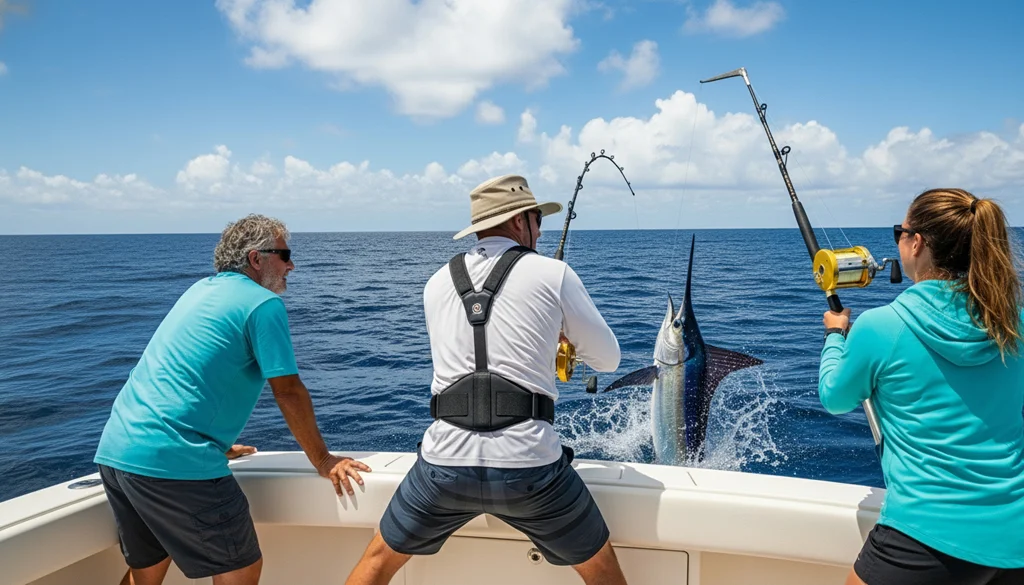
The most common technique for marlin fishing. The boat moves at a moderate speed, towing several lines equipped with artificial lures or natural bait (small tuna, bonito) at varying depths and distances. This is the recommended technique for beginners, as the crew largely handles the preparation—your role begins when the fish bites.
The jigging
This technique, imported from Japan and introduced to Mauritius in 2005 by a group of Japanese fishermen, involves vertically working a heavy metal lure to a depth of up to 120 meters. It is very effective for tuna, giant trevally (GT), and dogtooth tuna. Physically demanding, it is not recommended for people with back or shoulder problems.
The popping
Surface fishing with floating lures (poppers) cast and worked to imitate an injured fish on the surface. Particularly spectacular for giant trevally (GT), whose surface strikes are often explosive. This technique can be practiced from a coastal boat or from the shore.
The drop shot
A very sporty vertical fishing technique, used to target bottom-dwelling species at medium depths. Practiced by some specialist charter companies such as JPH Charters.
Live bait fishing
Using live fish (bonito, small tuna) as bait to attract large pelagic species, particularly marlin. Very effective but requires careful bait management on board.
How to choose your charter flight
There is a wide range of charter options in Mauritius, particularly on the west coast. Here are the criteria to consider before booking:
- The location: For marlin fishing, prioritize departures from Rivière Noire or Le Morne. For the north coast, Grand Baie or Trou aux Biches are good options.
- The size of the boat: Boats range from 26 to 55 feet. A larger boat offers more comfort and can accommodate more people, but is not necessarily more efficient. For multi-day expeditions to the Sudan Bank, a boat of at least 40 feet is recommended.
- The skipper's experience: Ask how many years the operator has been active, their references, and whether the skipper is himself a passionate fisherman or simply a boat driver.
- What's included: Check if the fishing license, equipment, drinks and bait are included in the price, or if additional charges apply.
- The policy on electrical outlets: In Mauritius, the fish generally belong to the boat owner. Some operators allow you to buy back part of the catch or have it prepared. Clarify this point before boarding.
- Online reviews: Check reviews on platforms like GetYourGuide, TripAdvisor or Google before booking.
Indicative prices
Prices vary depending on the size of the boat, the duration, the service provider, and the season. For guidance only (private rates):
- Half-day (4-5 hours): Starting from €316 for a small boat, between €400 and €500 for a 40-foot boat
- Full day (8 hours): between €740 and €1,200 depending on the size of the boat
- High-end boats (42-55 feet): Some service providers are advertising rates between €800 and €1,800 per day
- Sudan Bank shipping (several days): Prices upon request, depending on the duration and number of participants
Most rates include: skipper, basic fishing equipment, fuel, lures and bait, and sport fishing license. Always check what's included at the time of booking—some operators charge extra for jigging equipment or additional lures.
These prices are indicative only. Prices may vary depending on the year and the service provider.
To see the actual prices and book a fishing trip, click on the orange buttons or on the excursions displayed at the beginning and end of this article.
Tournaments and competitions
Mauritius hosts several sport fishing competitions each year, attracting anglers from all over the world. The main tournaments take place in December and January, at the peak of marlin season. Among the renowned competitions is the Marlin Fishing World Cupwhich brings together top-level international skippers.
If you wish to participate in a tournament as a tourist, inquire with local fishing clubs (Le Morne Angler's Club, Grand Baie Yacht Club) or directly with charter companies several months in advance, as places are limited.
Tips for beginners
- No experience required: Sport fishing by charter in Mauritius is accessible to complete beginners. The skipper and his crew will guide you throughout the trip — your role truly begins when the fish bite.
- Prepare yourself physically: Fighting a marlin or large tuna for 30 minutes to several hours is physically demanding. If you have back or shoulder problems, inform your operator before the trip.
- Be prepared for seasickness: Conditions can be rough, especially on the east coast. Take preventative medication the day before if you are susceptible.
- Leave early: Fishing trips usually start between 5am and 7am. The fish are most active around sunrise.
- Personal equipment: Polarized sunglasses, a cap, high-SPF sunscreen, a light jacket (for wind at sea), and non-slip shoes are recommended. A waterproof camera or a GoPro is highly recommended.
- Full day vs. half day: To maximize your chances of catching marlin, opt for a full day trip. A half-day trip is still a good option for tuna and smaller species.
Book your sport fishing trip
To book a sport fishing trip in Mauritius, several options are available:
- Directly from the charter companies: JPH Charters (Black River, since 1975), Le Trio Fishing (Albion), Maranatha Big Game Fishing (west coast), Fish Whisperer, Golden Wave, Tempo Fishing Club (Grand Baie), Mao Big Game Fishing…
- Via your hotel: Convenient, but often more expensive. The concierge service usually takes a commission.
- Via online booking platforms: GetYourGuide offers verified tours with reviews from other travelers and free cancellation in most cases.
Advice : Book at least 2 to 3 weeks in advance during peak season (November-March). The best boats fill up quickly.
Frequently asked questions about sport fishing in Mauritius (big game fishing)
Is it possible to fish for marlin in Mauritius all year round?
Yes, blue marlin are present year-round in Mauritian waters, but the chances of catching them are significantly better from December to March. Black marlin, on the other hand, are more prevalent from May to October. If your trip is planned outside these periods, a fishing trip is still possible—check with your charter company about the species available on the dates of your stay.
Do you need to be an experienced fisherman to do big game fishing in Mauritius?
No. Charter boats regularly welcome complete beginners, whether families or groups of friends. The skipper and crew handle navigation, line setting, and combat management in the initial stages. Your experience level primarily influences your choice of technique (trolling is the most accessible) and your physical comfort during prolonged fights.
What happens to the fish we catch?
In Mauritius, the fish caught generally belong to the boat owner. Some charter companies practice catch and release (Release and release) for marlin, in the interest of protecting the species. Others allow you to buy back some of the catch or have it prepared for dinner. Clarify this point when making your reservation.
What is the difference between a half-day outing and a full-day outing?
A half-day trip (4-5 hours, departing around 7 am, returning around noon) allows you to target the most active species at sunrise—tuna, wahoo, and sea bream. To maximize your chances of catching marlin, a full day (7-8 hours at sea) is highly recommended: it allows you to cover greater distances and explore several areas. The price per hour of actual fishing is often more attractive for a full day.
The information contained in this article is provided for guidance purposes only and reflects our best understanding of the situation at the time of writing (March 2026). Prices, availability, and regulations are subject to change. ilemaurice.im cannot be held responsible for any inaccuracies or changes that may occur since publication. We recommend that you verify the information directly with your chosen operator before making any reservations.
More information:
Rent a car
Book a hotel or villa
Buy an airplane ticket
Frequently Asked Questions – FAQ
All tourist sites and activities
Complete guide to tourist SIM cards in Mauritius
Formalities and procedures for coming on holiday to Mauritius
History and geography
Mauritian Creole
All the complete guides
Bus routes: Click here
Your advertisement on this page?
Do you want to display an advertisement for your business on this particular page (or elsewhere on the site)?
Thank you for contacting us by clicking here.
Contribute to and improve this page
We want to provide internet users with the most relevant and complete information, so if you would like to add to or modify this page (text, photo, etc.), or even report an error, please do not hesitate to contact us by sending an email to the following address: contribute@ilemaurice.im
(remember to clearly indicate the page to which your contribution relates)
(The photos you send will only be used to complete this page and will never be used commercially outside of this site without your permission)